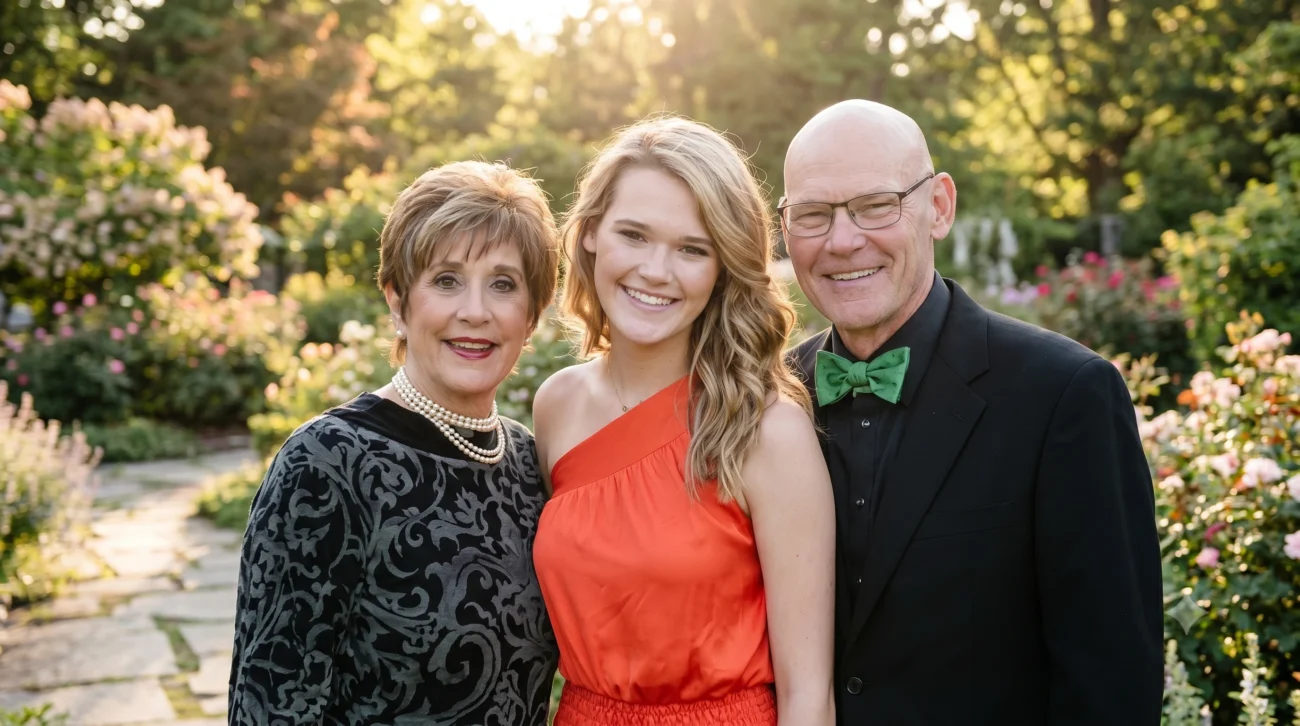
Emerson Normand Carville is searched because of the family she was born into, not because she has tried to become a public figure herself. She is the daughter of James Carville, the Democratic strategist forever linked to Bill Clinton’s 1992 presidential campaign, and Mary Matalin, the Republican consultant and author who spent decades inside national politics. In family references, Emerson is often called Emma, and she appears most often in public records as one of the two daughters raised by America’s best-known bipartisan political couple.
That public curiosity creates a problem for any honest biography. Emerson’s name appears across quick celebrity profiles, but many of those pages stretch thin facts into full-life claims they cannot prove. The reliable record is much smaller: a posted résumé, a few family references, profiles of her parents, and published accounts of the Carville-Matalin household. The result is a story that is less about fame than about the border between public family history and private adulthood.
Early Life and Family Background
Emerson Normand Carville was born into a household where politics was not background noise; it was the family trade. A résumé posted under her name lists her date of birth as April 17, 1998, and identifies her parents as Mary Matalin and James Carville. It also places her family address in New Orleans at the time the résumé was prepared, tying her public record to the Louisiana home base that became central to the family’s later story.
Her father, James Carville, became one of the most recognizable Democratic campaign figures of the late twentieth century. Her mother, Mary Matalin, built a long career on the Republican side as a consultant, author, editor, and media personality. Their marriage on Thanksgiving Day in 1993 drew attention because they had worked on opposing sides of the 1992 presidential campaign, a detail that helped turn their relationship into political shorthand.
Emerson’s full name appears to carry family history from both sides. “Normand” is associated with the Carville family line, while “Emerson” appears in Mary Matalin’s maternal family background. That naming pattern fits a family whose public identity often mixed national politics with strong attachments to home, ancestry, and place.
Growing Up in the Carville-Matalin Household
One of the clearest public glimpses of Emerson’s childhood came through a home profile, not a political interview. Architectural Digest described James Carville and Mary Matalin’s Alexandria, Virginia, townhouse as a family home for two young daughters, Matty and Emma, along with the family’s dogs. The article presented the house as a lively retreat from the demands of Washington life, with Matalin joking that children “spread out like Silly Putty.”
That detail matters because it places Emerson inside a family setting rather than a campaign narrative. The house overlooked the Potomac River, close enough to Washington for the parents’ work but far enough to suggest a need for distance from it. For a child, that meant growing up near a world of strategists, television appearances, book tours, and dinner-table argument, while still living the ordinary rhythms of school, sports, and family routines.
The Carville-Matalin household later became tied even more strongly to New Orleans. Their book Love & War: Twenty Years, Three Presidents, Two Daughters and One Louisiana Home framed the family’s story around marriage, politics, parenthood, and a move toward Louisiana. The publisher described the book as a look at how both the couple and the country had changed across two decades, with their daughters clearly part of that family account.
Education and First Ambitions
The strongest document for Emerson’s education is the résumé posted under her full name. It lists Episcopal High School in Alexandria, Virginia, from September 2012 to June 2016, with a graduation date of June 4, 2016. It also lists Louisiana State University in Baton Rouge as the college she planned to attend, with mass communications as her intended major.
The same résumé gives a sharper view of Emerson as a student than most public write-ups do. She listed AP courses in U.S. History, American Literature, and Human Geography, along with honor roll recognition across multiple high school years. Her activities included track and field, French Club, Young Republicans Club, Military Appreciation Club, and team management roles in volleyball and basketball.
Those details suggest a student drawn to communication, civic life, school service, and team settings. They also show how easily family context can color interpretation: a Young Republicans Club entry reads differently when the student’s mother is Mary Matalin and her father is James Carville. Still, the document should not be overread. It shows early interests, not a settled adult career.
Service, Travel, and Early Work Experience
Emerson’s résumé also points to service work and travel as part of her teenage years. She listed tutoring at Casa Chirilagua and Cora Kelly Magnet Elementary School, volunteering with Arlington Food Assistance Center, and joining a Bridges to Community service trip to the Dominican Republic. She also listed study programs in Paris and Barcelona, which suggests an education shaped by travel as well as classroom work.
Her early work experience included a listed internship with Epiphany Productions in political fundraising and event planning. That is the strongest basis for claims that Emerson had direct exposure to political events work. It fits naturally with her family environment, but it does not prove that she built a public career in politics or fundraising as an adult.
The truth is, that distinction is where many online profiles go wrong. A teenage internship can be meaningful without becoming a career label. Emerson’s documented record supports saying she showed early interest in communications, events, service, and civic spaces. It does not support presenting her as a known political operative.
The Influence of James Carville
James Carville’s influence on Emerson’s public identity is unavoidable because his name is the reason many readers search hers. Known for his sharp campaign instincts and plainspoken television style, Carville became a defining Democratic strategist after the 1992 Clinton campaign. He later turned that fame into books, teaching, commentary, and a long second life as a political media figure.
For Emerson, that meant growing up around a father whose work depended on persuasion, timing, conflict, and language. Politics in the Carville household was not just ideology; it was craft. A person raised near that world would almost certainly absorb lessons about how stories are built, how candidates are sold, and how public attention can both help and distort a life.
But here’s the thing: influence is not inheritance. Emerson’s planned study of mass communications and her internship in event planning sit near her father’s professional world, but they do not prove she followed him into it. A careful biography can recognize the family atmosphere without turning her into a political character she has not publicly chosen to be.
The Influence of Mary Matalin
Mary Matalin’s career is just as important to understanding Emerson’s background. Matalin’s official biography describes a long path through Republican politics, media, publishing, and public speaking. It also notes her books with Carville, including All’s Fair and Love & War, both of which helped build the couple’s public identity as political opponents who built a lasting marriage.
Matalin also wrote Letters to My Daughters, a title that places motherhood directly inside her public writing life. That matters because Emerson and her sister were part of Matalin’s public story without becoming public speakers themselves. Their presence helped shape the family narrative, even when they were not the ones telling it.
Growing up with Mary Matalin as a mother likely meant seeing a model of politics that mixed discipline, media skill, and strong personal conviction. It also meant living with the pressure that comes from having a mother whose public identity was built around strong opinions. That said, Emerson’s own politics, beliefs, and adult choices should not be assumed from either parent.
A Daughter in a Symbolic Marriage
The Carville-Matalin marriage has often been treated as a symbol of bipartisan possibility. James Carville and Mary Matalin have long fascinated readers because they built a marriage across a partisan divide that, in public life, often looks unforgiving. Their relationship became especially famous because both were not casual voters but professional combatants.
That symbolism shaped the public frame around Emerson before she was old enough to control it. She and her sister were often mentioned as part of a family that seemed to prove political disagreement did not have to destroy private affection. In a more polarized era, that idea has become even more striking, and it helps explain why readers continue to look up the family.
Yet Emerson should not be reduced to evidence in a debate about American politics. She did not become known because of speeches, campaigns, or public controversies. She became searchable because the family around her was already part of the national conversation. That makes restraint essential in writing about her.
Career and Public Work
There is no strong public evidence that Emerson Normand Carville has built a public career in politics, media, entertainment, or business. The record supports early exposure to political fundraising and event planning through her résumé, but not a confirmed adult role in those fields. Claims that describe her as an entrepreneur, event executive, strategist, or public professional should be treated carefully unless supported by better sourcing.
Her intended major in mass communications may point toward interests in media, public relations, journalism, advertising, or campaign messaging. LSU was a natural fit given the family’s Louisiana ties and the Carville-Matalin move toward New Orleans. Still, a listed college plan is not the same as a verified degree, job history, or career profile.
This is where a fact-checked biography has to resist the urge to create a neat arc. Emerson’s parents have public résumés that can be tracked through campaigns, books, broadcasts, and official roles. Emerson does not appear to have made her adult résumé widely public. The responsible conclusion is that her current professional life is not well documented.
Money, Net Worth, and Income Sources
There is no credible public estimate of Emerson Normand Carville’s personal net worth. Search results sometimes attach numbers to private figures, but those numbers are often copied from site to site without records behind them. In Emerson’s case, no verified public salary, business filing, property record, or professional profile establishes a reliable financial estimate.
Her parents have earned money through consulting, books, public speaking, television, teaching, and media work. That family background suggests access to opportunity, education, and networks that many people do not have. But a parent’s success is not proof of a child’s personal wealth, and it would be misleading to assign Emerson a net worth based only on surname.
The most honest answer is simple. Emerson’s income sources, assets, and business interests are not publicly confirmed. Any exact figure should be read as speculation unless tied to documents that can be checked.
Public Image and the Choice to Stay Private
Emerson’s public image is defined more by privacy than by exposure. She is named in family contexts, appears in a posted résumé, and is included in articles about her parents’ home and marriage. Beyond that, she does not appear to have built a broad public-facing identity around the Carville name.
That privacy should not be mistaken for mystery or scandal. Many children of public figures step away from the family spotlight because they want ordinary room to make adult choices. In Emerson’s case, the public evidence points to someone known because of family, not someone using family fame as a platform.
The internet tends to punish that kind of quietness by filling gaps with confident guesses. A respectful profile does the opposite. It treats what is known as enough, marks what is unknown as unknown, and avoids turning a private adult into a character in someone else’s political story.
Common Mistakes and Conflicting Claims
One common mistake is identifying Emerson as James Carville’s son. Public references from Architectural Digest and the résumé record support identifying Emerson as a daughter, also known as Emma. The confusion appears to come from low-quality rewritten profiles rather than strong reporting. +1
Another common conflict involves her date of birth. The posted résumé lists April 17, 1998, while some biography pages give other dates. Because the résumé is a direct document tied to her education and personal information, it deserves more weight than unsourced profile pages.
Career claims also vary widely online. Some sites describe Emerson as focused on event planning, but the reliable record only confirms an early internship related to political fundraising and events. That difference may sound small, but it matters. A biography should not turn one early résumé item into a full adult profession.
Relationship Status and Personal Life
No reliable public record confirms that Emerson Normand Carville is married, has children, or has a publicly known partner. That absence should be handled with care, not filled with guesses. A private person’s relationship status is not public information simply because her parents are famous.
Her immediate family is clear. Emerson is one of two daughters of James Carville and Mary Matalin, and her sister is widely identified as Matalin Mary “Matty” Carville. The sisters appear most often in public accounts as part of the Carville-Matalin family, not as independent public figures.
That family context explains the search interest, but it also sets a limit. Emerson’s adult friendships, dating life, and daily routines are not documented in reliable reporting. A fair biography should leave those areas alone unless Emerson herself chooses to make them public.
Where Emerson Normand Carville Is Now
As of 2026, Emerson Normand Carville appears to remain a private figure. There are no widely verified recent campaigns, books, public offices, media projects, awards, or business ventures tied to her name. The most reliable information still comes from older education material and public references to her family.
That may frustrate readers looking for a full celebrity-style update. But it is also the truest current status available. Emerson seems to have chosen a life that is not centered on public performance, even though she comes from a family that spent decades in front of cameras and microphones.
Her story still matters because it shows the quieter side of political fame. Children of public figures often inherit visibility before they inherit choice. Emerson Normand Carville’s public record suggests someone who grew up near national politics, absorbed its atmosphere, and then kept much of her own adult life outside the public file.
Frequently Asked Questions
Who is Emerson Normand Carville?
Emerson Normand Carville, also known as Emma Carville, is the daughter of Democratic strategist James Carville and Republican political consultant Mary Matalin. She is known mainly because of her parents’ high-profile political careers and their long marriage across party lines. Emerson herself appears to have kept a mostly private adult life.
How old is Emerson Normand Carville?
A résumé posted under Emerson Normand Carville’s name lists her date of birth as April 17, 1998. That would make her 28 years old in 2026. Some online pages give other dates, but the résumé is the stronger public document.
Who are Emerson Normand Carville’s parents?
Her parents are James Carville and Mary Matalin. Carville is a Democratic strategist and commentator, while Matalin is a Republican consultant, author, editor, and media figure. They married in New Orleans in 1993 and have two daughters.
Where did Emerson Normand Carville go to school?
The public résumé tied to her name lists Episcopal High School in Alexandria, Virginia, from 2012 to 2016. It also lists Louisiana State University in Baton Rouge as the college she planned to attend, with mass communications as her intended major. Those are among the clearest verified facts about her education.
Is Emerson Normand Carville in politics?
There is no strong public evidence that Emerson is a political strategist or public political figure. Her résumé lists an internship connected to political fundraising and event planning, but that does not establish an adult career in politics. Claims beyond that should be treated carefully unless supported by better records.
What is Emerson Normand Carville’s net worth?
Emerson Normand Carville’s personal net worth is not publicly confirmed. Online estimates that attach a specific number to her finances are not supported by credible public records. Her parents’ careers are public, but her own income, assets, and business interests remain private.
Why do people search for Emerson Normand Carville?
People search for Emerson because she is part of the Carville-Matalin family story. Her parents remain two of the best-known political consultants in modern American media, and their marriage has long interested readers because of their opposing political identities. Emerson’s name draws attention from that family connection, even though she has not pursued a high-profile public life.
Conclusion
Emerson Normand Carville’s biography is not a story of public ambition, scandal, or a famous child chasing the family spotlight. It is the story of a private woman born into one of America’s most recognizable political households. The facts that can be verified are specific but limited, and that limit deserves respect.
Her childhood was shaped by two parents who turned political argument into work while building a family across party lines. She attended Episcopal High School, planned to study mass communications at LSU, and showed early interests in service, travel, school activities, and event-related work. Those details make her more than a famous surname, even if they do not create a public career narrative.
The truth is, Emerson matters to readers because she sits near a larger American story. Her parents became symbols of political difference contained inside marriage, family, humor, and routine. Emerson’s quieter path shows the other side of that story: the right to grow up near public life without surrendering a private one.
