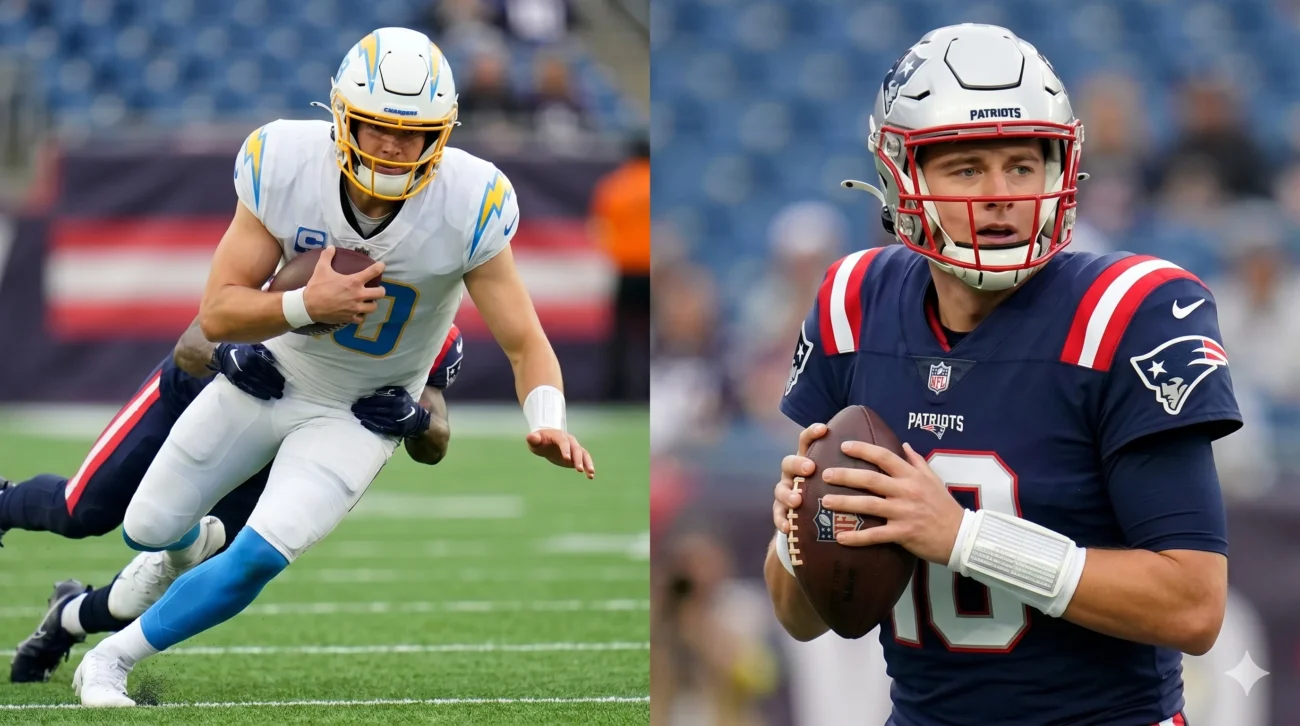
The box score from Chargers vs New England Patriots does not read like a routine playoff summary. It reads like the biography of a game that slowly revealed its character: cold, defensive, tense, and increasingly tilted toward New England. On January 11, 2026, at Gillette Stadium, the Patriots beat the Los Angeles Chargers 16-3 in an AFC Wild Card matchup that turned on pressure, field position, and one fourth-quarter touchdown. The player stats explain why the game never became the quarterback showcase many expected. +1
This was not a night of wild scoring swings or endless lead changes. It was a game shaped by Drake Maye’s poise, Justin Herbert’s frustration, and a Patriots defense that made every Chargers possession feel crowded. New England outgained Los Angeles 381-207, held the Chargers to 1-of-10 on third down, and won despite going 0-for-3 in the red zone. The score looked modest, but the statistical control was real. +1
The Game Behind the Numbers
The matchup belonged to the 2025 AFC playoff bracket, but it was played on January 11, 2026. New England entered as the AFC East champion at 14-3, while Los Angeles arrived as an 11-6 wild-card team from the AFC West. The setting mattered because Gillette Stadium has long been a difficult January venue, and the conditions were fittingly spare: 35 degrees, wind, and a game that rewarded patience more than polish. +1
The first quarter ended scoreless, which became the game’s first honest clue. Neither offense opened with rhythm, and both defenses played as if the margin would be small all night. New England broke through with an Andres Borregales field goal early in the second quarter, and Cameron Dicker answered for the Chargers with a 21-yard kick. By halftime, the Patriots led only 6-3, but Los Angeles had already missed chances to make the game feel different. +1
The second half belonged almost entirely to New England’s defense and kicking game until Drake Maye finally created separation. Borregales made a 39-yard field goal in the third quarter, stretching the lead to 9-3. Then, with 9:45 left in the fourth quarter, Maye found Hunter Henry for a 28-yard touchdown, the only touchdown either team scored. That one throw changed the tone from tight to controlled, and the Chargers never answered. +1
Drake Maye’s Stat Line Told the Story of Growth
Drake Maye completed 17 of 30 passes for 268 yards, one touchdown, and one interception. Those numbers were not perfect, but they were enough because his best plays came in the moments New England needed them most. He also led the Patriots in rushing, with 66 yards on 10 carries, giving New England a second way to punish the Chargers when the passing game stalled. That dual production made him the defining player in the game. +1
Maye’s interception, picked off by Daiyan Henley, kept the Chargers close and showed that New England did not cruise cleanly through the evening. But here’s the thing: the mistake did not define his performance because he kept returning to manageable decisions. His rushing yards helped New England stay out of the worst down-and-distance traps, and his late touchdown pass to Henry supplied the only true finishing blow. For a young quarterback in a playoff setting, that blend of recovery and production mattered more than a spotless line.
The biography of this game, if it has a lead character, begins with Maye learning how to win without forcing the script. He did not need to overwhelm Los Angeles with a string of deep completions. He needed to manage pressure, extend drives, and make one high-value throw when the Chargers defense finally gave him an opening. His final passer rating was 86.6, but the wider picture was stronger than the rating alone suggests.
Justin Herbert’s Frustrating Night
Justin Herbert finished 19-of-31 for 159 passing yards, with no touchdowns and no interceptions. At first glance, that line does not look disastrous, because there were no reckless throws that became Patriots takeaways. The problem is that it was far too contained for a quarterback with Herbert’s arm talent and Los Angeles’ postseason expectations. New England kept the Chargers from turning completions into damage. +1
Herbert also ran 10 times for 57 yards, which says as much about Los Angeles’ problems as it does about his athletic ability. Some of those yards were valuable, but they came from a game state where the quarterback had to become the emergency plan. The Chargers’ designed offense did not create enough early-down comfort, and Herbert spent too much of the night trying to salvage plays. That is not a sustainable way to win on the road in January.
The box score treated Herbert as both passer and rushing lifeline. That dual role can look admirable, and in many ways it was, because he kept competing inside a game that was slipping away. But it also revealed the Chargers’ limitations in protection, spacing, and drive finishing. A quarterback can avoid the catastrophic mistake and still leave with a stat line that reflects a trapped offense.
The Patriots Defense Became the Main Character
New England’s defense produced six sacks, and that number sat at the heart of the game. K’Lavon Chaisson and Milton Williams each recorded two sacks, while Marcus Jones and Anfernee Jennings added one apiece. The pressure did not come from one isolated matchup, which made it harder for the Chargers to fix during the game. Herbert faced a defense that kept changing the point of attack.
The Patriots also held Los Angeles to 120 net passing yards after sacks. That figure matters because it captures the hidden cost of pressure more clearly than Herbert’s raw passing total. A completed short pass can help a quarterback’s line, but a sack erases progress, changes field position, and narrows the playbook. By the second half, the Chargers offense looked less like a system and more like a series of escape attempts. +1
Craig Woodson led New England with 11 total tackles, while Christian Elliss added eight and Jack Gibbens had seven. Those tackle totals show how much of the game was played in front of the Patriots defense. New England did not need to gamble wildly because the pass rush was already creating stress. The back end could close on shorter throws, and the front could keep the Chargers from building momentum.
The Chargers Defense Did Its Part, But Not Enough
Los Angeles’ defense was not passive, and the player stats make that clear. The Chargers sacked Maye five times, with Odafe Oweh producing three sacks on his own. Tuli Tuipulotu and Elijah Molden also reached Maye, and Henley’s interception gave Los Angeles the kind of turnover that can change a playoff game. The issue was that the Chargers offense did not cash in enough of those defensive wins. +1
Denzel Perryman led Los Angeles with 13 total tackles, while Tony Jefferson had eight. Those numbers point to a defense that spent much of the night trying to contain Maye’s movement and New England’s steady gains. The Chargers were not embarrassed defensively; they allowed only 16 points and no rushing touchdowns. Still, the Patriots’ 381 total yards showed that New England controlled enough of the field to keep Los Angeles under pressure. +1
The Chargers defense kept the game close deep into the fourth quarter, which is often all a road playoff team can ask. Yet defensive resistance has limits when the offense fails to answer. New England’s final touchdown forced Los Angeles into a two-score chase, and the Chargers had not shown the rhythm needed for that kind of comeback. The defensive stat sheet had bright spots, but it did not have enough support.
Rushing Stats Showed the Difference in Control
New England rushed 29 times for 146 yards, averaging 5.0 yards per carry. Los Angeles rushed 22 times for 87 yards, averaging 4.0 yards per attempt. The gap was not only about total yardage; it was about how each team’s rushing production affected the rest of the offense. The Patriots could use the run game to stay balanced, while the Chargers leaned too heavily on Herbert’s scrambling. +1
Maye’s 66 rushing yards led all players, which is one of the most revealing details from the game. A quarterback leading his team in rushing can sometimes signal offensive imbalance, but for New England it worked because those runs helped punish aggressive coverage and rush lanes. Los Angeles had to respect Maye as a runner, and that extra burden made third down less predictable. His legs were not a side story; they were part of the Patriots’ offensive identity.
For the Chargers, Herbert’s 57 rushing yards led the team, which carried a different meaning. It showed toughness and improvisation, but it also showed that the backs and blocking did not give Los Angeles enough control. A playoff offense usually needs its quarterback to create special plays, but not to serve as its most reliable rushing answer. That distinction is one reason the Chargers finished with only three points.
Receiving Stats and the One Play That Broke the Game
Rhamondre Stevenson led all players with 75 receiving yards on three catches. That production from a running back was valuable because it gave Maye an efficient outlet and forced Los Angeles to defend more than traditional receiver routes. Hunter Henry had the most important reception, a 28-yard touchdown in the fourth quarter. In a game this tight, one catch can become the memory that outlives the rest of the stat sheet. +1
Ladd McConkey led the Chargers with 32 receiving yards on three catches. That modest team-leading number says almost everything about New England’s coverage and tackling. Los Angeles did not find a consistent downfield answer, and the Patriots prevented the Chargers’ receivers from stacking chunk plays. Herbert completed passes, but they rarely bent the game in Los Angeles’ favor.
Henry’s touchdown also carried a familiar football irony. The former Chargers tight end became the player who delivered the final scoring blow against his old franchise. That does not need to be overstated, because games are won by matchups more than storybook timing. Still, it gave the player stats a human detail that fans notice and remember.
Special Teams Gave New England a Floor
Andres Borregales made all three of his field-goal attempts and his only extra point, finishing with 10 points. In a 16-3 game, that made him one of New England’s most important players. His makes came from 23, 35, and 39 yards, and each one allowed the Patriots to turn imperfect drives into scoreboard pressure. Low-scoring playoff games often become kicking contests before anyone admits it. +1
Cameron Dicker made his only field-goal attempt for Los Angeles, a 21-yarder in the second quarter. His stat line was clean, but the Chargers gave him only one scoring chance. That was the larger problem for Los Angeles: not missed kicks, but missing opportunities to create kicks at all. The offense never forced New England to trade points for points. +1
Punting also reflected the shape of the game. JK Scott punted five times for the Chargers, while Bryce Baringer punted three times for New England. That difference did not decide the game alone, but it matched the rhythm of a night where Los Angeles repeatedly ran out of answers before crossing into scoring range. Field position became one more quiet advantage for the Patriots.
Third Down, Red Zone, and the Hidden Biography of the Game
The Chargers went 1-of-10 on third down, which may be the most damaging team statistic in the box score. Third down is where offensive identity gets tested, because a team must reveal whether it can protect, separate, and execute under obvious pressure. Los Angeles failed that test too often, and the result was a game filled with drives that never had time to mature. The Patriots went 4-of-11, which was not great, but it was enough. +1
The red-zone numbers were strange because neither team was efficient there. New England went 0-for-3 in the red zone, while Los Angeles went 0-for-2. Normally, that kind of red-zone failure keeps both teams exposed, but New England had more total yards, more scoring chances, and the one touchdown from outside the red zone. That combination protected the Patriots from their own finishing issues.
Turnovers also did not tell a simple story. Los Angeles finished with one turnover, while New England had two, including Maye’s interception. In many playoff games, that would be enough to swing the result toward the team with the cleaner giveaway total. Here, it was not, because the Chargers lacked the offensive efficiency to make New England pay. +1
How This Game Compared With Their Previous Meeting
The contrast with the teams’ previous meeting was stark. On December 28, 2024, the Chargers beat the Patriots 40-7, with Herbert throwing three touchdown passes and Los Angeles producing 428 total yards. That game made the Chargers look explosive and comfortable in Foxborough. The January 2026 playoff rematch looked like a different relationship entirely.
What changed was not one thing. New England had a different competitive shape under Mike Vrabel, Maye had become the central quarterback figure, and the Patriots defense had enough front-seven production to disrupt Los Angeles’ best plans. The Chargers, meanwhile, could not recreate the rhythm that had once made this matchup look so favorable. The player stats from the playoff game became evidence of a reversal, not just a single bad night.
That is why this box score has a lasting quality for both teams. For New England, it reads like confirmation of a return to playoff seriousness. For Los Angeles, it reads like another chapter in a wider frustration around postseason offense. The numbers are not biography in the literal sense, but they do trace character, pressure, and consequence.
Public Meaning for the Chargers
For the Chargers, the game placed familiar questions back in front of the franchise. Herbert is a gifted quarterback, and the statistics did not suggest he lost the game through reckless play. But the offense around him did not produce enough answers, and another playoff exit sharpened scrutiny on how Los Angeles builds around him. A three-point playoff performance tends to linger.
Jim Harbaugh’s presence raised expectations because he arrived with a record of building tough, organized teams. The Chargers did win 11 regular-season games, which should not be dismissed. Yet the playoffs demand a different level of offensive clarity, and this game exposed how thin the margin can become when protection breaks down. The player stats made the postgame conversation unavoidable.
The Chargers defense gave the team a chance to stay close, and that matters for any fair reading of the night. Five sacks, an interception, and only 16 points allowed would win plenty of postseason games with average offensive support. Los Angeles did not get that support. The result was a box score that made the defense look competitive and the offense look trapped.
Public Meaning for the Patriots
For the Patriots, the win carried the feel of an organizational statement. New England did not need a flawless offensive showcase to advance; it won with defense, a mobile quarterback, and special teams. That formula has deep roots in the franchise’s public image, even though the people leading it have changed. The win made the Patriots look modern without losing their old January identity.
Maye’s performance also gave the Patriots a quarterback story to build around. He showed enough arm strength, movement, and game management to make the player stats feel meaningful beyond one box score. Young quarterbacks are often judged in the playoffs by how they respond after mistakes, and Maye responded well. That matters more than a clean highlight reel.
The defensive front may have been the most reassuring part for New England. Six sacks in a playoff game against Herbert is not a casual achievement. It signaled depth, planning, and execution across multiple rushers. For a team trying to prove its postseason credibility, that kind of defensive performance travels well.
Frequently Asked Questions
What was the final score of Chargers vs New England Patriots?
The New England Patriots beat the Los Angeles Chargers 16-3 on January 11, 2026. The game was an AFC Wild Card playoff matchup at Gillette Stadium in Foxborough, Massachusetts. New England scored three field goals and one touchdown, while Los Angeles managed only one field goal. +1
Who had the best player stats in the game?
Drake Maye had the strongest overall statistical performance. He passed for 268 yards and one touchdown, and he also led the Patriots with 66 rushing yards. His interception kept the game imperfect, but his total production shaped the win. +1
What were Justin Herbert’s stats against the Patriots?
Justin Herbert completed 19 of 31 passes for 159 yards, with no touchdowns and no interceptions. He also rushed for 57 yards on 10 carries, which made him the Chargers’ leading rusher. His numbers showed effort and mobility, but they also showed how little the Chargers created through their normal offense. +1
Who scored the only touchdown?
Hunter Henry scored the only touchdown on a 28-yard pass from Drake Maye in the fourth quarter. The play came with 9:45 remaining and pushed New England’s lead to 16-3 after the extra point. It was the decisive offensive moment in a game dominated by defense and field goals. +1
How many sacks did each team record?
New England recorded six sacks, while Los Angeles recorded five. K’Lavon Chaisson and Milton Williams each had two sacks for the Patriots, and Odafe Oweh led the Chargers with three. The pass rush on both sides defined the game, but New England handled the pressure better. +1
Why did the Chargers lose despite forcing two turnovers?
The Chargers lost because they could not convert defensive plays into enough offense. Los Angeles went 1-of-10 on third down, 0-for-2 in the red zone, and finished with only 207 total yards. New England made mistakes, but the Chargers did not punish them with points. +1
Conclusion
The Chargers vs New England Patriots match player stats tell the story of a playoff game that valued steadiness over spectacle. New England’s defense controlled the terms, Maye added enough passing and rushing production, and Borregales turned drives into points. The Patriots did not dominate the scoreboard, but they controlled the game’s emotional and statistical weight.
For the Chargers, the numbers are harder to sit with because they point to a team that competed defensively but never found its offensive voice. Herbert avoided the interception that often becomes an easy headline, yet Los Angeles still produced only three points. That is the kind of result that forces deeper questions about structure, support, and postseason identity.
For the Patriots, the box score became a kind of public introduction to a new playoff version of the team. Maye did not have to be perfect, and the defense made sure he did not have to be. The next chapters will decide how far that formula can go, but this one already has a clear place in the record: New England 16, Los Angeles 3, and a stat sheet that explained every bit of it.
