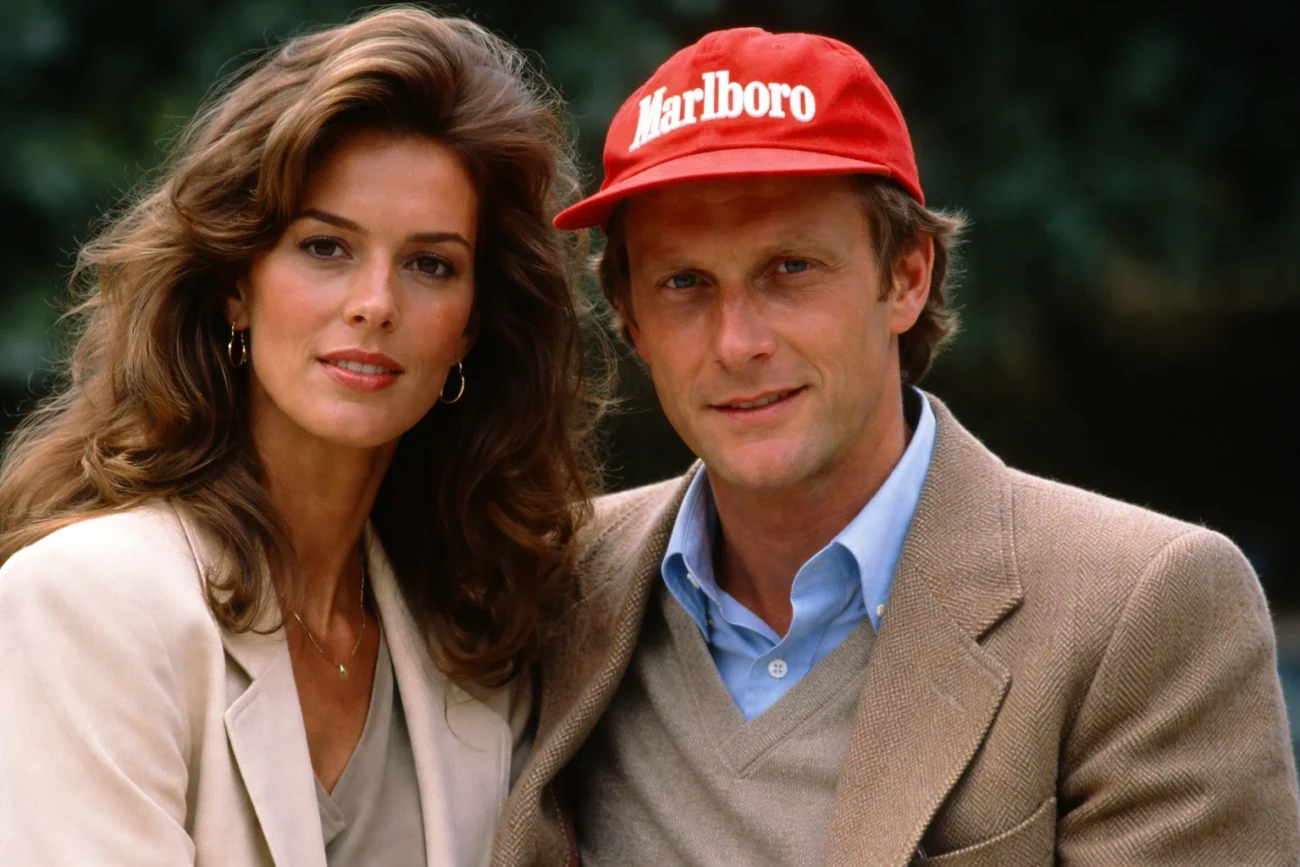
Search for Marlene Knaus and you’ll run into a familiar pattern: short celebrity profiles, recycled facts, and a lot of confident claims that don’t quite line up. She is often described in quick strokes—model, socialite, former wife of Formula 1 legend Niki Lauda—but the real story is thinner, quieter, and harder to pin down.
That’s part of what makes her interesting. Marlene Knaus is tied to one of the most recognizable names in motorsport history, yet she has largely stayed out of public view for decades. Unlike many figures connected to fame, she didn’t turn that proximity into a career in the spotlight. Instead, she became someone people search for but rarely find in full.
So what can actually be confirmed about her life? And why does so much of her story remain unclear?
Who Is Marlene Knaus?
Marlene Knaus is best known as the first wife of Niki Lauda, the Austrian Formula 1 driver who won three world championships and became one of the sport’s defining figures. Their relationship placed her close to a global sporting icon during the peak of his career, especially in the late 1970s when Formula 1 was gaining worldwide attention.
Most reliable accounts agree that the couple married in 1976, a year that would become central to Lauda’s legacy after his near-fatal crash at the Nürburgring. Their marriage lasted for about 15 years, ending in divorce in 1991. During that time, they had two sons, Lukas and Mathias, both of whom would later become part of the broader Lauda story.
But beyond those anchor points, details about Marlene Knaus are surprisingly scarce. There is no long list of interviews, no public memoir, and no consistent biographical record that fills in the gaps. That absence shapes how her story needs to be told.
Early Life: What’s Known and What Isn’t
The question of Marlene Knaus’s early life is where things start to blur. Many online sources claim she was born in 1956, but the origin of that date is unclear and rarely supported by strong documentation. The same goes for her birthplace and nationality, which vary depending on the source you read.
Some profiles describe her as Austrian, aligning with her later life alongside Lauda. Others suggest she was born in the United States or had South American roots. The contradictions are striking, and they point to a larger issue: much of what circulates about her background appears to come from repeated online copying rather than verifiable reporting.
Here’s where it gets interesting. The lack of reliable information doesn’t necessarily mean the details are unknowable; it often means they were never made public in the first place. Marlene Knaus seems to have entered public awareness not through her own career or public statements, but through her relationship with Lauda. That limited entry point shaped everything that followed.
The Marriage to Niki Lauda
Marlene Knaus married Niki Lauda in 1976, at a time when his career was already on the rise. That same year, Lauda suffered one of the most famous crashes in Formula 1 history, sustaining severe burns during the German Grand Prix at the Nürburgring. His recovery and return to racing became a defining chapter in sports history.
While Lauda’s story has been told in detail—through interviews, documentaries, and films like Rush—Knaus’s role during that period is less documented. She was present during a time of intense pressure and public attention, yet her perspective remains largely unrecorded.
That said, the timeline matters. The late 1970s and 1980s were a period of growing global fame for Lauda, and Knaus was part of his personal life during those years. Their marriage placed her in proximity to a world of elite motorsport, business ventures, and media coverage, even if she did not actively seek that spotlight.
The couple remained married for over a decade, which suggests a level of stability often overlooked in quick celebrity summaries. But like many long relationships, theirs eventually came to an end, with the divorce finalized in 1991.
Family Life and Children
One of the most concrete parts of Marlene Knaus’s story is her role as a mother. She and Lauda had two sons: Lukas Lauda and Mathias Lauda.
Mathias Lauda followed his father into motorsport, building a career as a professional racing driver. He competed in various racing series, including the Deutsche Tourenwagen Masters (DTM) and endurance racing events. His presence in the sport has kept the Lauda name visible in racing circles long after Niki Lauda’s active career ended.
Lukas Lauda, by contrast, has remained more private, though he has been involved in managing aspects of his brother’s racing career. This contrast between the two sons—one public, one largely private—mirrors the broader dynamic surrounding Marlene Knaus herself.
Family, in this case, becomes one of the few stable threads in a story otherwise marked by limited public information. It’s also one of the reasons her name continues to surface in searches, especially from readers trying to understand the wider Lauda family.
Life After Divorce
After her divorce from Niki Lauda in 1991, Marlene Knaus largely stepped away from public attention. Unlike many figures connected to high-profile marriages, she did not pursue media appearances, personal branding, or public commentary on her past.
There are scattered claims about where she lives today or what she does, but most of them trace back to low-reliability sources. Some suggest she settled in Europe, others point to the United States. None of these claims are consistently backed by strong evidence.
That said, her absence from public life appears to be intentional. While Lauda continued to build a second chapter as an airline entrepreneur, television commentator, and later chairman of Mercedes-AMG Petronas Formula One Team, Knaus stayed out of that orbit.
There’s a catch, though. This kind of privacy often invites speculation. When verified information is limited, rumor tends to fill the space. That’s why it’s important to separate what is known from what is repeated without proof.
Was Marlene Knaus a Model?
Many profiles describe Marlene Knaus as a former model, often portraying her as a striking figure within European social circles during the 1970s. The claim appears frequently, but the supporting evidence is thin.
There are no widely cited modeling portfolios, major campaigns, or interviews that clearly document a sustained career in the industry. That doesn’t mean the claim is false—it may well be accurate—but it does mean it should be treated with caution.
The pattern is familiar. A single description appears in one source, then gets repeated across dozens of others until it feels like established fact. Over time, the line between confirmed information and assumption becomes harder to see.
For readers, the key takeaway is simple: Marlene Knaus may have had connections to fashion or social scenes of the time, but the extent of her work in modeling is not clearly documented in the public record.
The Challenge of Writing About a Private Person
Writing about Marlene Knaus highlights a broader issue in modern celebrity coverage. Not everyone connected to a famous figure leaves behind a detailed public record. Some people remain largely private, even when they are part of high-profile relationships.
That creates a tension for writers and readers alike. On one hand, there is clear curiosity—people want to know more about her life, her background, and her perspective. On the other hand, the available information doesn’t always support a full narrative.
So what does this actually mean? It means the most honest account of Marlene Knaus is one that acknowledges its limits. Instead of stretching thin facts into a dramatic story, it’s better to focus on what can be verified and explain why the rest remains unclear.
In a media environment filled with overconfident claims, that kind of restraint can actually build trust.
Public Interest and Lasting Curiosity
Interest in Marlene Knaus has not faded, even years after her divorce from Niki Lauda and his passing in 2019. Part of that interest comes from the enduring popularity of Lauda himself, whose life continues to be revisited through documentaries, books, and films.
Whenever Lauda’s story is told, questions about his personal life tend to follow. That includes his first marriage, his children, and the people who were part of his journey behind the scenes. Knaus, by extension, remains a point of curiosity.
But there’s another factor at play. In an era where many public figures share every detail of their lives online, someone who remains largely out of view stands out. The absence of information becomes part of the story.
Not everyone agrees on how to interpret that silence. Some see it as a sign of deliberate privacy, others as a gap waiting to be filled. Either way, it keeps her name circulating in search results and discussions.
Frequently Asked Questions
Frequently Asked Questions About Marlene Knaus
Who is Marlene Knaus?
Marlene Knaus is best known as the first wife of Formula 1 legend Niki Lauda. She was married to him from 1976 to 1991 and is the mother of his two sons, Lukas and Mathias. Beyond that connection, publicly available information about her life remains limited.
How many children does Marlene Knaus have?
She has two sons with Niki Lauda: Lukas Lauda and Mathias Lauda. Mathias became a professional racing driver, while Lukas has mostly stayed out of the public spotlight.
Was Marlene Knaus a model?
Many sources describe her as a former model, but there is little detailed documentation of her work in that field. The claim is widely repeated, though not strongly supported by primary sources.
What is Marlene Knaus’s nationality?
There is no clear, consistently verified answer. Different sources list different nationalities, including Austrian and American. This remains one of the most uncertain aspects of her biography.
Where is Marlene Knaus now?
There is no widely confirmed, up-to-date public information about her current residence or daily life. She has largely remained out of the public eye since her divorce from Niki Lauda.
Is Marlene Knaus still alive?
There are no credible reports indicating otherwise. However, because she lives privately, there are few recent public updates about her life.
Conclusion
Marlene Knaus occupies a rare position in modern public life: widely searched, often discussed, yet only lightly documented. Her connection to Niki Lauda ensures that her name continues to surface, but her own story resists easy storytelling.
That resistance matters. It forces a different kind of approach—one that values accuracy over volume and clarity over speculation. Instead of filling in gaps with assumptions, it invites a closer look at what can actually be known.
There’s also a broader lesson here about how we treat people connected to fame. Not everyone who stands next to a public figure chooses to live in the spotlight. Some step back, and when they do, the record becomes quieter, less detailed, and harder to summarize.
For readers, that means adjusting expectations. The story of Marlene Knaus is not one of constant public milestones or dramatic reinvention. It’s a story defined as much by what remains private as by what is known—and that, in its own way, is worth understanding.
