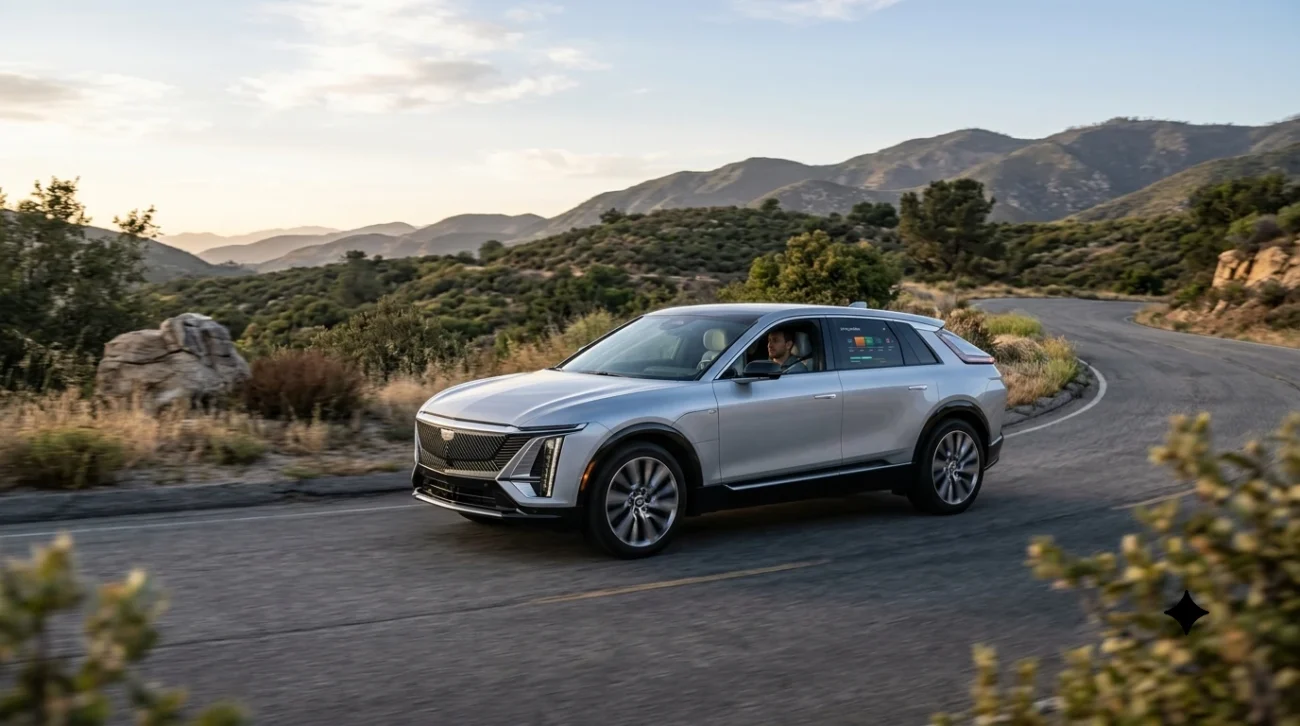
Yes, the driving modes in the Cadillac LYRIQ can lead to different real-world battery usage, but they do not change the battery’s physical capacity or create separate official range ratings. Cadillac does not publish one EPA range figure for Tour mode, another for Sport mode, and a third for Snow/Ice mode. Instead, each mode changes how the vehicle responds to the driver, which can influence how quickly energy is consumed.
The practical effect depends heavily on driving behavior. Sport mode may encourage stronger acceleration and higher speeds, while Tour mode makes smooth, measured inputs easier. Snow/Ice mode changes power delivery to improve traction, but the cold weather that prompts its use is often a much bigger cause of reduced range than the mode itself.
For most LYRIQ owners, speed, temperature, cabin heating, wheel and tire choice, elevation, and acceleration habits will have a greater effect on range than switching between the standard drive modes. The 2026 Cadillac LYRIQ-V is a clearer exception because Cadillac specifically warns that extended use of its Velocity Max setting reduces vehicle range.
How Cadillac LYRIQ driving modes affect battery usage
A driving mode changes the calibration of selected vehicle systems. Depending on the LYRIQ’s model year, trim, drivetrain, and equipment, the chosen mode may adjust accelerator response, steering effort, suspension behavior, electric motor sound, adaptive cruise control response, and electric all-wheel-drive operation.
None of those changes increases or decreases the amount of energy the battery can store. Recent standard LYRIQ models use a battery with a rated energy capacity of about 102 kilowatt-hours. Selecting Sport instead of Tour does not shrink that battery, just as returning to Tour does not add energy to it.
What changes is the way the vehicle delivers and consumes power. A more responsive accelerator map can request greater motor torque from a smaller pedal movement. A performance setting may also change cooling behavior, motor operation, or the way an all-wheel-drive system distributes power.
The driver remains the largest variable. A person who accelerates gently and holds a steady speed in Sport may use less energy than someone who repeatedly accelerates and brakes in Tour. That is why a fixed statement such as “Sport mode reduces range by 15 percent” is not supported by Cadillac’s published information.
There is also a difference between official range, displayed range, and actual range. The EPA estimate is a standardized rating for a particular vehicle configuration. The instrument-panel figure is a prediction based on recent operation and current conditions, while actual range is the distance the vehicle covers before it needs to charge.
Driving modes mainly affect the prediction and the real-world result. They do not rewrite the EPA rating printed for the vehicle.
What each LYRIQ driving mode does
Tour mode
Tour is the LYRIQ’s normal everyday setting. Cadillac describes it as a balanced mode intended to provide a smooth ride while maintaining comfortable handling and response.
Many drivers assume Tour is the vehicle’s dedicated maximum-range mode, but Cadillac does not describe it that way. It is better understood as the standard baseline. Its smoother accelerator behavior may help a driver avoid sudden power requests, which can support lower energy use.
Tour is likely to be the easiest mode for efficient daily driving because it does not emphasize performance or low-traction operation. Even so, it cannot cancel the effect of high speed, cold weather, steep hills, strong headwinds, low tire pressure, or heavy climate-control use.
On a steady highway trip, the difference between Tour and Sport may be small if the driver holds the same speed and avoids hard acceleration. At that point, aerodynamic drag and rolling resistance account for much of the energy demand. The mode name matters less than what the vehicle is being asked to do.
Sport mode
Sport changes the LYRIQ’s character by sharpening its response. Cadillac says the setting can alter accelerator tuning, steering effort, suspension behavior, motor sound, adaptive cruise control operation, and other systems where fitted.
The accelerator change is the part most likely to influence range. A smaller pedal movement may produce a stronger response than it would in Tour. That immediate power delivery can make the vehicle feel quicker and may encourage the driver to accelerate more aggressively.
Strong acceleration requires high power, and repeated bursts of acceleration raise average energy consumption. Some of that energy can later be recovered through regenerative braking, but the vehicle cannot recover all of it. Energy is lost through the motors, battery, inverter, tires, and braking system.
Sport mode does not automatically consume a large amount of extra electricity every second it is active. Steering and suspension settings may use some additional energy, but propulsion speed and acceleration are usually more important. If the driver operates the vehicle gently, the difference may be limited.
Cadillac does not publish a standard Sport-mode range penalty. Any percentage quoted online should be treated as a result from a particular vehicle, route, temperature, or driver unless it comes from a controlled test. It should not be applied to every LYRIQ.
Snow/Ice mode
Snow/Ice mode is designed to improve control on slippery roads. It softens or adjusts accelerator response and can change traction, steering, and electric all-wheel-drive behavior.
A gentler power response can reduce wheelspin, which prevents energy from being wasted by spinning the tires. That does not make Snow/Ice mode an economy setting. Its main purpose is safe, predictable operation in poor conditions.
Drivers often notice lower range while using Snow/Ice mode, but the mode may not be the primary cause. Cold battery temperatures, cabin heating, snow, slush, winter tires, dense air, and wet roads all increase energy demand or reduce battery performance.
This creates an easy misunderstanding. The mode is active at the same time the range falls, so the driver assumes one caused the other. In many cases, both are responses to the same winter conditions.
Cadillac also advises drivers to turn off One-Pedal Driving on slippery surfaces. That guidance concerns traction and predictable deceleration rather than battery efficiency. Safety takes priority over recovering a small amount of energy.
My Mode
My Mode allows the driver to combine selected preferences rather than accepting a single preset. On supported LYRIQ models, the available choices can include accelerator feel, brake feel, steering, suspension, and motor sound.
Its effect on battery usage depends on how it is configured. A relaxed accelerator setting may support smooth driving, while a Sport-style accelerator response may make stronger power delivery easier to access. A driver could also choose firmer steering without selecting the most aggressive accelerator behavior.
This makes My Mode useful for owners who want a particular driving feel without adopting every part of Sport mode. It is not automatically more efficient or less efficient than Tour. The result follows the chosen settings and the driver’s actions.
V-Mode and Velocity Max
The 2026 Cadillac LYRIQ-V adds performance settings that are not found in the same form on the standard LYRIQ. V-Mode lets the driver configure performance-related systems, while Velocity Max unlocks the model’s highest available output.
Cadillac lists the LYRIQ-V at up to 615 horsepower and 650 pound-feet of torque with Velocity Max. The company also states that the setting changes accelerator mapping, propulsion-system cooling, motor capability, motor sound, and electric all-wheel-drive behavior.
This is the clearest example of a LYRIQ setting that Cadillac directly links to increased energy use. The owner’s manual says Velocity Max is not intended for everyday operation and warns that extended use reduces vehicle range.
Cadillac does not give a fixed mileage loss for each activation. The effect will depend on how long the feature remains active, the battery’s condition and temperature, and how much of the available performance the driver uses.
The LYRIQ-V also has a lower EPA range rating than the longest-range standard LYRIQ configurations. Its 285-mile estimate reflects the complete performance model, not simply the effect of pressing the Velocity Max control during one journey.
Why there are no separate EPA ranges for each mode
EPA range ratings apply to tested vehicle configurations rather than every selectable driving preference. The government lists versions of the LYRIQ by factors such as drivetrain and certified equipment, but it does not give separate entries for Tour, Sport, Snow/Ice, or My Mode.
A separate rating for every mode would also be difficult to interpret. Sport changes response, but it does not force every driver to accelerate at the same rate. Snow/Ice mode may be used on dry pavement, wet roads, deep snow, or ice, each of which creates a different energy demand.
My Mode adds even more possible combinations. One driver may choose relaxed acceleration with firmer steering, while another may choose Sport-style acceleration with a different suspension setting. A single range figure could not represent all of those choices accurately.
Official LYRIQ range differences are easier to see between complete vehicle versions. EPA records for recent model years show different ratings for rear-wheel-drive, all-wheel-drive, and V-Series models. Those variations reflect the full vehicle, including its motors, weight, wheels, tires, software, and performance level.
For 2024, Cadillac promoted estimates of about 314 miles for rear-wheel drive and 307 miles for all-wheel drive. For 2025 and 2026, certain rear-wheel-drive versions reached an EPA estimate of 326 miles, while all-wheel-drive configurations carried lower figures depending on equipment. The 2026 LYRIQ-V is rated at 285 miles.
Those figures should not be read as proof that one drivetrain component or one feature caused the entire difference. Each rating applies to the complete certified configuration. They do show that the version a buyer chooses can have a larger effect on official range than occasional use of a standard driving mode.
What matters more than the selected mode
Speed is often the largest controllable factor during a long trip. Electric vehicles use much more energy as highway speed rises because aerodynamic resistance increases sharply. A LYRIQ driven quickly in Tour may consume more electricity than one driven moderately in Sport.
Acceleration matters most in urban and mixed driving. Smooth power delivery avoids high peaks in energy demand and reduces the need to slow down soon afterward. Regenerative braking can recover part of the vehicle’s motion, but avoiding unnecessary acceleration is still more efficient than trying to recover the energy later.
Outside temperature can change the result far more than a standard mode selection. Cold weather reduces battery efficiency and increases the need for cabin and battery heating. Hot weather can also raise energy use through air conditioning and thermal management.
Short winter journeys are especially demanding because the vehicle may spend a large share of each trip warming the cabin and battery. Preconditioning while the LYRIQ remains plugged in can reduce the amount of stored battery energy used for that initial heating.
Wheel and tire choices also matter. Larger wheels, performance tires, winter tires, low tire pressure, and damaged alignment can increase rolling resistance. The range rating for one LYRIQ configuration should not be assumed to apply to another version with different wheels or tires.
Elevation and weather add further variation. Climbing requires energy, although some can be recovered on the descent. Headwinds, rain, snow, and standing water increase resistance and can lower range even if the driver never changes modes.
Cabin settings can affect the dashboard estimate quickly. Heating, air conditioning, heated seats, and other electrical loads draw energy from the same battery used for propulsion. The effect becomes more noticeable during slow or short journeys because accessory use accounts for a larger share of total consumption.
Why the dashboard range changes after selecting a mode
The LYRIQ’s displayed range is an estimate, not a direct measurement of how many miles are physically stored in the battery. The vehicle calculates that prediction from recent driving habits, climate-control use, battery condition, ambient temperature, and other operating data.
Selecting Sport may not immediately remove a fixed number of miles from the display. If the driver continues at a steady speed, the estimate may barely change. If Sport leads to repeated hard acceleration, the vehicle may record higher consumption and revise the predicted range downward.
The same process works in the other direction. After a period of gentle driving in mild weather, the displayed estimate may rise. The battery has not become larger; the vehicle has changed its forecast because recent energy use suggests that the remaining charge may last longer.
Owners should avoid judging a driving mode from a brief change in the range display. The estimate can move because of temperature, cabin settings, recent traffic, or a change from city to highway driving. A more useful measure is average energy consumption over a repeatable route.
The LYRIQ may show consumption as miles per kilowatt-hour or through another energy-use display, depending on model year and software. Comparing that figure across several similar journeys gives a better picture than watching the predicted mileage after a single mode change.
How to test Tour and Sport fairly
A fair personal comparison requires consistent conditions. The same route should be driven at a similar time of day, with similar traffic, temperature, cabin settings, tire pressure, passenger load, and starting state of charge.
The route should also be long enough to reduce the effect of initial cabin heating, parking-lot movement, and minor traffic differences. A test lasting only a few miles can be distorted by one hard acceleration or a brief period of heating.
Drivers should alternate which mode they test first. If Tour is always tested with a cold battery and Sport is always tested after the vehicle has warmed up, Sport may appear more efficient even though the test conditions caused the difference.
Matching speed and acceleration is the hardest part. If the driver naturally accelerates faster in Sport, the result measures the combined effect of the setting and the driver’s response. That may still be useful because it reflects how the mode is actually used.
Several repeated journeys are more valuable than one run. A consistent difference across similar trips suggests a real change in consumption. A gap that disappears after additional testing may have been caused by traffic, wind, temperature, or normal variation.
Common misunderstandings about LYRIQ range and drive modes
One common claim is that Tour mode unlocks the LYRIQ’s full advertised range. Tour is a sensible setting for calm daily driving, but the EPA estimate is not a promise that the vehicle will travel that distance whenever Tour is active. Real-world results can be higher or lower.
Another misconception is that Sport always reduces range by a known percentage. Cadillac has not published a universal penalty for the standard LYRIQ’s Sport mode. The difference depends on acceleration, speed, route, weather, and driver behavior.
Snow/Ice mode is also sometimes described as a winter efficiency setting. Its purpose is traction and vehicle control. Any reduction in winter range is more likely to come from cold temperatures, heating, tires, and road conditions than from the mode alone.
One-Pedal Driving is often grouped with the drive modes, but it is a separate regenerative-braking function. It can help recover energy during necessary deceleration, especially in urban traffic, yet it cannot recover everything used during acceleration.
A higher regeneration setting does not guarantee the best possible range on every route. On an open road, maintaining momentum can be more efficient than repeatedly slowing through strong regeneration and then accelerating again.
Drivers may also worry that using Sport mode damages the battery. Cadillac presents Tour, Sport, Snow/Ice, and My Mode as normal operating settings and does not state that occasional Sport use harms the battery. High-power driving can increase heat and consumption, but that is not the same as proving a specific rate of long-term battery damage.
Frequently Asked Questions
Does Tour mode give the Cadillac LYRIQ its longest range?
Tour is usually the best baseline for smooth everyday driving, and its calmer response may make efficient acceleration easier. Cadillac does not publish a separate Tour-mode range, so it cannot be treated as a guaranteed maximum-range setting.
How much range does Sport mode reduce?
There is no official fixed percentage for the standard LYRIQ. Sport may reduce real-world range if it leads to stronger acceleration or higher speeds, but the difference can be small when the vehicle is driven gently.
Does Snow/Ice mode use more battery than Tour?
Snow/Ice mode changes traction and accelerator behavior rather than battery capacity. The cold, snow, winter tires, and cabin heating present during its use are usually more important causes of reduced range.
Can My Mode be set up for better efficiency?
A relaxed accelerator setting in My Mode may help the driver apply power more smoothly. Its actual efficiency depends on the selected combination of settings and the way the vehicle is driven.
Does One-Pedal Driving increase LYRIQ range?
It can recover some energy during slowing and may improve efficiency in stop-and-go traffic. It cannot recover all the energy used during acceleration, and Cadillac advises turning it off on slippery roads.
Why did the estimated range fall after I selected Sport?
The dashboard prediction responds to recent energy use, driving behavior, climate settings, and environmental conditions. If Sport leads to harder acceleration, the LYRIQ may revise its estimate downward even though the battery’s capacity has not changed.
Does Velocity Max reduce range in the LYRIQ-V?
Yes. Cadillac specifically states that extended Velocity Max use reduces vehicle range because the setting changes power delivery, cooling, motor capability, sound, and all-wheel-drive operation. The company does not publish a fixed mileage loss for each use.
Conclusion
The Cadillac LYRIQ’s driving modes can change battery usage, but they do so by altering vehicle response rather than changing the amount of energy stored in the battery. Tour, Sport, Snow/Ice, and My Mode do not have separate EPA range ratings.
For ordinary driving, Tour offers the easiest starting point for smooth and predictable operation. Sport may use more energy when its sharper response encourages stronger acceleration, while Snow/Ice should be selected for traction rather than range.
The 2026 LYRIQ-V’s Velocity Max setting is the clearest exception because Cadillac directly warns that extended use lowers range. Even then, the size of the loss depends on how the feature is used.
Drivers who want to travel farther between charges should focus first on speed, temperature, climate use, tire condition, route, and smooth acceleration. The selected mode matters, but the conditions outside the car and the choices made behind the wheel usually matter more.
