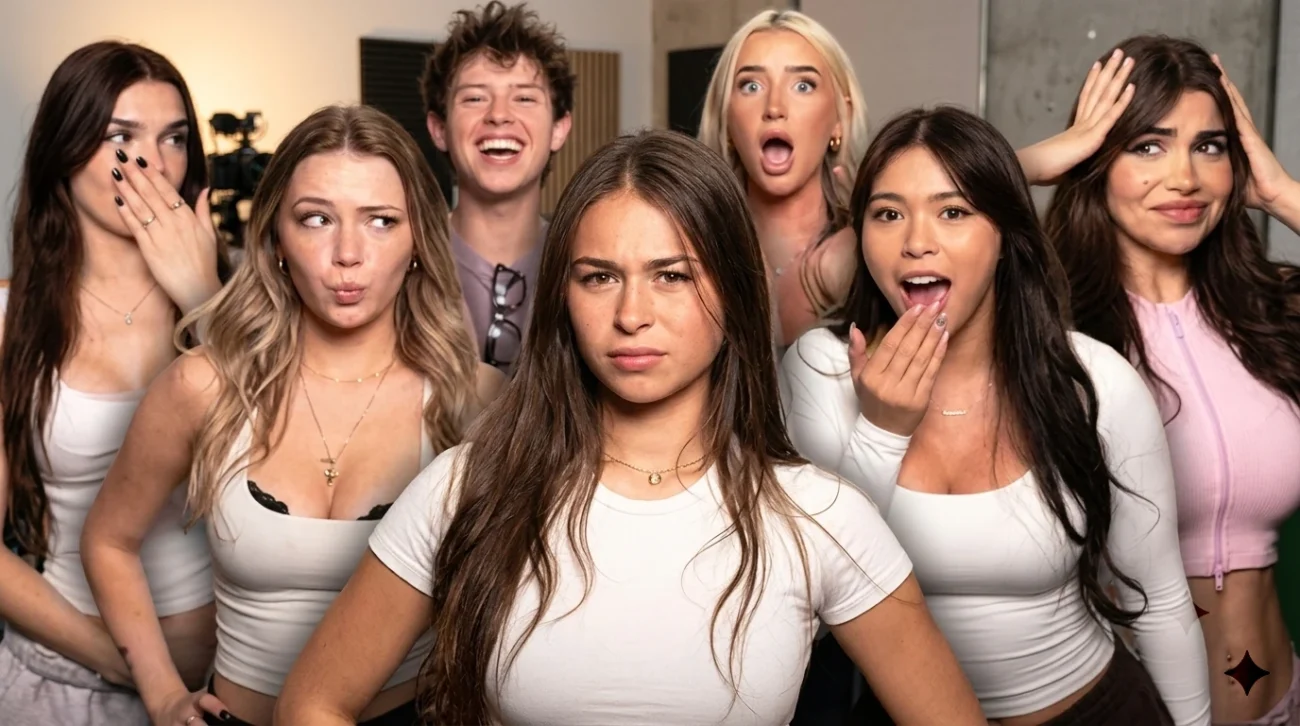
Bop House became one of the internet’s most discussed creator collectives within weeks of its December 2024 launch. Founded by Sophie Rain and Aishah Sofey, the Florida-based group brought several young female influencers together to film social-media content, share audiences and promote their individual subscription accounts. Its rise was fast, highly visible and commercially ambitious, but the story soon expanded beyond viral dances and luxury-house videos to include membership changes, public disputes, security concerns and debate over how adult creators market themselves on mainstream platforms.
Bop House is not a person, so it does not have a conventional biography built around a birth date, childhood or family. Its story is instead the biography of a digital brand: how it began, who shaped it, why it attracted attention and how its identity changed as members left, new creators joined and the original living arrangement became less fixed.
What Is Bop House?
Bop House is a creator collective associated with social-media personalities who earn money through platforms including OnlyFans. The group’s public content has appeared mainly on TikTok and Instagram, where members have posted dances, challenges, comedy clips, fashion videos, staged arguments and scenes from luxury properties in South Florida.
The public posts are generally less explicit than the material associated with the members’ paid accounts. Their main purpose is visibility. A short video featuring several creators can introduce each participant to the others’ followers, giving every member a chance to gain traffic without relying only on her own audience.
The name “Bop House” draws from internet slang. “Bop” can be used as a derogatory term for a woman seen as sexually available or provocative, though the group has also promoted the more positive phrase “baddie on point.” By adopting the word as a brand, the founders turned a common insult into a memorable identity.
Founding and Original Members
Bop House publicly launched in December 2024. Sophie Rain and Aishah Sofey were identified as its co-founders, and the original group included Summer Iris, Alina Rose, Joy Mei, Ava Reyes, Camilla Araújo and Julia Filippo.
The founders did not begin as unknown creators. Several members already had substantial followings before joining, which helped the group reach a large audience quickly. Their individual visibility gave the collective an advantage over a new brand starting without recognizable faces.
Early coverage described the members as young adult creators, mostly in their late teens or early twenties. Exact birth dates and ages were not consistently confirmed for every member, and the lineup changed after the launch. Claims that present one permanent roster can therefore become outdated quickly.
The house concept drew comparisons with earlier influencer collectives such as Hype House and Team 10. Those groups had shown that creators could increase their reach by living or filming together, sharing production resources and appearing repeatedly in one another’s posts. Bop House adapted that structure to a business in which direct fan subscriptions were a central source of income.
Why the Group Grew So Quickly
Bop House offered viewers a simple, recognizable premise. A group of young creators appeared to live together in an expensive Florida mansion, producing videos throughout the day while presenting a life built around friendship, beauty, travel and financial freedom.
That image worked well on short-form platforms because viewers did not need a detailed introduction. Each clip could stand alone while still reinforcing the larger story of the house. Someone who discovered one member through a dance video could soon encounter the rest of the group through tags, collaborations and recommended posts.
The collective also benefited from controversy. Discussions about the members’ earnings, clothing, appearance, religion and business model drew both supporters and critics. Even negative reactions helped circulate the Bop House name, giving the group attention beyond its existing fan base.
Its members understood that online success depends on repetition. A single viral video can bring a burst of followers, but a collective can produce more combinations, settings and storylines than one creator working alone. The house provided a recurring visual backdrop and gave the group a steady supply of collaborative material.
How the Bop House Business Works
Bop House operates as a shared marketing network rather than one single subscription account. Each member maintains her own public identity and typically directs followers toward her individual paid platforms.
The basic model begins with free content. TikTok and Instagram posts attract a broad audience, while profile links and personal pages guide interested adults toward subscription-based material. The group’s public visibility helps members reach potential customers who may not have discovered them separately.
A shared property can make production easier. Creators can film several videos in one session, use the same rooms and outdoor spaces, and coordinate group appearances without arranging separate trips for every collaboration. A mansion also creates a visual impression of wealth and success, which strengthens the aspirational image surrounding the brand.
The work behind that image can be demanding. Large creator businesses may involve editors, managers, photographers, security workers, assistants and people who help handle subscriber messages. The polished content seen on social media can therefore be the public surface of a much larger commercial operation.
Reported Earnings and Net Worth Claims
Bop House attracted major attention after members claimed the collective had generated about $10 million during its first month. Later reports repeated even higher monthly totals. Those figures were widely discussed, but they were based on statements from the creators rather than publicly available audited records.
It is also unclear how the group calculated its earnings. The reported totals may have combined revenue from the members’ individual accounts, including income they might have earned even without Bop House. Without access to account statements and earlier financial records, no outside observer can determine exactly how much additional revenue the collective produced.
Sophie Rain has made some of the best-known personal earnings claims connected with the group. She has said she earned tens of millions of dollars through OnlyFans and later reported lifetime gross earnings exceeding $100 million. Those figures have not been independently confirmed by the platform.
Gross earnings are not the same as personal net worth. OnlyFans keeps a percentage of payments made to creators, and members may also pay taxes, managers, contractors, security teams, travel expenses and property costs. No credible, independently verified net-worth figure exists for Bop House as a single organization.
The same caution applies to individual members. Online estimates often present precise numbers without access to contracts, debts, investments or tax records. Any such figure should be treated as speculation unless supported by financial documents or direct, verifiable disclosure.
The Mansion and the Reality of Living Together
The “house” was central to the group’s identity, but Bop House was not always a full-time residence for every member. The properties associated with the group served as filming locations, meeting spaces and temporary homes, while members also traveled or worked elsewhere.
That distinction matters because creator houses often sell the appearance of constant togetherness. Viewers see a steady stream of shared videos, but those posts may have been filmed in batches during limited periods when the group was in one place.
The arrangement also changed as leases, schedules and personal relationships shifted. Bop House became less dependent on one exact address and more connected to the broader idea of a shared creator brand.
Publicly available information about ownership of the houses, rental terms and individual financial contributions remains limited. The group has not released detailed business records explaining who paid for each property or how expenses were divided.
Sophie Rain’s Departure
The group faced a major turning point in July 2025, when Sophie Rain publicly announced that she was leaving Bop House. She said she felt she was losing control of her personal voice and described the working environment as increasingly restrictive.
Rain also acknowledged conflict with fellow member Camilla Araújo. Their disagreement became part of the public conversation around the collective, though outsiders did not have access to every private discussion or business issue behind the split.
Her departure raised questions about whether Bop House could retain its visibility without one of its founders and most recognizable members. It also exposed a common weakness in creator collectives: the brand may depend on friendship and collaboration, but members still have separate careers, financial interests and public identities.
Later coverage continued to connect Rain with the Bop House name, creating some uncertainty about her exact status. That may reflect occasional collaboration, a continued founder association or the use of “Bop House” as a broader production label. A clear, permanent return was not publicly confirmed.
Camilla Araújo’s Exit and a New Member
Camilla Araújo also left the group after the conflict became public. Her departure added to the impression that Bop House was entering a new phase rather than continuing with its original lineup.
The collective responded by turning recruitment into content. A public search for a new member reportedly attracted more than 12,000 applicants. Lexi Marvel was later selected to join, giving the group a new face and another promotional storyline.
The large number of applications showed how valuable the Bop House name had become to aspiring creators. Joining offered more than a place in a mansion. It promised access to a major audience, frequent collaborations and the credibility that comes from association with an established online brand.
The selection process also showed the group’s ability to turn disruption into attention. Instead of treating a vacancy as a private staffing problem, Bop House made the search part of its public entertainment.
Controversies and Public Criticism
Bop House has faced criticism over the way its members promote adult subscription businesses through mainstream social platforms. TikTok and Instagram have large teenage audiences, and many Bop House videos resemble ordinary dance, fashion or lifestyle content.
The debate became more intense after the group collaborated with Piper Rockelle while she was 17. Both Rockelle and Bop House said the appearance was a social-media collaboration, not an attempt to add her to the adult creator collective. Even so, critics questioned whether the association blurred boundaries between teen entertainment and adult marketing.
Some viewers have also objected to youth-coded styling used in creator content, including school-inspired outfits, braces or references to looking unusually young. The members involved are adults, but critics argue that such presentation can attract attention built around youth.
Supporters of the group respond that the creators are consenting adults and that parents and platforms also bear responsibility for what minors see online. The dispute remains part of a broader debate over how recommendation systems distribute suggestive material and how clearly platforms separate adult businesses from general entertainment.
Security and Privacy Concerns
The visibility that made Bop House successful also created serious safety risks. Members have described stalking, unwanted visitors, break-ins and incidents involving police responses.
A widely recognized mansion can become easy to identify through exterior details, neighborhood features or property records. Viewers may also study backgrounds, vehicles and travel posts to determine where creators live or film.
These risks can lead to major security costs. Guards, cameras, private transportation and controlled access may become necessary when a group attracts millions of followers. The need for protection complicates the image of effortless freedom presented in public videos.
The danger also follows creators beyond the house. Once personal information, images or locations spread online, removing them can be difficult. Paid content may be copied or redistributed, while false images and impersonation accounts can continue long after a creator leaves the group.
Public Image and Cultural Impact
Bop House has been presented in sharply different ways. Admirers see it as a group of young women building independent businesses, controlling their images and earning money outside traditional entertainment companies.
Critics see a carefully staged commercial system that sells intimacy, promotes unrealistic wealth and reaches younger audiences through platforms not designed solely for adults. Both readings reflect real parts of the group’s public story.
The collective also changed how creator houses were discussed. Earlier groups often focused on music, comedy, fashion or general influencer fame. Bop House placed subscription income at the center of the model and showed how a shared social brand could support several separate paid businesses.
Its influence can be seen in the appearance of similar adult-creator houses and in the wider attention paid to collaborative promotion. Even if the original lineup never reunites permanently, the format has already become part of the modern creator economy.
Current Status
As of 2026, Bop House remained a recognizable name, but its exact structure was less clear than it had been at launch. The original roster had changed, and public reporting did not establish that every member continued to live or work together full-time.
The group is best understood as an evolving creator network rather than a fixed household. Its identity can include shared properties, recurring collaborations, social-media accounts and the ongoing use of the Bop House brand.
No fully verified public record confirms the group’s current finances, ownership structure or complete active roster. Because creator collectives change quickly, claims about present membership should be checked against recent statements from the creators themselves.
Frequently Asked Questions
Who founded Bop House?
Sophie Rain and Aishah Sofey founded Bop House in December 2024. Rain later announced her departure in July 2025, although later coverage continued to associate her with the brand.
Who were the original Bop House members?
The original lineup included Sophie Rain, Aishah Sofey, Summer Iris, Alina Rose, Joy Mei, Ava Reyes, Camilla Araújo and Julia Filippo. Membership later changed following public departures and the addition of Lexi Marvel.
Is Bop House a real place?
Yes. The group has used luxury properties in South Florida as residences and filming locations. However, the members have not always lived together full-time, and the brand is not tied permanently to one confirmed address.
How much money did Bop House make?
Members claimed the group generated about $10 million in its first month, with later reports citing higher totals. These figures were self-reported and have not been independently audited.
What is Bop House’s net worth?
Bop House does not have a publicly confirmed net worth. Online estimates are unreliable because the group has not released verified information about revenue, expenses, ownership, debts or assets.
Why did Sophie Rain leave Bop House?
Rain said she felt she was losing control over her own voice and described the environment as restrictive. She also acknowledged conflict with Camilla Araújo, though the full private and financial details were not publicly disclosed.
Does Bop House still exist?
The Bop House name remained active and recognizable in 2026, but the collective no longer appeared to have the same fixed structure as its original launch. It continues to be better understood as a flexible creator brand and collaboration network.
Conclusion
Bop House rose because it combined a familiar influencer-house format with a direct subscription business. Its members used shared videos, luxury settings and overlapping audiences to turn social-media attention into commercial reach.
The group’s history also shows the limits of building a business around public friendship. Departures, disagreements and changing schedules tested the idea that a creator house could remain stable while each member pursued an independent career.
Its biggest financial claims remain unverified, and its current structure is not fully public. Still, its impact is clear: Bop House became a widely recognized example of how entertainment, personal branding and adult subscription media can operate within the same social-media system.
The story matters because it is larger than one mansion or one lineup. Bop House reflects a form of online fame in which identity, relationships and even conflict become part of the product, while the people behind the brand must manage the lasting costs of visibility.
