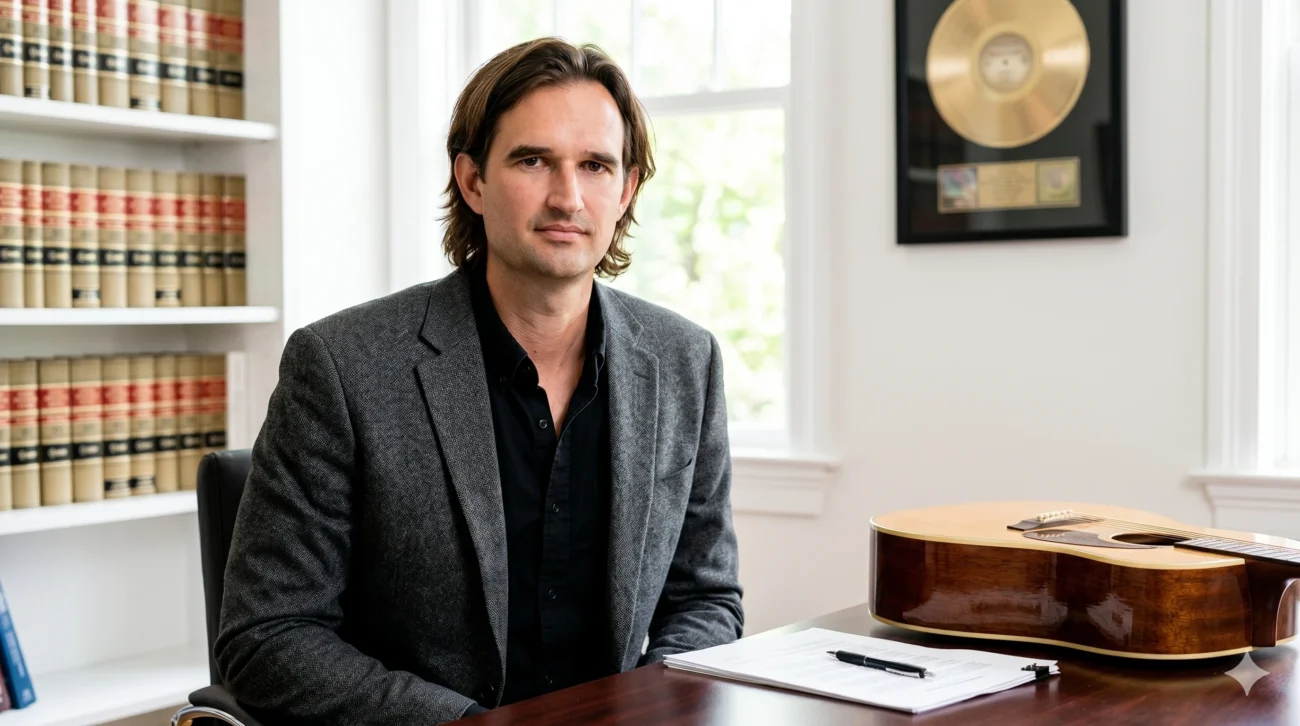
Blake Anderson Hanley is the kind of public figure the internet often struggles to describe. He is not a celebrity in the usual sense, yet his name keeps showing up in celebrity searches because he was once married to NCIS actress Emily Wickersham. That connection explains the curiosity, but it does not explain the man. Hanley’s public record points to a more unusual path: a South Florida musician who built the project Ghost Lion, moved into legal-aid work, and kept much of his personal life away from the machinery of fame.
That combination makes him easy to search and harder to profile responsibly. There are verified facts: his work with Ghost Lion, his marriage to Wickersham from 2010 to 2018, and his legal connection to Florida and the Legal Aid Society of Palm Beach County. There are also many recycled claims about his family life, finances, and current relationships that should be handled with care. A fair biography of Blake Anderson Hanley has to begin with that distinction, because the most honest version of his story is not the loudest one online.
Who Is Blake Anderson Hanley?
Blake Anderson Hanley is an American musician, songwriter, composer, producer, and attorney whose best-documented creative work is Ghost Lion. The project’s official biography describes him as a South Florida native whose music grew out of West Palm Beach’s divided but culturally rich environment. Ghost Lion’s sound blends indie pop, calypso, cumbia, South American folk, electronic textures, and live drums, a mix that reflects Hanley’s interest in musical borders and social division. The project has released the EP Ballad of St. Panama, several singles, and the full-length album Nuclear Island.
His legal career is also part of the public record. The Florida Bar maintains a member profile for Blake Anderson Hanley, and the Legal Aid Society of Palm Beach County lists Blake Hanley as a staff attorney in its Heirs Property Project. That is an important correction to the way many entertainment sites frame him, because his professional life did not end with music or with his marriage to an actress. The public evidence shows a person who moved between creative work and service-oriented legal practice rather than someone living only in the orbit of Hollywood. +1
For many readers, though, the first point of recognition is still Emily Wickersham. IMDb identifies Wickersham as an actress known for NCIS, Gone, I Am Number Four, and Remember Me, and says she was married to musician and domestic-violence lawyer Blake Hanley from November 23, 2010, until December 2018. That public relationship made Hanley a recurring subject of fan searches, especially as Wickersham’s NCIS profile grew. The challenge is that search attention often outpaces verified information, which is why Hanley’s biography deserves a careful, measured approach.
Early Life and South Florida Roots
Hanley’s own music biography places his upbringing in West Palm Beach, Florida, and describes that setting as central to the way he came to think about culture. The official Ghost Lion bio says the city appeared diverse, but that different communities often lived in separate social “bubbles.” Hanley is quoted there as saying he wanted to understand other people’s experiences and hoped his music could create a welcoming space where different cultures could exist together. That is one of the few direct public comments that offers a glimpse of his worldview rather than just his résumé.
Public articles often give more specific details about his birthday, parents, and childhood, but many of those details are repeated without strong sourcing. Some sites identify him as born in Palm Beach in 1984 and name family members, yet those claims are not supported in the same way as his music biography or bar-related public records. That does not mean every such claim is false, but it does mean they should not be treated as settled fact in a serious profile. With Hanley, the responsible choice is to say what can be confirmed and avoid dressing uncertainty as intimacy.
What is clear is that South Florida did more than provide a hometown label. Ghost Lion’s official bio connects Hanley’s music to the subtropical culture of the region, with its overlapping Caribbean, Latin American, and American influences. His interest in rhythm, acoustic guitar, political feeling, and cross-cultural sound makes more sense when seen against that background. The result is a public identity shaped less by celebrity access and more by place, sound, and the wish to cross boundaries.
Education and First Ambitions
Hanley’s educational record is less fully documented in easily available public sources than his music and legal work. The Florida Bar profile result confirms that the Bar maintains basic licensing information about Florida lawyers, including law school and admission details, though the public page viewed through search did not provide a full biographical narrative. Secondary sources have linked him to legal education in California, but a cautious biography should not repeat specific school claims unless they can be matched to an official listing. The most reliable takeaway is that he completed the training and licensing steps required to practice law in Florida.
His earliest ambitions, based on the Ghost Lion biography, appear to have been musical before they were legal. The official bio says his musical journey began with classical guitar, inspired by the self-titled Buena Vista Social Club album. It then points to Nine Inch Nails as a second major influence, with Hanley asking what the middle ground between those two extremes might sound like. That contrast says a lot about the artist he became: drawn to warmth and rhythm on one side, tension and darker electronic force on the other.
Punk also entered the frame. Ghost Lion’s biography says Hanley was inspired by bands such as The Clash and the Sex Pistols, especially their politics and relationship to reggae. Those influences helped him imagine music with a social-commentary component rather than songs built only for mood or romance. In a small but telling way, that same concern with justice later reappeared in his decision to work in law.
Ghost Lion and the Breakthrough Moment
Ghost Lion is the clearest public expression of Hanley’s creative life. The name itself came from a personal tension, according to the project’s official biography. Friends called him “Ghost” because he would disappear into the shadows, and Hanley added “Lion” to represent the courage he wished he had to be seen and loved. He described the name as representing a tension between the shadow self and the true self, between darkness and light.
That origin story gives the music more emotional shape. Songwriting, Hanley has said through the official bio, became a way to handle shyness and process emotion. The songs were not simply a career vehicle; they were a method of expression for someone who had struggled with visibility. That makes Ghost Lion’s public-facing sound, with its bright rhythms and darker themes, feel less like a branding exercise and more like a personal compromise between exposure and protection.
The project’s first EP, Ballad of St. Panama, was released in 2017. By then, Hanley had already won a Live Nation Battle of the Bands contest for employees worldwide, performed at the House of Blues in Los Angeles, and received a $35,000 grand prize. Ghost Lion’s biography says he used that money to buy recording gear, a practical detail that helps explain how a contest win became a creative foundation. The win also led to showcases for Republic/Universal and Vanguard Records, though the official account says those opportunities did not turn into label offers.
The Sound and Themes of Ghost Lion
Ghost Lion’s music resists a simple genre label. The official bio calls it “subtropical world-pop” and describes a blend of indie, pop, calypso, cumbia, South American folk, and electronic music. Its recordings include nylon-string acoustic guitar, distorted bass synths, electronic ambience, global rhythms, samples, and live drums by Paul O’Leary. That combination places Hanley’s work somewhere between singer-songwriter confession, danceable global pop, and politically aware indie music.
The subject matter is equally personal. Ghost Lion’s official biography says Hanley writes about fears, spirituality, loneliness, loss, existential questioning, relationships, heartbreak, and identity. The album Nuclear Island is described as a 13-song work written during a time when both his personal world and the wider world felt close to collapse. That phrasing is dramatic, but it is tied to the artist’s own account of the record rather than a critic’s projection.
What stands out is the gap between Hanley’s modest public profile and the size of the themes he has taken on. He is not a mainstream pop star with a large publicity apparatus, and Ghost Lion is not a household name. But the project’s materials show ambition, both musical and emotional. The songs try to make private unease speak to public fracture, which is a much more specific artistic aim than simply being “indie.”
From Music to Legal Aid
The turn toward law was not presented by Hanley’s own music biography as a retreat from creativity. Ghost Lion’s official bio says that after the record-label showcases did not turn into offers, Hanley followed a drive to affect social justice by becoming a lawyer. Since 2018, the bio says, he has worked for the Legal Aid Society of Palm Beach County, an organization that provides access to the judicial system for low-income residents. The phrasing suggests continuity between the social concerns in his songs and the work he chose outside music.
Legal Aid Society of Palm Beach County’s staff page gives a more concrete public anchor. It lists Blake Hanley as a staff attorney in the Heirs Property Project, alongside a supervising attorney and other staff members. Heirs property work can be deeply practical and deeply personal, often involving family homes, unclear title, inherited land, and the risk of losing property because earlier generations did not leave clean legal paperwork. The staff listing does not provide a biography, but it places Hanley in a form of legal work tied to housing, family assets, and economic stability.
That context matters because many celebrity-driven profiles reduce him to a “family lawyer” or “domestic violence lawyer” without explaining what public-interest law can involve. IMDb uses the phrase “domestic violence lawyer” in Wickersham’s biography, and Nicki Swift reported in 2021 that Hanley said he was a domestic-violence lawyer working with Legal Aid Society of Palm Beach County. Legal Aid’s current staff page, however, places him under the Heirs Property Project, not the Domestic Violence Project. The fairest reading is that Hanley’s legal work has been connected to Legal Aid, while specific practice descriptions may vary by time, source, or assignment. +2Nicki Swift+2
Marriage to Emily Wickersham
Hanley’s marriage to Emily Wickersham brought his name into a wider entertainment context. IMDb states that Wickersham was married to musician and domestic-violence lawyer Blake Hanley from November 23, 2010, until December 2018. Other public summaries have reported that the wedding took place in the Florida Keys, and Nicki Swift, citing earlier entertainment coverage, also described the couple as having married in 2010 before divorcing eight years later. The exact reasons for the divorce have not been publicly detailed in a reliable way. +1
Wickersham’s fame grew during the marriage. She became widely known for playing Special Agent Eleanor “Ellie” Bishop on NCIS, one of television’s longest-running procedurals. People reported in 2026 that she played Bishop for eight seasons, left at the end of Season 18 in 2021, and later made a limited return in Season 23. That continuing fan interest in Wickersham helps explain why readers still search Hanley’s name years after the marriage ended.
Still, it would be unfair to treat the relationship as the whole story. Hanley’s work with Ghost Lion and his legal career are public and verifiable on their own. His former marriage explains why many people first encounter his name, but it does not define the limits of his biography. In fact, one of the most revealing parts of his public image is how little he appears to have capitalized on that connection.
Divorce, Privacy, and Public Curiosity
The divorce between Hanley and Wickersham appears to have remained private by celebrity standards. Nicki Swift reported in 2021 that the details behind the split were difficult to find and seemed “very private.” That observation matches the broader public record, where there is no clear, well-sourced account of conflict, scandal, or public accusation tied to the end of the marriage. In a media culture that often rewards oversharing, their quietness is itself meaningful.
Privacy has shaped Hanley’s image more than publicity has. Nicki Swift wrote that he did not appear to be big on sharing his private life with the press, but that he did share details about his music career. That distinction feels accurate across the available record. He has allowed the public to see the artist and the lawyer, while keeping much of the domestic person out of view.
The internet has filled that silence with speculation. Recent biography pages make claims about a second marriage, a child, a current law firm, and net worth estimates, but many of those pages cite one another or provide no clear primary support. Some of those details may be accurate, but a publication-ready biography should not turn repetition into proof. The ethical line is simple: if the source base is weak, the language should be careful.
Money, Work, and Net Worth
There is no reliable public net worth figure for Blake Anderson Hanley. Many celebrity biography sites estimate his wealth in ranges such as hundreds of thousands of dollars to more than a million, but those figures generally do not cite financial records, royalty statements, law-firm compensation, property filings, or other hard evidence. For a private person whose income sources may include legal work, music royalties, licensing, and past creative activity, precise public accounting is not available. Any number presented as fact should be treated with skepticism.
What can be said is more modest and more useful. Hanley has had at least two plausible income streams: music and law. Ghost Lion’s catalog and performances represent the creative side, while his Florida legal work reflects a professional career in a licensed field. Public-interest legal work, especially legal aid, is not usually associated with celebrity-scale earnings, which makes many inflated net worth claims especially suspect.
Money is often part of search interest because readers want to understand status. But Hanley’s story is not mainly a wealth story. It is a story about movement between ambition and service, art and practical advocacy, public curiosity and personal restraint. That may be less flashy than a net worth estimate, but it is closer to the evidence.
Public Image and Media Footprint
Hanley’s public image is unusual because it is made from fragments rather than constant visibility. He has an official music site with a thoughtful biography, a legal-professional trail through Florida, and a former marriage to a television actress. Beyond that, he does not appear to maintain the kind of high-volume publicity presence that makes a subject easy to package. That scarcity has made him a target for thin profiles that sound confident while saying very little.
The strongest public account of his inner life comes through Ghost Lion’s own materials. There, he speaks about shyness, division, culture, heartbreak, and wanting music to reach people emotionally. Those are artist statements, not independent reporting, but they are still more meaningful than unsourced claims about lifestyle. They give readers a sense of what Hanley has chosen to say about himself.
There is also a kind of quiet consistency in the record. The music concerns itself with belonging and separation, and the legal work connects to people who need help navigating systems that can be hard to understand. The two careers may look unrelated at first glance, but they both circle around access, voice, and protection. That thread helps make sense of a biography that might otherwise seem split in two.
Where Blake Anderson Hanley Is Now
As of the most current public information available, Hanley remains tied to Florida legal work and to the Ghost Lion music catalog. Legal Aid Society of Palm Beach County’s staff page lists Blake Hanley as a staff attorney in the Heirs Property Project, and Ghost Lion’s official website remains active with music, videos, lyrics, and a biography. Those are the most reliable public indicators of his current professional identity. They show a person still connected to the two fields that define his public life. +1
His current private life is less clear. Several recent online profiles claim he remarried and has a daughter, but those claims are not as firmly sourced as his marriage to Wickersham, his Ghost Lion work, or his Legal Aid listing. A respectful biography should not ignore that readers are asking the question, but it also should not overstate what is known. The accurate answer is that Hanley’s current family life is largely private unless he or a direct public record confirms more.
That privacy may be frustrating for search users, but it is also part of the person’s public character. Hanley seems to have chosen a life where work is visible and domestic life is guarded. For someone adjacent to television fame, that is a meaningful choice. It has kept him from becoming a gossip fixture and allowed his music and legal work to carry most of the record.
Frequently Asked Questions
Who is Blake Anderson Hanley?
Blake Anderson Hanley is an American musician and attorney best known publicly for Ghost Lion and for his former marriage to actress Emily Wickersham. Ghost Lion’s official biography describes him as a singer-songwriter, composer, and producer from South Florida. Public legal sources also connect him to Florida legal practice and Legal Aid Society of Palm Beach County. +1
What is Blake Anderson Hanley known for?
He is known for two main reasons. In entertainment searches, he is often identified as Emily Wickersham’s former husband, since IMDb lists their marriage from November 23, 2010, until December 2018. In his own professional life, he is known for Ghost Lion and for legal work in Florida.
Was Blake Anderson Hanley married to Emily Wickersham?
Yes, according to IMDb, Emily Wickersham was married to musician and domestic-violence lawyer Blake Hanley from November 23, 2010, until December 2018. Wickersham is widely known for her role as Ellie Bishop on NCIS. The details of their divorce have not been publicly explained in a reliable, detailed way. +1
What band or music project is Blake Anderson Hanley part of?
Hanley is associated with Ghost Lion, a project whose official biography names him as its singer-songwriter, composer, and producer. Ghost Lion released the EP Ballad of St. Panama in 2017 and later released the album Nuclear Island. The project’s sound mixes indie pop, calypso, cumbia, South American folk, electronic elements, and live drums.
Is Blake Anderson Hanley a lawyer?
Yes, public sources support that Hanley is a lawyer connected to Florida. The Florida Bar maintains a member profile for Blake Anderson Hanley, and Legal Aid Society of Palm Beach County lists Blake Hanley as a staff attorney. The strongest current staff-page evidence places him in the organization’s Heirs Property Project. +1
What is Blake Anderson Hanley’s net worth?
There is no verified public net worth for Blake Anderson Hanley. Online estimates vary, but they generally do not provide financial documents or reliable evidence. The safest answer is that his income appears to come from legal work and music-related activity, while exact wealth figures remain unconfirmed.
What is Blake Anderson Hanley doing now?
The best public evidence shows Hanley connected to Florida legal work and the ongoing public presence of Ghost Lion’s music. Legal Aid Society of Palm Beach County lists him as a staff attorney, and Ghost Lion’s official site continues to host information about the project’s releases and artistic background. His current private family life is not fully documented by strong public sources. +1
Conclusion
Blake Anderson Hanley’s biography is not a simple celebrity-adjacent story, even if that is how many readers first find him. He has lived part of his public life near the entertainment world, but the better record shows a musician and attorney shaped by South Florida, social awareness, and a preference for privacy. His work with Ghost Lion gives him a creative identity that stands apart from any relationship headline.
What makes Hanley interesting is the way his careers speak to each other. The music is concerned with division, belonging, fear, and identity; the legal work, at least in its public Legal Aid form, connects to people trying to secure stability and access to justice. Those are not identical missions, but they share a human center. They suggest a person drawn to forms of work that help people be seen, heard, or protected.
The public may never know every detail of Hanley’s private life, and that is not a failure of the story. Some biographies are built from spectacle, while others are built from the choices a person makes after the spotlight has moved elsewhere. Blake Anderson Hanley’s place now seems to be in that quieter second category: still creating, still working, and still best understood through the parts of his life he has chosen to make public.
