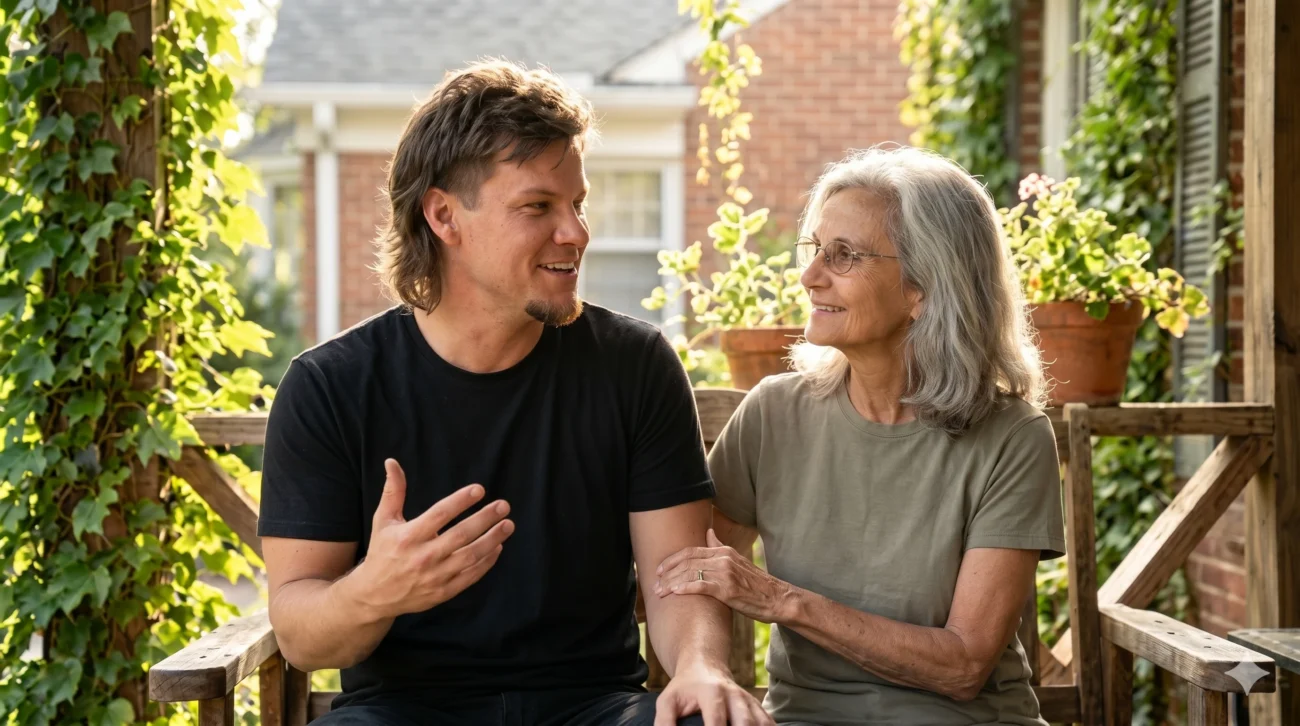
Gina Capitani did not become known by chasing a spotlight. Her name began appearing in searches because her son, comedian and podcaster Theo Von, kept returning to the people and places that shaped him: Covington, Louisiana; a much older father; a childhood marked by money stress; and a mother whose work ethic seemed to leave a permanent mark. To many of Von’s listeners, Gina is not a celebrity mother in the usual sense. She is the private woman standing behind some of the most personal and funny stories in one of modern comedy’s most unusual careers.
That makes writing about Gina Capitani different from writing about a performer, politician, or public executive. The confirmed record is limited, and much of what circulates online comes from Theo’s interviews, podcast comments, social media posts, and secondary celebrity-biography articles. A careful biography has to respect that boundary. Gina’s life is public enough to invite curiosity, but private enough that not every detail can or should be filled in as fact.
What can be said clearly is this: Gina Capitani is best known as the mother of Theodor Capitani von Kurnatowski III, the Louisiana-born comedian known professionally as Theo Von. She is widely described in public accounts as being from Wyoming, Illinois, and as the mother of four children raised in a family marked by class pressure, regional movement, and the loss of Theo’s father, Roland Theodor Achilles von Kurnatowski Sr., in 1996. Her story matters because it helps explain the family background behind a comic voice built on memory, discomfort, tenderness, and survival.
Early Life and Wyoming, Illinois
Public accounts of Theo Von’s background identify Gina Capitani as having been born and raised in Wyoming, Illinois, a small city in Stark County. That detail is one of the most consistent pieces of information attached to her biography, though many other personal claims about her early life remain less firmly sourced. Wyoming is a small Midwestern place, the kind of town where family history and local reputation tend to carry weight. For readers trying to understand Gina, that origin matters because it places her outside the entertainment world from the beginning.
Several online profiles list Gina’s date of birth as July 9, 1948, and describe her ancestry as Irish and Italian. Those details are widely repeated, but they are usually not tied to primary documentation or a direct interview with Gina herself. A responsible biography can acknowledge that these claims circulate while also treating them with care. The safer statement is that she is publicly described as a woman from Illinois whose name entered wider awareness because of Theo Von’s fame.
Little is publicly known about Gina’s childhood, schooling, or early ambitions. There is no reliable public record showing that she sought a media career, held public office, published work, or built a professional platform under her own name. That absence is not a failure of the record so much as part of the story. Gina appears to have lived as a private person before her son’s audience began looking for the people behind his comedy.
Marriage to Roland von Kurnatowski
Gina Capitani’s life became tied to a far more unusual family history through Roland Theodor Achilles von Kurnatowski Sr., Theo Von’s father. Roland is generally identified as having been born in Bluefields, Nicaragua, and later settling in New Orleans. Public memorial and biographical records place his birth in the early twentieth century and his death in New Orleans in 1996. His background has often been described as Polish-Nicaraguan, with Theo himself speaking publicly about that side of his heritage.
The age difference between Gina and Roland is one of the most discussed details in the family story. Theo Von was born on March 19, 1980, in Covington, Louisiana, and his father was in his late sixties at the time. Some accounts say Roland was 67 when Theo was born, while Theo has sometimes used slightly different ages in comic retellings. That gap created a family setting in which a young child had a father from a much older generation and a mother carrying much of the daily pressure of the household.
Reports differ on some of the finer points of Gina and Roland’s marriage, and those differences are worth noting rather than smoothing over. Some articles state that Roland and Gina had four children together, while others focus only on the children from Theo’s immediate household and Roland’s children from other relationships. Public accounts consistently identify Gina as Theo’s mother and Roland as Theo’s father. Beyond that, specific claims about marriage dates, household arrangements, and private family dynamics should be handled carefully.
Motherhood in Covington, Louisiana
Theo Von was raised in Covington, Louisiana, a city north of Lake Pontchartrain that sits within the cultural pull of greater New Orleans while maintaining its own smaller-town identity. His public biography has often described a childhood shaped by low-income circumstances, legal emancipation at 14, and the death of his father when he was 16. In that context, Gina Capitani appears in the public story less as a polished public figure and more as a working mother inside a difficult family economy. Her role is remembered through the pressure, humor, and emotional charge that Theo later brought into his comedy.
Public accounts say Gina had four children: Zefferino, Theo, Whittier, and Rolanda. The siblings have not all pursued public lives, and several details about them come from secondary profiles or Theo’s own comments. Zefferino, often called Zeff, is usually identified as Theo’s older brother, while Whittier and Rolanda are described as his younger sisters. Rolanda has been described in some accounts as an emergency room nurse, though, as with many details around the family, readers should distinguish between widely repeated reporting and direct public confirmation.
Theo has spoken openly about a childhood that was not neat or easy. He has described feeling embarrassed by his father’s age, trying to make his mother laugh, and living with strain that he did not fully understand as a child. Those recollections do not give outsiders a complete map of Gina’s life, but they do show the emotional role she played in Theo’s early world. She was not a distant biographical footnote; she was part of the daily material from which his sense of humor formed.
Work, Money, and the Delivery-Driver Story
One of the most repeated claims about Gina Capitani is that she worked delivery jobs, including delivering newspapers when Theo was young and later delivering packages. Several celebrity-biography sites and articles say she worked as an Amazon delivery driver into her seventies. Some of those accounts trace the claim back to Theo’s public comments, including podcast discussions about his mother still doing deliveries. The detail has taken hold because it fits the broader image of Gina as a woman who kept working even after her son became successful.
That image should be treated with both respect and caution. There is no widely available employment record that independently confirms every version of the delivery-driver story, and many articles repeat one another without adding new sourcing. Still, Theo’s own public remarks have often framed his mother as a worker under stress, someone he wanted to help, and someone whose labor shaped his childhood. The story’s importance lies not just in the job title, but in what it reveals about the family’s relationship to work and money.
Claims about Gina Capitani’s net worth are even weaker. Some websites attach speculative figures to her name, but there is no credible public financial disclosure, business filing, or verified reporting that establishes her personal wealth. Since she is not a public executive, celebrity performer, or business owner with public earnings, exact net-worth claims should be rejected unless they come with evidence. The most honest answer is that Gina’s income and personal finances are private, while Theo Von’s success has clearly changed the family’s public visibility.
How Gina Capitani Influenced Theo Von
Theo Von’s comedy is built around stories that often feel half-confession, half-folk tale. He talks about childhood, shame, addiction, class, family oddities, and the strange emotional logic of growing up around adults who were carrying their own burdens. Gina Capitani sits inside that material because she was part of the emotional weather of his early life. The public does not know every detail of their relationship, but listeners have heard enough to understand that it was complicated, meaningful, and lasting.
In interviews and podcast episodes, Theo has suggested that trying to make his mother laugh may have helped push him toward comedy. That is a striking detail because it turns comedy from performance into a childhood survival skill. A child who senses stress in a parent may learn to use humor as a way to soften the room, win approval, or create a moment of relief. For Theo, that instinct eventually became a career, but its earliest setting appears to have been domestic and personal.
The relationship has not always been presented as simple. Theo has spoken about anger, forgiveness, and the difficulty of loving parents who were also sources of pain or confusion. That honesty is part of why his audience responds to him. It also protects Gina from being flattened into a saintly internet figure, because real parent-child relationships are rarely that clean.
Theo Von’s Rise and the New Interest in Gina
Gina Capitani’s public profile rose because Theo Von’s career kept expanding. He first became known to many viewers through MTV’s “Road Rules: Maximum Velocity Tour” in 2000 and later through appearances on “The Challenge.” He moved from reality television into stand-up comedy, then into podcasting, where his voice found a much larger and more loyal audience. His podcast, “This Past Weekend,” helped turn him from a comic with a following into a major figure in personality-driven media.
By the mid-2020s, Theo Von was no longer just a stand-up with a podcast. He had become a host whose interviews with entertainers, politicians, athletes, and cultural figures drew national attention. TIME included him in its 2025 TIME100 Creators list, describing him as a figure who reflects the changing way audiences consume media. That larger profile pulled more attention toward his family story, including the mother he had spoken about for years.
The result is a strange kind of borrowed fame. Gina did not release a memoir, star in a show, or turn herself into a brand. Yet her name appears in searches because millions of people feel they know Theo through long-form conversations and want to understand the home he came from. In the podcast era, relatives can become subjects of public curiosity simply because they appear in stories that listeners hear again and again.
Public Image and Privacy
Gina Capitani’s public image is built around endurance. Articles about her often describe her as hardworking, private, humble, and devoted to her children. Those descriptions may be fair in spirit, but they can also become too easy when writers repeat them without evidence. A warmer and more accurate approach is to say that the available public record presents Gina as a private mother whose work and family role have been emphasized by her son’s storytelling.
Privacy is central to her biography. Gina has not spent years giving interviews, building a public platform, or correcting every article written about her. That means the public version of her life is incomplete by design. It also means readers should be wary of pieces that claim to know her thoughts, motivations, or feelings in great detail.
The best way to treat Gina is as a person, not a symbol. She may represent hard work to Theo’s fans, but she is not just an emblem of motherhood or sacrifice. She is a private woman with a family history that became public because one of her children learned how to turn memory into art. That distinction keeps the story grounded.
Family Loss and Turning Points
Roland von Kurnatowski’s death in 1996 was a major turning point in Theo Von’s life. Theo was 16 at the time, and public accounts say Roland died of cancer. Losing a parent as a teenager is already difficult, but Theo’s relationship with his father carried the added weight of age difference, distance, embarrassment, and regret. Gina’s role after that loss is often described through the language of single motherhood, though the full household situation is not completely documented in public sources.
Family loss did not only shape Theo’s emotional life; it also shaped how audiences later heard him. His stories about his father are often funny, but they are rarely only funny. They carry the ache of missed time and the oddness of being a child with a parent old enough to belong to another era. Gina’s presence in those stories gives them another layer, because she was the parent still living, still working, and still part of the ongoing relationship.
There are also public accounts of difficulty between Theo and his parents before his father’s death. Theo’s legal emancipation at 14 is one of the most striking facts in his biography, and it suggests a childhood that did not fit ordinary family expectations. The details should not be exaggerated beyond the record, but they help explain why Theo’s reflections on family often move between affection and pain. Gina’s story, as seen from the outside, sits directly inside that tension.
Current Status and Life Away From the Spotlight
Gina Capitani is generally described as living a private life away from the entertainment industry. Some online profiles claim she lives in Tucson, Arizona, while others avoid naming a current residence. Because she is a private person, current-location claims should be treated carefully unless they come from a reliable, recent, and direct source. What is clear is that she has not become a public-facing media personality despite Theo’s fame.
Reports that she continued working in delivery into her seventies remain part of her public image. If accurate, that detail says something powerful about habit, independence, and the way some people understand dignity through work. It also raises a broader question about how fame changes a family unevenly. One child may become wealthy and widely known while a parent continues living according to older routines and values.
Theo has publicly expressed a desire to support his mother and reduce her stress. That theme appears in coverage of his relationship with her and helps explain why fans view Gina with affection. Still, her present daily life belongs largely to her. The most respectful answer to where she is now is that she appears to remain private, known to the public mainly through her son’s words.
Net Worth and Financial Reality
There is no reliable public estimate of Gina Capitani’s net worth. Articles that assign her a specific number are usually guessing, and those guesses should not be repeated as fact. Unlike entertainers or business executives, Gina does not have public contracts, box-office earnings, sponsorship deals, or company valuations attached to her name. Her financial life is private, and responsible writing should leave it there.
Theo Von’s own success has led readers to wonder whether Gina still works by choice or necessity. That is a fair question, but it cannot be answered fully from public information. A person can keep working because of money, identity, habit, independence, or some mix of all four. Without direct confirmation from Gina, any confident explanation would be speculation.
What can be said is that money is part of the family story because Theo has spoken about low-income circumstances and stress in childhood. That background helps readers understand why work, rent, and support show up in public discussions of Gina. It also explains why fans respond strongly to the image of her continuing to work while her son becomes a major comic voice. The contrast is memorable, but it should not be turned into a fairy tale.
Legacy Through Theo Von’s Comedy
Gina Capitani’s legacy, at least in public view, is tied to Theo Von’s comedy and the family memories that shaped it. Theo’s voice is unusual because it does not sound manufactured in the way many celebrity personas do. It carries the rhythms of Louisiana, the odd turns of a child trying to explain adult behavior, and the emotional residue of a household that was funny and hard at the same time. Gina is part of that sound even when she is not the subject of a joke.
That influence is not the same as a professional achievement, and it should not be dressed up as one. Gina did not write Theo’s material or manage his career, as far as public records show. Her influence appears to be personal rather than institutional. She helped form the early life that Theo later mined for stories, insight, and comic tension.
There is real value in that kind of influence. Many artists are shaped less by formal training than by the people they tried to understand as children. Gina’s place in Theo’s biography helps readers see that his comedy did not emerge from nowhere. It came from a family, a region, a set of pressures, and a mother whose presence remains part of his public imagination.
Frequently Asked Questions
Who is Gina Capitani?
Gina Capitani is best known as the mother of comedian and podcaster Theo Von. Her full public identity is tied mainly to Theo’s biography, where she is named as the mother of Theodor Capitani von Kurnatowski III. She is not known as a performer or public media figure in her own right.
Where is Gina Capitani from?
Public accounts widely describe Gina Capitani as being from Wyoming, Illinois. That detail appears in biographical summaries of Theo Von’s early life and is one of the more consistent facts associated with her background. More detailed claims about her childhood and schooling are not widely confirmed.
How old is Gina Capitani?
Many online profiles list Gina Capitani’s birth date as July 9, 1948, which would place her in her late seventies in 2026. That date is widely repeated, but it is not always attached to primary documentation. Because Gina is a private person, her exact age should be presented with that caution.
Was Gina Capitani married to Theo Von’s father?
Gina Capitani is publicly identified as Theo Von’s mother, and Roland Theodor Achilles von Kurnatowski Sr. is publicly identified as his father. Roland was much older than Gina and died in 1996, when Theo was 16. Some details about Gina and Roland’s marriage vary across online accounts, so the confirmed parentage is clearer than the full marriage timeline.
How many children does Gina Capitani have?
Public accounts generally say Gina Capitani has four children: Zefferino, Theo, Whittier, and Rolanda. Theo Von is the best known of them because of his comedy and podcasting career. The other siblings have largely remained outside the public spotlight, though some details about them appear in celebrity-biography coverage.
What does Gina Capitani do for work?
Gina Capitani is often described as having worked delivery jobs, including newspaper delivery and later package delivery. Some accounts say she worked as an Amazon delivery driver into her seventies, based partly on Theo Von’s public comments. The broad claim that she is associated with delivery work is widely repeated, but exact current employment details are private.
What is Gina Capitani’s net worth?
There is no credible public record establishing Gina Capitani’s net worth. Any exact figure attached to her name should be treated as an unsupported estimate unless it comes from reliable financial documentation. Her son Theo Von’s success is public, but Gina’s personal finances remain private.
Conclusion
Gina Capitani’s biography is not the story of a woman who sought fame. It is the story of a private mother whose name became visible because her son turned his family history into comedy, confession, and conversation. That kind of visibility can be affectionate, but it can also distort the person at the center of it.
The facts that can be confirmed point to a woman from Illinois, a mother of four, and a central figure in Theo Von’s emotional and comic formation. Around those facts sits a larger field of repeated claims, some plausible and some too thinly sourced to carry much weight. The honest profile keeps both things in view.
What makes Gina Capitani matter to readers is not celebrity status. It is the human pull of her story: work, motherhood, privacy, strain, and the complicated love that adult children often carry into public life. As Theo Von’s audience grows, interest in Gina will likely continue, but the best way to understand her is still the simplest one. She is a private woman whose life helped shape a very public voice.
