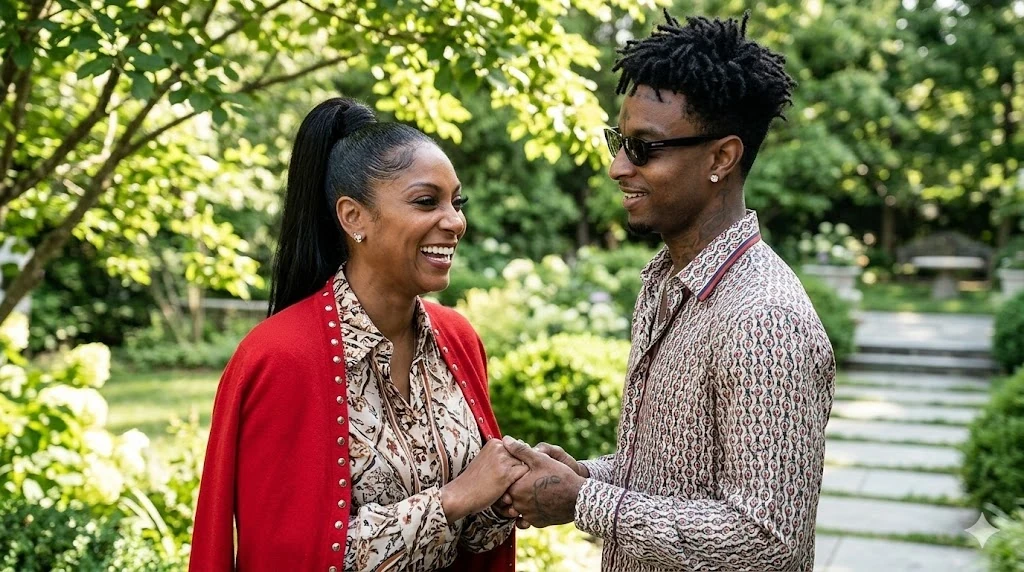
Heather Carmillia Joseph became a public name because of a very public son, but her own life has remained mostly outside the frame. She is best known as the mother of Shéyaa Bin Abraham-Joseph, the Grammy-winning rapper the world knows as 21 Savage, a British-born, Atlanta-raised artist whose immigration case forced fans to revisit everything they thought they knew about his background. The closer one looks at Heather Carmillia, the clearer the story becomes: she matters because she sits at the beginning of a family journey that crosses London, Caribbean heritage, Atlanta, fame, and the hard edge of immigration law. She is also a reminder that not every person tied to celebrity has chosen celebrity for herself.
Who Is Heather Carmillia Joseph?
Heather Carmillia Joseph is publicly identified as the mother of 21 Savage, whose legal name is Shéyaa Bin Abraham-Joseph. Public biographical accounts of the rapper identify him as born in London on October 22, 1992, to Heather Carmillia Joseph and Kevin Cornelius Emmons. His family background has been described as British with Caribbean roots, including Dominican ancestry on his mother’s side. Those details form the strongest public record around her identity, because Heather herself has not lived as a media personality or frequent interview subject. +1
That limited public record matters because the internet has turned her into a subject of fast, often careless biography. Many sites list exact birthdates, occupations, partners, children, and net worth figures for Heather Carmillia, but much of that material is either unsourced or copied from other low-authority pages. A careful biography has to begin with restraint. The most reliable facts connect her to her son’s family history, childhood migration, and public immigration case, not to a fully documented career of her own.
Early Life and Caribbean Family Background
The most consistent reporting around Heather Carmillia Joseph places her within a British-Caribbean family story. Her son was born in London, and several public accounts describe his mother’s family roots as Dominican. That connection matters because the Caribbean diaspora has long shaped Black British life, especially in London, where families from Dominica, Jamaica, Saint Vincent and the Grenadines, Trinidad, Barbados, and other islands built communities across generations. In Heather’s case, the verified record does not support a detailed childhood biography, but it does point to a family history shaped by movement, identity, and migration.
Some online biographies claim Heather was born in Dominica, while others say she was born or raised in East London. Those claims should be treated carefully because they often appear without documents, interviews, or named sources. What can be said with more confidence is that her son’s public story begins in London and carries Caribbean family roots through his mother. That is enough to place Heather Carmillia within a wider cultural history without pretending to know private details that she has not publicly confirmed. +1
Marriage, Family, and 21 Savage’s Birth
Heather Carmillia Joseph is named in public accounts as the mother of Shéyaa Bin Abraham-Joseph, while Kevin Cornelius Emmons is identified as his father. Shéyaa was born in London in 1992, years before he became one of Atlanta rap’s most recognizable voices. Several biographical accounts say Heather and Kevin separated, after which Heather became the parent most closely associated with Shéyaa’s move to the United States. The details of that relationship remain largely private, and there is no need to turn that privacy into speculation.
The family story became widely discussed only after 21 Savage’s immigration status became public in 2019. Until then, his identity in popular culture had been tied almost entirely to Atlanta, not London. That shift made readers newly curious about his parents, especially Heather, because she was the parent linked to his childhood move. It also showed how celebrity biographies often flatten complicated family histories until a legal case forces the full timeline into view.
Moving from London to Atlanta
Heather Carmillia’s most consequential public role is tied to her son’s childhood move from the United Kingdom to the United States. Reporting on 21 Savage’s immigration case says he arrived in the U.S. as a child and grew up in Atlanta, the city that shaped his accent, friendships, music, and public identity. His legal team later said he first came to the U.S. at age seven, then returned to the United Kingdom briefly in 2005 before coming back on a visa that expired in 2006. That legal timeline became central to the 2019 case that brought his birthplace into the headlines. +1
For Heather, the move placed her family inside a new country and a new social world. Atlanta gave her son the community that would later define his music, but it also placed the family within the complicated machinery of American immigration status. 21 Savage has said he did not understand his paperwork situation as a child, a point that resonated with many immigrants who arrived young and grew up American in every practical sense. Heather’s name is attached to that story because migration is not an abstract policy issue inside a family; it is a daily life.
Raising a Son Who Became 21 Savage
The public does not have a detailed, confirmed account of Heather Carmillia’s parenting style, home life, or private sacrifices. Still, the broad shape of her influence is clear because 21 Savage’s public identity was formed through the life she helped make possible. He grew up in Atlanta after a London birth, carrying layers of British, Caribbean, and American experience into a career that listeners first understood as purely Southern. That combination became part of his story only after his immigration case revealed the hidden geography behind his life.
A parent’s influence is not always visible in awards, interviews, or public records. Sometimes it appears in the fact of survival, relocation, and the creation of stability under pressure. Heather Carmillia’s public story is not one of red carpets or branded ventures. It is a quieter story of a mother whose child became famous, then watched as private family history became part of national news.
The 2019 ICE Arrest That Changed the Family Narrative
On February 3, 2019, U.S. Immigration and Customs Enforcement detained 21 Savage in Georgia. ICE said he was a British citizen who had overstayed a visa, while his lawyers pushed back against parts of the government’s framing and argued that he had lived openly in the United States for years. The arrest startled fans because it disrupted the widely held assumption that 21 Savage was born and raised entirely in Atlanta. It also brought Heather Carmillia Joseph’s name into a much larger public conversation about childhood migration and documentation. +1
The case quickly became more than a celebrity headline. His legal team said he had a pending U visa application and deep family ties in the United States. He was released on bond after days in detention, and the case drew attention from artists, lawyers, activists, and immigrant-rights groups. For Heather and the wider family, it meant a private family timeline was suddenly being examined by the press, fans, and federal authorities. +1
How the Immigration Case Ended
The immigration case did not resolve immediately after 21 Savage left detention. It remained a shadow over his career and travel for years, even as his music continued to grow in reach. In October 2023, the Associated Press reported that he had become a lawful permanent resident of the United States and had been cleared to travel internationally. His attorney, Charles Kuck, said immigration court proceedings had ended, giving him freedom to travel outside the country.
That resolution also changed the emotional meaning of the family story. For years, 21 Savage’s London birth had been treated by some as a strange twist or a meme, but the case was serious. It involved detention, legal uncertainty, family separation fears, and the question of how the United States treats people who arrived as children. Heather Carmillia’s place in that history is not as a public advocate, but as a mother whose family became a symbol of a larger American argument.
The SPARC Confusion
One of the most common internet errors around Heather Carmillia Joseph is the claim that she is the same person as Heather Joseph, the executive director of SPARC, the Scholarly Publishing and Academic Resources Coalition. SPARC’s official biography identifies Heather Joseph as its executive director and describes her work in open access and academic publishing. It does not identify her as Heather Carmillia Joseph, nor does it describe her as 21 Savage’s mother. Without reliable evidence linking the two, the claim should not be treated as fact. +1
This confusion shows how search-driven writing can distort a private person’s biography. A shared name, repeated across enough websites, can become a false identity in the eyes of readers. Many pages now present Heather Carmillia as both 21 Savage’s mother and a publishing-policy executive, but those pages rarely provide primary support. The more responsible reading is that Heather Carmillia Joseph and SPARC’s Heather Joseph should be treated as separate unless a credible source proves otherwise.
Career, Income, and Net Worth Claims
There is no strong public record establishing Heather Carmillia Joseph’s career, income sources, or net worth. Many celebrity-biography sites give estimated net worth figures, often ranging from hundreds of thousands of dollars to more than a million. Those numbers should be read as guesses, not verified financial reporting. A private person’s wealth cannot be responsibly calculated from her child’s fame, family association, or repeated online claims.
The same caution applies to career descriptions. Some sites call her an advocate, academic leader, or open-access executive, but that appears connected to the SPARC identity confusion. Others describe her mainly as a mother and private figure, which is closer to what reliable public evidence supports. The fairest conclusion is that Heather Carmillia’s personal finances and professional life are not publicly documented in a way that allows confident reporting.
Children and Family Life
Heather Carmillia Joseph is publicly known above all as the mother of 21 Savage. Some online profiles also name twin daughters, Kyra and Jayda Joseph, and describe them as choreographers based in London. Those claims appear often, but they are not as firmly documented in major reporting as the connection to 21 Savage. A careful account can mention that these names circulate in online profiles, while making clear that public confirmation is limited.
The family’s public image is also shaped by loss. 21 Savage’s younger brother, Terrell Davis, also known as TM1way, was killed in London in 2020, a tragedy reported by several outlets at the time. While that event is tied more directly to 21 Savage’s public life than to Heather’s documented biography, it forms part of the family’s wider story of grief across countries. It also reminds readers that behind celebrity coverage are families living through private pain under public attention.
Public Image and Privacy
Heather Carmillia Joseph has not built a visible public brand from her son’s fame. She does not appear to have a heavily documented media career, a public-facing business empire, or a long record of interviews. That absence has created space for low-quality biographies to fill in the blanks, but it also suggests a person who has maintained boundaries. Privacy, in her case, is not a missing chapter; it is part of the story.
Readers often want a fuller picture of celebrity parents because they are looking for the source of a star’s character. That instinct is understandable, especially with an artist whose life story includes immigration, violence, survival, and success. But there is a difference between context and intrusion. Heather Carmillia’s public meaning can be explained without pretending she has shared more than she has.
Why Heather Carmillia Still Draws Interest
Heather Carmillia remains a search topic because 21 Savage’s story still invites questions. Fans want to know how a London-born child became an Atlanta rapper, how his family moved, and how his immigration case reached national headlines. Her name appears in that search because mothers often become the first clue readers use to understand a famous person’s origin. In this case, that clue leads to a complex story about identity and belonging.
There is also a deeper reason people keep looking her up. 21 Savage’s life challenges simple labels: British by birth, Atlanta by upbringing, Caribbean through family heritage, American by lived experience, and now a lawful permanent resident of the United States. Heather Carmillia sits at the family center of those overlapping identities. Her own biography may be lightly documented, but her place in that story is real.
21 Savage’s Career and the Family Context
21 Savage’s success gives Heather Carmillia’s name its public reach. He broke through in the mid-2010s and became known for a spare delivery, unsentimental lyrics, and a public image rooted in Atlanta street experience. His 2018 album “I Am > I Was” marked a major step in critical and commercial recognition. In 2020, he and J. Cole won the Grammy Award for Best Rap Song for “A Lot,” giving 21 Savage his first Grammy win. +1
That career arc changed how people read his family history. Once the public learned he was born in London, the story became less about contradiction and more about formation. Atlanta shaped his art, but London and Caribbean family roots were also part of the biography. Heather Carmillia’s importance lies in that layered formation, not in any exaggerated claim that she personally engineered a music career.
Common Misunderstandings About Heather Carmillia
The first misunderstanding is that Heather Carmillia Joseph has a fully public biography comparable to her son’s. She does not. The available record is strongest where it overlaps with 21 Savage’s documented life, especially his birth, family background, childhood move, and immigration case. Details beyond that require caution.
The second misunderstanding is that repeated online claims become reliable through repetition. A birthdate, net worth estimate, or job title is not confirmed simply because many websites publish it. Some of the most polished-looking pages about Heather Carmillia repeat the same unsupported claims. Good biography writing should slow down at exactly the point where search content speeds up.
The third misunderstanding is that privacy means irrelevance. Heather Carmillia’s limited public footprint does not make her unimportant. It means her importance has to be described through the facts that can be known. Her life matters publicly because it connects to family, migration, motherhood, and the making of a major artist.
Where Heather Carmillia Joseph Is Now
Heather Carmillia Joseph’s current day-to-day life is not publicly documented in reliable detail. Most recent articles describe her as private and closely associated with her family rather than with a public career. Claims about her residence, partner, work, or personal routine should be treated carefully unless they come from direct reporting or official records. The most accurate answer is that she remains best known through her relationship to 21 Savage and keeps much of her life outside the public eye.
That privacy is especially striking in an era when celebrity families often turn visibility into opportunity. Heather Carmillia has not become a regular interview presence or a constant figure in entertainment media. The public knows her because of her son, not because she has pushed herself into the spotlight. That distinction gives her story a quieter dignity.
Frequently Asked Questions
Who is Heather Carmillia Joseph?
Heather Carmillia Joseph is best known as the mother of rapper 21 Savage, whose legal name is Shéyaa Bin Abraham-Joseph. Public biographical accounts identify her as one of his parents, along with Kevin Cornelius Emmons. She is not widely documented as a public figure outside that family connection.
Is Heather Carmillia Joseph 21 Savage’s mother?
Yes, Heather Carmillia Joseph is publicly identified as 21 Savage’s mother. He was born in London in 1992 and later grew up in Atlanta, where he built his music career. Her name became more widely searched after his 2019 immigration case drew attention to his British birth and childhood migration.
Where is Heather Carmillia Joseph from?
The strongest public record places Heather Carmillia within a British-Caribbean family background. Her son was born in London, and public accounts describe Dominican roots on his mother’s side. Claims that she was born in a specific city or on a specific date should be treated carefully unless backed by reliable documentation.
Is Heather Carmillia Joseph the same person as SPARC’s Heather Joseph?
There is no reliable public evidence proving that Heather Carmillia Joseph is the same person as Heather Joseph, the executive director of SPARC. SPARC’s own biography identifies Heather Joseph as an open-access advocate but does not connect her to 21 Savage. The claim appears to have spread through online biography pages and should be treated as unverified.
What is Heather Carmillia Joseph’s net worth?
Heather Carmillia Joseph’s net worth is not reliably documented. Figures listed on celebrity-biography sites are estimates at best and often appear without financial records, reporting, or clear sourcing. It would be misleading to present those numbers as verified.
Does Heather Carmillia Joseph have other children?
Some online profiles say Heather Carmillia Joseph has twin daughters named Kyra and Jayda Joseph, often described as choreographers. Those claims are repeated across entertainment sites, but they are not as firmly supported by major public reporting as her relationship to 21 Savage. The most cautious approach is to describe those details as reported online rather than fully established public record.
Why is Heather Carmillia Joseph famous?
Heather Carmillia Joseph is famous because of her connection to 21 Savage. Her name became especially visible after his 2019 ICE detention revealed more about his London birth, family background, and childhood move to the United States. She is searched because readers want to understand the family story behind an artist whose identity crosses several countries and cultures.
Conclusion
Heather Carmillia Joseph’s biography is not a conventional celebrity profile. There are no long interview archives, no official memoir, and no verified public career record that can be mapped year by year. What exists instead is a smaller but meaningful public story: a mother, a family migration, a son who became famous, and a legal case that turned private history into public knowledge.
The truth is, the gaps are part of the biography. They tell us that Heather Carmillia has not tried to turn her son’s fame into constant visibility. They also challenge writers and readers to respect the difference between what is known and what is merely repeated. In a media culture that rewards certainty, her story requires care.
Her place in 21 Savage’s life remains the reason people search her name. Through that connection, Heather Carmillia stands near a story about London, Atlanta, Caribbean heritage, immigration status, fame, and belonging. That is enough to make her worth understanding, even if the most respectful version of that understanding leaves room for privacy.
