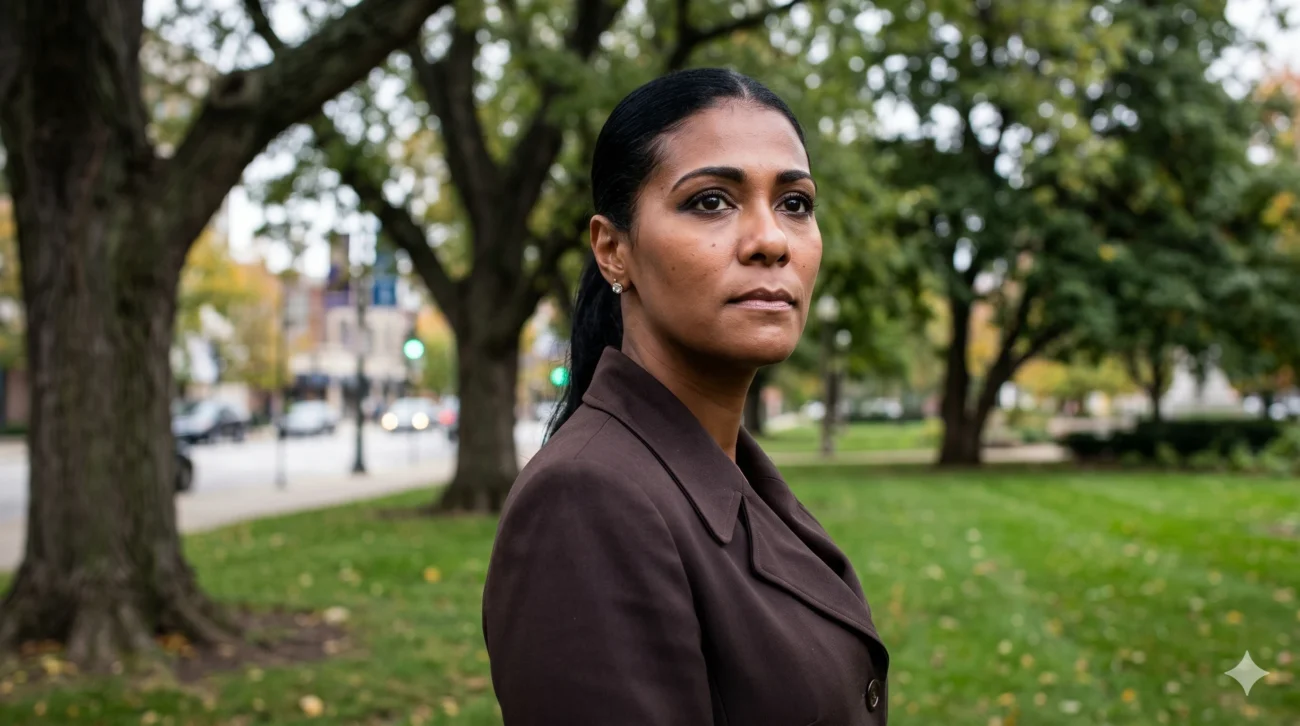
Tyna Robertson became known to many people not through a chosen public career, but through courtrooms, headlines, and her connection to high-profile men. Her name is most often searched alongside former Chicago Bears star Brian Urlacher, dancer Michael Flatley, and her son Kennedy Urlacher, now a college football player. That public trail can make her seem like a celebrity figure, but the more accurate picture is more complicated. She is a private woman whose life became partly visible because legal disputes made pieces of it public.
The strongest record identifies her as Tyna Karageorge, formerly known as Tyna Robertson, in federal litigation filed in Illinois. That court record connects her to a long-running custody conflict involving Brian Urlacher and their son, Kennedy, and to later claims she brought after the death of her husband, Ryan Karageorge. Public interest in her has lasted because the story sits where fame, family law, grief, and media attention meet. But here’s the thing: a careful biography of Tyna Robertson has to begin with what can be verified and stop short of pretending that every internet claim is fact.
Early Life and Publicly Known Background
Very little about Tyna Robertson’s early life has been confirmed by strong public records. Many online profiles give details about her age, birthplace, education, and early work, but those accounts often rely on one another rather than on official documents or reputable reporting. Some identify her as Tyna Marie Robertson and later Tyna Karageorge, a connection supported by the federal court caption in Karageorge v. Urlacher. Beyond that, the record becomes thin, and any responsible biography has to say so plainly.
That lack of confirmed background does not mean Robertson had no life before the headlines. It means most of that life remains private, which is different. The public record begins only when she enters legal and media stories involving well-known men, and that can distort how readers understand her. A person’s court history is not the same thing as a full life story, even when court records are the clearest documents available.
Some sites describe Robertson as a former dancer or real estate agent, but those descriptions should be handled with care unless tied to reliable records. Claims about net worth are even weaker, because private individuals rarely have verifiable public financial disclosures. A biography that inflates those details may satisfy curiosity, but it does not serve readers well. The more honest approach is to separate her confirmed public identity from unsupported biographical shorthand.
Relationship With Brian Urlacher
Robertson’s name first became widely visible through her relationship with Brian Urlacher, one of the most recognizable defensive players in Chicago Bears history. Urlacher and Robertson were not reported as married; public reporting described her as his former girlfriend. Their son, Kennedy Urlacher, was born in 2005, and he became the center of a custody and visitation dispute that brought Robertson into sports media coverage. In 2007, the Associated Press reported that a judge ordered both parents to attend a three-hour parenting class during litigation over parental visits.
The 2007 reporting placed Kennedy with Robertson in Joliet, Illinois, while Urlacher had visitation at his home in Lake Forest. That detail matters because it shows how a family matter became public mainly because one parent was famous. For most families, a parenting class order would never leave the courthouse. With Urlacher involved, even ordinary custody procedures became news.
The public record does not support treating Robertson simply as an accessory to Urlacher’s story. She was a mother in a disputed custody case, and the issues at stake were deeply personal. The case also shows the imbalance that can come with celebrity proximity. Urlacher’s public identity as a Hall of Fame-caliber athlete made the story easier to package for sports readers, while Robertson’s side of the experience was filtered through court filings and headlines.
Motherhood and Kennedy Urlacher
Kennedy Urlacher is the clearest and most enduring family link between Robertson and Brian Urlacher. He has grown into a football player in his own right, which has brought renewed attention to his parents and childhood. USC’s official football roster lists Kennedy Urlacher as a safety from Chandler, Arizona, and says he transferred from Notre Dame to USC in summer 2025. The roster also states that he played in all 13 games for USC in 2025 and entered 2026 competing for playing time as a junior.
Kennedy’s rise has changed the way people search for Tyna Robertson. Some readers arrive at her name because they are researching Brian Urlacher’s family, while others find her through Kennedy’s college football profile. That creates a new cycle of attention around old disputes. Stories that once belonged to family court are now resurfacing through sports biography and recruiting interest.
For Robertson, that means a chapter of her private life remains tied to her son’s public future. Kennedy’s career should not be reduced to his parents’ conflict, and Robertson’s life should not be reduced to custody litigation. Still, the connection explains why her name keeps appearing in search results years after the most intense legal coverage faded. Family history, once indexed online, rarely disappears cleanly.
Marriage to Ryan Karageorge
After her relationship with Urlacher, Robertson became publicly identified as Tyna Karageorge. Court records and reporting connect that name to Ryan Karageorge, her husband, whose death in December 2016 became part of later litigation. NBC Chicago reported that Urlacher received temporary custody of Kennedy after Ryan Karageorge died, a development that helped set off another public legal fight. That reporting also described Robertson’s later lawsuit against Urlacher and others.
The details of Ryan Karageorge’s death have been discussed in court-related reporting, but not every claim around it should be repeated as settled fact. Robertson alleged that others damaged her reputation by portraying her as responsible for what happened. Urlacher’s attorney denied the allegations, according to NBC Chicago, and said the claims had already been disproven. That disagreement became the basis for one of the most public legal chapters of Robertson’s life.
This is the point where biography and legal record become difficult to separate. Robertson was not only a litigant; she was also a widow and a mother whose family life had become a matter of public argument. The documents preserve allegations, defenses, and rulings, but they cannot fully capture the personal toll of that period. A fair account should make room for that without turning grief into drama.
The Defamation Lawsuit Against Brian Urlacher
In 2018, Robertson, under the name Tyna Karageorge, filed a lawsuit against Brian Urlacher and several others. NBC Chicago reported that the lawsuit sought $125 million and accused Urlacher of conspiring to “defame and destroy” her by suggesting she was involved in Ryan Karageorge’s death. The suit named multiple defendants connected to the custody dispute and family court proceedings. Urlacher’s attorney rejected the claims in the same report.
The case later reached federal court in the Northern District of Illinois, where Judge Gary Feinerman issued a memorandum opinion and order in September 2019. The federal opinion identifies the plaintiff as “Tyna Karageorge, formerly known as Tyna Robertson,” and lists Urlacher and several attorneys and court-connected figures among the defendants. The opinion addressed procedural and legal issues, including allegations that some defendants conspired in ways that harmed her custody position. Some claims were dismissed, and the court found certain allegations too vague or unsupported to proceed against at least one defendant.
That ruling does not tell the whole human story, but it does set the boundary for what can be stated with confidence. Robertson brought serious claims. The defendants contested them. The court evaluated whether the claims met legal standards, not whether every painful piece of the family history could be fully resolved.
The Michael Flatley Case
Robertson’s name also appears in a major California Supreme Court decision involving Michael Flatley, the dancer known for Riverdance and Lord of the Dance. The 2006 decision in Flatley v. Mauro described a demand letter sent by attorney D. Dean Mauro on behalf of Tyna Marie Robertson, who claimed Flatley had raped her. Flatley sued Mauro for civil extortion, intentional infliction of emotional distress, and interference with economic advantage based on the demand letter and follow-up calls. The court’s decision focused on Mauro’s conduct and whether California’s anti-SLAPP law protected it.
This case is often mentioned in articles about Robertson, but it is easy to misstate its meaning. The published decision was not a full trial of Robertson’s allegation against Flatley. It examined whether Mauro’s communications, including a demand for a seven-figure payment, were protected legal advocacy or could be treated as extortion as a matter of law. The California Supreme Court concluded that the communications at issue fell outside anti-SLAPP protection because they amounted to criminal extortion.
For Robertson’s biography, the Flatley case shows how early her name became attached to high-profile litigation. It also shows how legal stories can define a private person for decades, even when the core appellate ruling is really about attorneys, speech protections, and civil procedure. Readers looking for a simple character judgment will not find one in that decision. What they will find is a record of how a claim involving a famous entertainer became a leading California case on extortion and anti-SLAPP law.
Public Image and Media Coverage
Robertson’s public image has been shaped less by interviews or personal projects than by legal narratives created around her. She has not built a public brand in the way actors, athletes, or influencers do. Instead, her name appears in news stories, court opinions, legal summaries, and search-driven biography pages. That type of visibility can be unforgiving because it preserves conflict more readily than context.
Media coverage of Robertson often frames her through relationships with men who were already famous. She is Brian Urlacher’s former partner, Kennedy Urlacher’s mother, the woman named in the Flatley case, or the plaintiff in a defamation suit. Those descriptions may be factually relevant, but they are incomplete. They tell readers why her name became public, not who she is in the fuller private sense.
The newer wave of online profiles has not always improved that picture. Many repeat uncertain details about age, career, money, and residence without showing readers where the information came from. A stronger profile has to resist that habit. Robertson’s public record is dramatic enough without adding unverified claims to make it feel more complete.
Career, Work, and Money
There is no well-documented public career record for Tyna Robertson comparable to a filmography, business filing history, political résumé, or professional biography. Some websites describe her as having worked in real estate or entertainment-adjacent jobs, but those details are not consistently supported by primary documents. Because of that, any firm statement about her career path would risk overstating what is known. The safer and more accurate conclusion is that her professional life has not been reliably documented in mainstream public sources.
The same caution applies to net worth. Search results sometimes attach estimated figures to Robertson, but those numbers appear speculative and are not backed by financial filings available in the public reporting reviewed here. Unlike athletes or entertainers with contracts, endorsements, and public business ventures, Robertson does not have a transparent income trail. A credible biography should not invent a financial portrait just because readers are curious.
What can be said is that Robertson’s public identity has been shaped more by litigation than by an independent public occupation. That does not mean she has not worked or supported herself in private ways. It only means those details are not confirmed enough to publish as fact. For a private person, that boundary deserves respect.
Why Her Story Still Draws Attention
The continued interest in Tyna Robertson comes from a rare convergence of factors. Brian Urlacher remains one of the most famous figures in modern Chicago Bears history. Kennedy Urlacher’s college football career gives the family story fresh relevance for sports readers. The legal record includes a large defamation claim, a custody dispute, and a California Supreme Court case involving another famous performer.
That combination makes Robertson’s name unusually durable online. Every time Kennedy appears in a roster update or Urlacher returns to public conversation, old articles and court summaries can resurface. Search engines reward names connected to multiple recognizable figures, even when the person at the center has chosen a quieter life. Robertson’s visibility is therefore less a measure of celebrity than of digital permanence.
The truth is, many readers are not looking for gossip when they search her name. They are trying to understand how the pieces connect. Was she married to Urlacher? Is she Kennedy’s mother? What happened in the lawsuit? Why does Michael Flatley appear in the same story? Those are reasonable questions, and they deserve answers grounded in records rather than recycled rumor.
Where Tyna Robertson Is Now
Robertson does not appear to maintain a major public platform, and recent reliable reporting about her current life is limited. That absence should not be filled with guesswork. Some online sources suggest she lives quietly away from the spotlight, but that is difficult to confirm through strong reporting. What can be said is that her current public presence is far smaller than the legal footprint attached to her name.
Her son Kennedy’s football career has become the more active public story. As of USC’s 2026 roster information, Kennedy is competing within a major college program after transferring from Notre Dame. That development may keep public interest in Robertson alive, but it does not necessarily mean she is seeking attention. Parents of athletes often become search subjects simply because fans want to know family backgrounds.
For now, the most respectful reading of Robertson’s life is that she is a private person whose public record has outlived the events that created it. She is not known for a current entertainment career, media role, or public advocacy platform. Her name remains visible because the internet remembers court filings, sports stories, and famous associations long after private people step back.
Frequently Asked Questions
Who is Tyna Robertson?
Tyna Robertson is a private American woman best known publicly as the former partner of former Chicago Bears linebacker Brian Urlacher and the mother of their son, Kennedy Urlacher. In federal court records, she is identified as Tyna Karageorge, formerly known as Tyna Robertson. Her name appears most often in connection with custody litigation, a defamation lawsuit, and the earlier Flatley v. Mauro case.
Was Tyna Robertson married to Brian Urlacher?
Public reporting describes Tyna Robertson as Brian Urlacher’s former girlfriend or former partner, not his wife. They share a son, Kennedy Urlacher, whose custody and visitation arrangements became the subject of public court coverage. Urlacher later received temporary custody after the death of Robertson’s husband, Ryan Karageorge, according to NBC Chicago.
Is Tyna Robertson Kennedy Urlacher’s mother?
Yes, Tyna Robertson is Kennedy Urlacher’s mother. Kennedy is the son of Robertson and Brian Urlacher, and he has become a college football player in his own right. USC lists him as a safety who transferred from Notre Dame in summer 2025 and played for the Trojans during the 2025 season.
What lawsuit did Tyna Robertson file against Brian Urlacher?
In 2018, Robertson, then identified as Tyna Karageorge, filed a lawsuit against Brian Urlacher and others. NBC Chicago reported that she sought $125 million and alleged that Urlacher and others worked to damage her reputation after her husband Ryan Karageorge’s death. Urlacher’s attorney denied the claims, and later federal court proceedings addressed legal and procedural issues in the case.
What was Tyna Robertson’s connection to Michael Flatley?
Tyna Marie Robertson was named in the California Supreme Court decision Flatley v. Mauro as the woman on whose behalf attorney D. Dean Mauro sent a demand letter to Michael Flatley. The decision says Robertson accused Flatley of rape, while Flatley sued Mauro over alleged civil extortion tied to the demand letter and calls. The appellate case focused on Mauro’s conduct and California’s anti-SLAPP law, not on a full trial of Robertson’s underlying allegation.
What is Tyna Robertson’s net worth?
There is no reliable public record establishing Tyna Robertson’s net worth. Online estimates should be treated as speculative because they are not tied to verified financial filings, public contracts, or credible reporting. A careful biography should not present those figures as fact.
What is Tyna Robertson doing now?
Robertson’s current life is not well documented in reliable public sources. She appears to have kept a lower public profile while attention has shifted toward Kennedy Urlacher’s football career. Without confirmed reporting, claims about her current residence, work, or personal life should be treated cautiously.
Conclusion
Tyna Robertson’s biography is not the story of a conventional public figure. It is the story of a private person whose name became public through family ties, legal disputes, and proximity to famous men. That makes her difficult to write about fairly, because the available record is real but incomplete. The most responsible profile has to honor both sides of that truth.
What is known is specific: she is Kennedy Urlacher’s mother, Brian Urlacher’s former partner, and the person later identified in court as Tyna Karageorge. She has been involved in litigation that drew public attention, including a defamation suit connected to custody conflict and a separate California case involving Michael Flatley and attorney D. Dean Mauro. Those records explain why readers search her name, but they do not fully define her life.
The open spaces in Robertson’s story matter as much as the documented chapters. They remind readers that search results can create the illusion of complete knowledge when they are really showing fragments. For Tyna Robertson, the fairest view is measured and human: a mother, a widow, and a private person whose most public moments came during some of the hardest parts of life.
