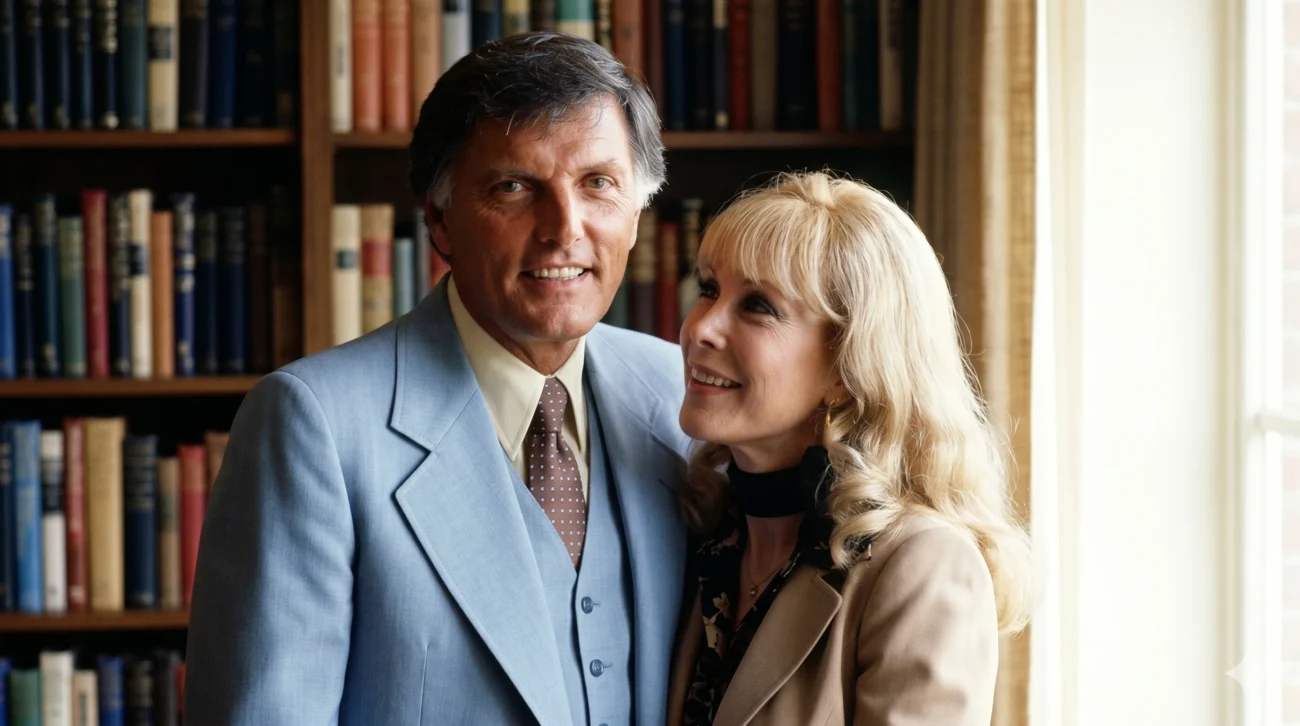
Charles Donald Fegert is not a household name, but his name keeps surfacing because of one very public chapter: his marriage to actress Barbara Eden. Search results often flatten him into a celebrity footnote, yet the record shows a more specific story. He was a Chicago advertising executive tied to the city’s newspaper business, a private figure pulled into public attention through a Hollywood marriage. The challenge is separating what can be verified from what later websites have repeated without much proof.
Who was Charles Donald Fegert?
Charles Donald Fegert was an American newspaper advertising executive best known publicly as the second husband of Barbara Eden, the star of I Dream of Jeannie. Public death and memorial records list him as Charles D. Fegert, born November 8, 1930, and died September 25, 2002, at age 71. +1 His professional identity was based in Chicago, where he worked in newspaper advertising rather than entertainment.
Most readers searching for Charles Donald Fegert are trying to answer three questions: who he was, what he did, and why he is linked to Barbara Eden. The short answer is that he worked in advertising leadership at the Chicago Sun-Times and was married to Eden from 1977 until their split in the early 1980s. People magazine’s later biographical coverage of Eden identifies him as a Chicago Sun-Times executive and says the marriage lasted five years before divorce in 1982.
The public record around Fegert is much thinner than the public record around Eden. He does not have the kind of archive that actors, politicians, or major corporate chiefs usually leave behind. That means a responsible account has to treat some widely repeated claims with care, especially claims about wealth, personality, and private family life. Where details are not backed by primary records, it is better to say so than to decorate the story.
Why people search for him now
Interest in Fegert usually comes through Barbara Eden rather than through newspaper history. Eden remains culturally visible because I Dream of Jeannie has stayed in circulation for decades, and People has continued to cover her career, public appearances, and long life in entertainment. +1 As readers revisit Eden’s biography, they often encounter Fegert as the second of her three husbands.
There is also a second search motive: readers want to know whether the many recent short biographies about him are reliable. The web is full of posts repeating the same claims about his career, education, family, and net worth, but many of those articles cite one another or give no clear sourcing. Several agree that he worked at the Chicago Sun-Times and Chicago Daily News, yet they differ on details such as the exact divorce year and estimates of his finances. That inconsistency is a sign to slow down, not a reason to invent certainty.
A useful article on Fegert should therefore do two jobs at once. It should explain the verified outline of his life and show where the record becomes less firm. It should also give readers the context they came for: his Chicago career, his marriage to Eden, the end of that marriage, and why his name still appears in searches more than two decades after his death.
Early life and Chicago roots
The most reliable public records place Fegert’s birth on November 8, 1930. +1 Many online biographies say he was born and raised in Chicago, and that account fits the later public record linking him to Chicago newspapers and a Chicago residence. Still, detailed claims about his childhood, parents, schools, and early employment are not consistently supported by primary sources in the open web.
That distinction matters because many modern celebrity-biography pages present small details with more confidence than the evidence allows. Some identify him as a South Side Chicago native, a Loyola University graduate, and a former Coast Guard member. Those details may be accurate, but they are harder to verify from accessible primary records than his birth date, death date, and connection to Eden. A careful profile should not treat every repeated claim as equally proven.
What can be said with confidence is that Fegert’s adult life was rooted in Chicago’s media business. In the mid-20th century, Chicago was still a muscular newspaper town, with several major publications competing for readers, advertisers, and civic influence. The Chicago Public Library’s newspaper holdings show the long overlap of the Chicago Daily News, Chicago Sun-Times, Chicago Tribune, Chicago Defender, and other city papers through the 20th century.
Career in newspaper advertising
Fegert’s career is usually described as a rise through newspaper advertising, with the Chicago Sun-Times at the center of the story. People identifies him as a Chicago Sun-Times executive, and a 1975 press-photo listing describes Charles D. Fegert as vice president of advertising for Field Newspaper. +1 That 1975 item is useful because it places him in a senior advertising role before his marriage to Eden became public.
The distinction between editorial fame and advertising power is important. Newspaper executives on the business side rarely become public figures, but their work mattered deeply to the survival of print publications. Advertising revenue paid for large newsrooms, production systems, distribution networks, and the daily fight for market share. A senior advertising officer in a major Chicago newspaper company would have been part of the commercial engine behind the paper.
Many recent profiles say Fegert served as vice president of advertising and marketing for the Chicago Sun-Times and the Chicago Daily News. That claim is widely repeated, and it is broadly consistent with the 1975 Field Newspaper photo listing. +1 The safer phrasing is that he was a senior advertising executive associated with the Chicago Sun-Times and Field Newspaper, with many secondary accounts linking him to both the Sun-Times and Daily News.
His field was not glamorous in the Hollywood sense, but it demanded persuasion, speed, and relationships. Newspaper advertising executives worked with department stores, local businesses, national brands, agencies, and internal sales teams. They had to understand readership, circulation, pricing, placement, and the changing habits of advertisers as television grew stronger. That commercial pressure helps explain why someone in Fegert’s position could be well known in Chicago business circles without becoming famous to the broader public.
The Chicago newspaper world he worked in
Fegert’s working years came during a demanding period for American newspapers. Television had already taken a large share of public attention, suburban shopping patterns were changing local advertising, and daily papers faced rising production costs. Chicago’s newspaper market was also crowded for much of the century, with publications fighting for both readers and ad dollars. In that setting, advertising leadership was not a back-office function; it was a survival function.
The Chicago Daily News, one of the city’s historic papers, ceased publication in 1978, while the Chicago Sun-Times continued as a major daily paper. The Chicago Public Library’s listing shows the Daily News running through 1978 and the Sun-Times continuing from 1948 forward. That timeline helps frame Fegert’s career because his senior advertising work appears to have taken place around the last years of a more crowded Chicago newspaper era.
This context also helps correct a common misunderstanding. Fegert is sometimes described online as though he personally changed modern newspaper advertising, but that is a large claim requiring better evidence than most profiles provide. What can be said is that he held senior advertising responsibility in a major newspaper environment at a time when print media faced hard commercial shifts. That is meaningful without overstating his individual influence.
Marriage to Barbara Eden
Fegert entered wider public attention when he married Barbara Eden in 1977. Eden was already famous from I Dream of Jeannie, the NBC sitcom that ran from 1965 to 1970 and became the role most closely associated with her career. People’s biographical coverage says Eden married Chicago Sun-Times executive Charles Fegert in 1977 after her divorce from actor Michael Ansara.
The marriage brought together two very different public worlds. Eden belonged to Hollywood, television, film, stage, fan conventions, and national entertainment press. Fegert belonged to Chicago newspaper advertising and business circles. That contrast is one reason their relationship still draws attention: it was not a typical pairing of two entertainers.
Several secondary accounts say they married on September 3, 1977, in the Chicago area. +1 Because those accounts lean on Eden’s later memoir and entertainment coverage, the date is widely reported, though readers should understand that the most accessible high-trust source, People, gives the year and marriage length rather than every ceremony detail. What is clear is that the marriage became a major public biographical marker for both of them, especially for Fegert.
Eden’s fame shaped how Fegert was later remembered. In public memory, he became “Barbara Eden’s second husband” more often than “Chicago advertising executive Charles Fegert.” That label is understandable, but it is incomplete. It explains why readers search his name, not the whole of his adult life.
What Eden later said about the marriage
The difficult part of writing about Fegert is the end of the marriage. Eden later discussed the relationship in her memoir Jeannie Out of the Bottle, published by Crown and listed in Google Books as a 304-page memoir covering her career and personal life. Her memoir includes her marriages to Michael Ansara, Charles Fegert, and Jon Eicholtz, as well as the death of her son Matthew Ansara.
Public summaries of Eden’s account say the marriage deteriorated and that she described Fegert’s behavior as abusive. One account citing Eden’s memoir and a 2011 Sydney Morning Herald interview reports that she said he became involved with people who drank heavily and used cocaine, and that she left after he became abusive. Because these are serious allegations, they should be attributed to Eden rather than presented as independently established facts.
The distinction is not a dodge. It is basic fairness. Fegert died in 2002, years before Eden’s 2011 memoir reached a large readership, so he could not publicly answer later claims. A responsible article can report Eden’s account while making clear that it is her account and that the open public record does not offer a detailed competing version from Fegert.
The marriage ended after roughly five years. People says the couple divorced in 1982, while some secondary accounts say the divorce was finalized in 1983. +1 The cleanest way to handle that discrepancy is to say they separated and divorced in the early 1980s, with People using 1982 and some later accounts citing 1983 as the finalization year.
Life after Eden
After the divorce, Fegert appears to have returned to private life. Unlike Eden, he did not build a second public identity through interviews, memoirs, entertainment appearances, or public-facing projects. That absence leaves a gap that later websites often fill with vague claims about business ventures, family devotion, or wealth. Readers should be cautious with those claims unless they are tied to records.
The best-supported facts after the marriage are simple. Fegert remained associated in public memory with Chicago and died on September 25, 2002. Find a Grave lists his remains as cremated and gives his birth and death dates. AncientFaces also lists Charles D. Fegert of Chicago, Cook County, Illinois, with the same birth and death dates.
Many online biographies say he had children from marriages before Eden. Some name three children, but open search results do not provide enough primary sourcing to treat every name and family detail as settled for a publication-quality profile. In a story like this, privacy should count for something. Unless family members have chosen to speak publicly, their lives do not need to be pulled into a search-driven biography.
Net worth claims and what to ignore
One of the weakest areas in online coverage of Fegert is net worth. Different websites give different estimates, from hundreds of thousands of dollars to several million, usually without documents, estate records, salary data, or a clear method. One profile estimates $500,000, while another claims $2.5 million. +1 Those figures cannot both be treated as reliable just because they appear in search results.
The honest answer is that Fegert’s verified net worth is not publicly established. He likely earned a comfortable living as a senior advertising executive, but “comfortable” is not the same as a documented fortune. Without estate filings, compensation records, property records, or reporting from a trusted financial publication, any exact net worth number is speculative. Readers should treat precise dollar amounts with skepticism.
This is a useful example of how celebrity-adjacent biographies often go wrong. A person becomes searchable because of a famous spouse, and then websites add standard sections on net worth, height, family, career, and legacy even when the evidence is thin. That format may look complete, but it can be less accurate than a shorter account that clearly separates known facts from unsupported claims.
Why his story is often miswritten
Fegert’s biography is easy to distort because it sits between two kinds of public record. On one side, Barbara Eden’s life is heavily documented through interviews, books, entertainment profiles, and fan interest. On the other side, Fegert’s own career was mostly business-facing and local, leaving fewer searchable records. The imbalance encourages writers to define him through Eden alone.
Another problem is repetition. Recent articles about Fegert often echo one another, sometimes using the same claims and structure without showing original reporting. When many websites repeat “born in Chicago,” “Loyola graduate,” “vice president of advertising,” and “net worth in the millions,” the repetition can create a false feeling of certainty. Repetition is not verification.
A stronger account has to be comfortable with limits. We know his dates of birth and death from memorial and genealogical records. We know he was a Chicago Sun-Times executive from People’s coverage of Eden and from a 1975 Field Newspaper photo listing. We know he married Eden in 1977 and the marriage ended in the early 1980s. Beyond that, details should be framed according to how strong the evidence is.
Barbara Eden’s life after Fegert
Eden’s life after the marriage helps explain why Fegert remains a recurring search term. She married real estate developer Jon Eicholtz in 1991 and has remained publicly associated with him for decades. People has covered Eden’s later life, including her continued fan appearances, her reflections on her career, and her long connection to I Dream of Jeannie. +1
Her 2011 memoir brought renewed attention to earlier chapters of her personal life. The book debuted on the New York Times Best Seller list, according to biographical summaries, and covered her marriages and the death of her son Matthew. That renewed attention gave readers a reason to search for Fegert long after his death.
It is also worth remembering that Eden’s career does not depend on this marriage for its meaning. She had already become a television icon before Fegert entered the public story, and she continued working and appearing publicly afterward. Fegert’s connection to her is real, but it should not consume the whole account of either person. A fair profile keeps the scale right.
What can be confirmed
The strongest confirmed facts about Charles Donald Fegert are limited but clear. He was born on November 8, 1930, and died on September 25, 2002. +1 He was tied professionally to Chicago newspaper advertising, and People identifies him as a Chicago Sun-Times executive.
A 1975 historic press-photo listing identifies Charles D. Fegert as vice president of advertising for Field Newspaper. That supports the broader claim that he held a senior newspaper advertising position before his marriage became celebrity news. It also helps anchor his career in a source outside later celebrity-biography summaries.
His marriage to Barbara Eden began in 1977 and ended after about five years. People gives the divorce year as 1982, while some later sources cite 1983 as the final legal endpoint. +1 The difference is small but should not be hidden, because careful dating is part of trustworthy biography.
What remains uncertain
Several claims about Fegert remain less firmly documented in easily accessible public sources. These include exact education details, military service, full family structure, later business work, and net worth. Some may be true, and some may come from older newspaper or subscription records not visible in open search. But unless they are backed by accessible sources, they should be described as reported claims rather than settled facts.
The same caution applies to descriptions of his personality. Some articles call him charming, ambitious, forceful, or private, while Eden’s later account describes darker behavior during the marriage. Personality claims are always difficult when they come mostly from secondary summaries or from one side of a painful relationship. A careful writer should attribute such descriptions and avoid turning them into broad character judgments.
There is also uncertainty around how much influence he had on newspaper advertising beyond his own workplace. Being a vice president of advertising at a major newspaper company is a serious career achievement. Saying he reshaped the whole newspaper industry is a much larger claim. Without trade reporting, internal records, awards, or expert testimony, the narrower statement is the more reliable one.
How to understand his legacy
Fegert’s legacy is modest in public terms but still worth getting right. He represents a type of mid-century and late-20th-century business figure who had real influence inside local media institutions without becoming nationally famous. Newspaper advertising executives helped keep papers financially alive, even if their names rarely appeared above the fold. In Chicago, that work happened in a hard-fought media market with deep civic importance.
His celebrity connection is the reason most readers find him, but it is not the only reason he mattered. He had a career before Eden, held senior responsibility in newspaper advertising, and lived most of his life outside the entertainment press. That fuller view does not require exaggeration. It only requires looking beyond the easy label.
At the same time, Eden’s account of the marriage cannot be brushed aside. Her memoir and later interviews are part of the public record, and they shape how the relationship is remembered. The fairest approach is to report her account clearly, note that Fegert is not available to respond, and avoid softening serious claims into vague “marital problems.” Good biography does not protect reputations by blurring hard facts.
Frequently Asked Questions
Who was Charles Donald Fegert?
Charles Donald Fegert was a Chicago-based newspaper advertising executive best known publicly as Barbara Eden’s second husband. Public records list him as born on November 8, 1930, and deceased on September 25, 2002. +1 His professional life was tied to the Chicago Sun-Times and Field Newspaper.
What was Charles Donald Fegert’s job?
Fegert worked in newspaper advertising and held senior responsibility in that field. People identifies him as a Chicago Sun-Times executive, and a 1975 press-photo listing describes him as vice president of advertising for Field Newspaper. +1 Many later profiles also link him to the Chicago Daily News, though the strongest accessible support places him in senior advertising work connected to Field Newspaper and the Sun-Times.
When did Charles Donald Fegert marry Barbara Eden?
Barbara Eden married Charles Fegert in 1977 after her first marriage to actor Michael Ansara ended. People says Eden and Fegert were together for five years before divorcing in 1982. Some secondary accounts give September 3, 1977, as the wedding date, but the most reliable broadly accessible source confirms the year rather than every ceremony detail.
Why did Barbara Eden and Charles Fegert divorce?
Eden later described the marriage as troubled and said Fegert became abusive, according to public summaries of her memoir and interviews. Because these are serious personal claims, they should be attributed to Eden’s account rather than stated as independently proven by court records in open search. The marriage ended in the early 1980s, with sources differing between 1982 and 1983 for the final divorce date.
Did Charles Donald Fegert have children?
Many online profiles say Fegert had children from relationships before his marriage to Eden. The open search record, however, is not strong enough to treat every name and family detail as fully verified for a careful biography. Since those family members are private people, a responsible article should avoid unnecessary detail unless supported by clear public records.
What was Charles Donald Fegert’s net worth?
There is no reliable public figure for Fegert’s net worth. Some websites estimate amounts ranging from $500,000 to several million, but they generally do not provide estate records, salary records, or a clear method. +1 The safest answer is that his exact net worth is unknown.
When did Charles Donald Fegert die?
Charles Donald Fegert died on September 25, 2002. Find a Grave and AncientFaces both list his birth date as November 8, 1930, and his death date as September 25, 2002. +1 He was 71 years old.
Conclusion
Charles Donald Fegert’s story is a reminder that search fame and life significance are not the same thing. Most people search his name because of Barbara Eden, but the verified record shows a man with his own professional identity in Chicago newspaper advertising. That identity deserves attention, even if the surviving public record is limited.
The most trustworthy account is also the most restrained one. Fegert was born in 1930, became a senior advertising figure connected to the Chicago Sun-Times and Field Newspaper, married Eden in 1977, divorced in the early 1980s, and died in 2002. Those facts are enough to form a clear outline without padding the story with weak claims.
What remains harder to know is the private man behind those facts. Eden’s later account of the marriage is part of the record and should be reported with care. Other claims about family life, finances, and personal character require more proof than many online biographies provide.
For readers, the practical takeaway is simple: treat Charles Donald Fegert as more than a celebrity footnote, but be wary of overbuilt profiles that pretend the record is fuller than it is. His life sits at the intersection of Chicago media history and Hollywood biography. The truth is clearest when both sides are kept in view.
