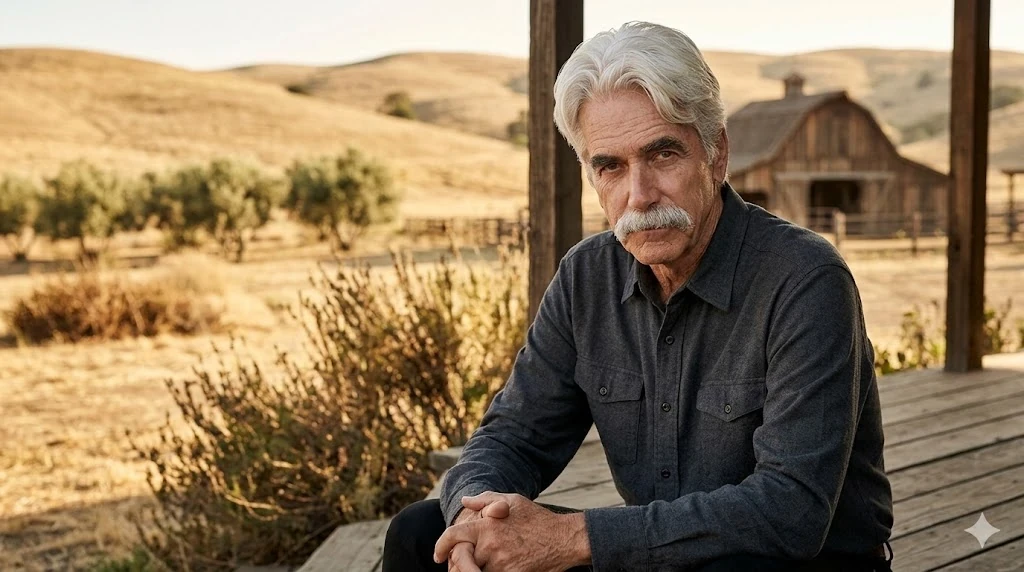
Sam Elliott has built one of the most recognizable screen presences in American film: the silver mustache, the spare way of speaking, the deep baritone that seems to arrive from somewhere below the floorboards. For more than five decades, he has played cowboys, soldiers, ranchers, bikers, fathers, lawmen, and lonely men carrying private grief. That weathered image is part of why so many people now search the same question: what disease does Sam Elliott have?
The honest answer is simpler and more careful than the internet usually likes. Sam Elliott has not publicly confirmed that he has cancer, Parkinson’s disease, COPD, dementia, or any other specific chronic disease. He has spoken in general terms about having had health issues and surgeries before filming 1883, but he has not turned those details into a public medical story.
That distinction matters because Elliott is not only a famous actor; he is also an 81-year-old man whose face and voice have been watched closely for decades. Fans may notice age, exhaustion, a role that requires frailty, or the ordinary changes that come with time and assume something more dramatic. A responsible biography has to separate the public record from the rumor mill, while still taking seriously why people care.
The Verified Answer About Sam Elliott’s Health
There is no credible public record showing that Sam Elliott has disclosed a named disease. Searches around his health often point to rumor pages, recycled celebrity blogs, or ads that use his image or name to attract clicks. Those sources frequently present speculation as fact, which is especially risky with medical claims about a living person.
What Elliott has acknowledged is limited. In interviews around 1883, he referred to having gone through health issues and surgeries before production, and he described the work as physically demanding. He did not identify a disease, give a diagnosis, or invite the public into the details of his medical history.
That leaves readers with a clear but restrained answer. If the question is “what disease does Sam Elliott have,” the most accurate response is that no disease has been publicly confirmed. Anything more specific should be treated as unverified unless it comes from Elliott, his representatives, or a reliable outlet with clear sourcing.
Why the Question Keeps Following Him
The question follows Elliott partly because his body has always been part of his work. He is tall, lean, slow-moving in a deliberate way, and famous for a voice that has made him as valuable in narration as in front of a camera. His screen image was never youthful polish; it was age, grit, silence, and authority even when he was younger.
As actors grow older, audiences sometimes mistake visible aging for illness. Elliott was born on August 9, 1944, in Sacramento, California, and he has been working since the late 1960s. A person seen across that span will change in ways that feel personal to viewers who have carried his performances through their own lives.
There is another reason for confusion: Elliott has played sick, grieving, and physically diminished men with unusual conviction. In The Hero, his character is an aging actor facing cancer. In 1883, he played Shea Brennan, a Civil War veteran worn down by loss, duty, and the brutal demands of the trail. Those roles were fictional, but Elliott’s naturalism can make fiction feel close to confession.
Early Life and Family
Samuel Pack Elliott was born in Sacramento and grew up with a family history tied to work, discipline, and the West. His father, Henry Nelson Elliott, worked for the U.S. Fish and Wildlife Service, and his mother, Glynn Mamie Sparks, worked as a physical training instructor. The family later moved to Portland, Oregon, where Elliott spent much of his youth.
His father was practical and skeptical of acting as a career. Elliott has spoken over the years about wanting to perform despite that resistance, and that tension became part of his origin story. It was not a tale of instant encouragement or easy access to Hollywood.
After graduating from David Douglas High School in Portland, Elliott attended college in Oregon and later studied in California. He spent time at Clark College in Vancouver, Washington, where he appeared in stage productions and began to take acting seriously. By the late 1960s, he was in Los Angeles, joining the long line of hopeful actors trying to turn presence into work.
First Steps in Acting
Elliott’s film debut came in Butch Cassidy and the Sundance Kid in 1969, though his role was small. Katharine Ross, the woman who would later become his wife, starred in that film, but the two did not begin their relationship there. Their connection came years later, after both had lived more life and gathered more career history.
Early in his career, Elliott worked steadily rather than explosively. He appeared in television shows, Westerns, and supporting parts that suited his look and voice. Hollywood understood him quickly as a Western type, but it took longer for the industry to understand how much feeling he could bring to quiet men.
One of his first major television breaks came with Mission: Impossible, where he appeared in the early 1970s. He then built a career through projects such as Lifeguard, The Sacketts, and The Shadow Riders. These roles helped establish him as an actor who could carry masculinity without making it loud.
Career Breakthrough and Screen Identity
Elliott’s breakthrough was not one single overnight event. It was a slow accumulation of roles that made him seem less like a performer than a figure carved into American genre memory. By the 1980s and 1990s, he had become one of Hollywood’s most reliable embodiments of the modern Western man.
In Mask, released in 1985, Elliott played Gar, the biker boyfriend of Cher’s character. The role showed another side of him: tender, protective, masculine without being emotionally empty. That performance helped widen his image beyond cowboy shorthand.
Then came roles in Road House, Tombstone, and Gettysburg, all of which deepened the public idea of Elliott as a man made for dust, leather, and moral gravity. In Tombstone, his Virgil Earp stood beside Kurt Russell’s Wyatt Earp and Val Kilmer’s Doc Holliday. The film became a lasting favorite, and Elliott’s presence helped give its mythmaking weight.
The Voice That Became a Trademark
Elliott’s voice deserves its own place in his biography because it is one of the rare voices that became a career asset. It is low, measured, and rough at the edges, the kind of voice that can sell a truck, narrate a Western, or make a joke land with almost no movement. Many actors are recognized by their faces; Elliott is recognized before he enters the frame.
That voice has also fed health speculation. Some listeners hear gravel and wonder whether it signals a throat problem or lung disease. The public record does not support that leap, and Elliott’s voice has sounded distinctive for most of his career.
Age can change any voice, especially one used professionally for decades. But Elliott’s vocal quality is not new, and it has been central to his appeal since long before current rumors began. His sound is part biology, part craft, and part the slow confidence of an actor who learned the value of leaving space around words.
Marriage to Katharine Ross
Elliott married actress Katharine Ross in 1984, forming one of Hollywood’s longer-lasting and quieter marriages. Ross was already widely known for The Graduate, Butch Cassidy and the Sundance Kid, and The Stepford Wives. Their relationship began after they worked together on The Legacy, a 1978 film that placed them in close professional contact.
The marriage has endured in part because the couple has kept much of their personal life away from publicity. They have appeared together at events, supported each other’s careers, and shared a family life that has not been packaged constantly for public consumption. In a celebrity culture built around exposure, their privacy has become part of their image.
They have one daughter, Cleo Rose Elliott, born in 1984. Cleo has pursued music and has occasionally appeared in public with her parents. The family has also faced painful private moments that became public through legal reporting, but Elliott and Ross have largely avoided turning family hardship into media theater.
Awards, Recognition, and Late-Career Respect
Elliott spent decades as the kind of actor people admired before awards bodies fully caught up. He worked often, stayed recognizable, and became a cultural shorthand for a certain American masculinity. Yet his most prestigious nominations came later, after he had already earned the respect of several generations of viewers.
His performance in Bradley Cooper’s 2018 version of A Star Is Born brought him his first Academy Award nomination. Elliott played Bobby Maine, the older brother of Cooper’s Jackson Maine, with a mix of restraint, hurt, and loyalty. The role was not large in screen time, but it carried emotional force because Elliott made silence feel like history.
He later won a Screen Actors Guild Award for his performance as Shea Brennan in 1883. That role introduced him to younger viewers through Taylor Sheridan’s expanding Western television world. It also reminded long-time fans that Elliott could still anchor a story with grief, command, and vulnerability.
The Role of The Hero in Health Rumors
The 2017 film The Hero is one of the main reasons people connect Elliott with cancer. In it, he plays Lee Hayden, an aging actor famous for Westerns who learns he has pancreatic cancer. The character’s life overlaps with Elliott’s public image so closely that some viewers blurred the line between performance and biography.
That confusion is understandable, but it is still confusion. Actors often take roles that echo their public persona without making the story autobiographical. Elliott’s performance worked because he understood the emotional terrain of aging, regret, and professional legacy, not because he was announcing his own illness.
The film gave him one of his richest late-career parts. It asked what happens when a man known for myth has to face his ordinary human limits. But the cancer in The Hero belongs to the character, not to the verified public account of Sam Elliott’s life.
1883, Physical Strain, and Public Concern
1883 placed Elliott back in the Western world, but it was not nostalgic comfort. Shea Brennan is a grieving former Union captain leading immigrants across unforgiving territory, and the series demands emotional heaviness from its first scenes. Elliott played him as a man who had outlived too much and kept moving because stopping would mean collapse.
The production was physically demanding, with outdoor work, horses, dust, weather, and long shooting days. Elliott has said that he arrived at the job after health issues and surgeries, which made the work harder. That comment is the most concrete public basis for concern, but it does not identify a disease.
Fans who saw him in 1883 may have read the character’s pain as the actor’s condition. That is a common hazard with performers who work close to the bone. Elliott’s gift is making a fictional wound feel real, and that gift can make audiences forget where the role ends.
Recent Projects and Current Status
Elliott has continued to work into his 80s. In 2025, he joined the second season of Landman, Taylor Sheridan’s Paramount+ series set in the West Texas oil business. His casting reunited him with Billy Bob Thornton, his Tombstone co-star, and placed him again inside a world of fathers, sons, land, money, and old damage.
In Landman, Elliott plays T.L. Norris, the father of Thornton’s Tommy Norris. The role uses his age directly, giving him material tied to grief, decline, and family strain. That kind of part can spark new health searches because audiences see him in a wheelchair or in emotional distress on screen and wonder whether the portrayal reflects real life.
The answer remains the same. A role is not a diagnosis, and current work does not reveal the contents of a person’s medical file. Elliott’s ongoing presence in major television projects shows that he remains professionally active, even as he chooses roles suited to his age and screen authority.
Net Worth and Income Sources
Sam Elliott’s net worth is commonly estimated by celebrity finance sites in the range of several million dollars, often around $20 million, but those figures are estimates rather than audited public records. Like many actors of his generation, his income has come from film roles, television work, voice-over jobs, commercials, residuals, and long-term visibility. Because he has worked steadily for decades, his earnings likely reflect durability more than one enormous payday.
Voice work has been a major part of his earning power. Elliott has lent his voice to commercials, animation, documentaries, and narration, giving brands and productions instant recognition. That kind of work can be financially valuable because it uses a performer’s identity in a concentrated way.
His real estate and private financial arrangements are not fully public. Responsible coverage should avoid pretending to know exact assets without records. What can be said with confidence is that Elliott’s career has been unusually long, and longevity in Hollywood often matters as much as peak fame.
Public Image: The Lasting Appeal of Restraint
Elliott’s public image rests on restraint. He does not speak like someone chasing attention, and he has rarely seemed interested in remaking himself to suit each new entertainment cycle. That steadiness has made him feel authentic to viewers, even though authenticity on screen is always partly performance.
His persona has also made him a symbol of a certain old-school masculinity. He often plays men who are capable, wounded, loyal, and slow to explain themselves. That image can be comforting, but it can also hide how much craft goes into making stillness expressive.
What’s surprising is how flexible that image has been. Elliott can be funny, as in The Big Lebowski, where his Stranger became one of the film’s most beloved presences. He can be tender, as in A Star Is Born, and tragic, as in 1883. The mustache and voice are instantly recognizable, but the best work has always depended on what he does beneath them.
Controversies and Public Friction
Elliott has had few major controversies across a long career, which makes the ones that did surface more visible. In 2022, he criticized Jane Campion’s The Power of the Dog during a podcast appearance, calling out its view of the American West and making comments that drew backlash. He later apologized publicly, saying he had not expressed himself well and that he regretted hurting people.
The episode stood out because Elliott’s identity is so closely tied to Western stories. He had spent much of his career inside the genre, and his comments were read by some as gatekeeping a mythic version of masculinity. Others saw the apology as a sign that he understood the criticism and wanted to correct the damage.
That moment did not erase his standing, but it complicated the public image. It showed that Elliott’s old-school appeal can sit uneasily inside newer cultural conversations. It also showed something basic about long public lives: even a careful actor can misstep when personal feeling, genre loyalty, and public speech collide.
How to Read Celebrity Health Claims Responsibly
Health claims about celebrities should be treated with the same care as health claims about anyone else. A diagnosis is not confirmed because a person looks older, walks differently, loses weight, or plays a sick character. Those observations may prompt concern, but they do not create evidence.
The strongest sources for a celebrity health story are direct statements, representatives, court or public records where relevant, or careful reporting by established outlets. Weak sources include ads, anonymous social videos, copied blog posts, and pages that use medical terms without citing where they came from. If a page quickly turns from “Sam Elliott has a disease” to selling a treatment, that should raise immediate suspicion.
But here’s the thing. The public’s concern often comes from affection, not cruelty. Fans search because they have watched Elliott for years and feel protective of him, but affection still needs discipline. Respect means caring about the person without inventing a diagnosis for the performer.
Frequently Asked Questions
What disease does Sam Elliott have?
Sam Elliott has not publicly confirmed that he has any specific disease. There is no verified public record showing that he has cancer, Parkinson’s disease, COPD, dementia, or another named chronic illness. The accurate answer is that his private medical details remain private beyond his general reference to past health issues and surgeries.
Does Sam Elliott have cancer?
There is no reliable public confirmation that Sam Elliott has cancer. The cancer rumor appears to be linked partly to The Hero, where he played an aging actor diagnosed with pancreatic cancer. That storyline was fictional and should not be treated as a statement about Elliott’s real health.
Does Sam Elliott have Parkinson’s disease?
No credible public source has confirmed that Sam Elliott has Parkinson’s disease. Some viewers speculate based on age, movement, or screen roles, but those are not valid ways to diagnose a neurological condition. Without a direct statement or reliable reporting, the claim remains unsupported.
Why do people think Sam Elliott is sick?
People often think Elliott is sick because he is now in his 80s, has played ill or grieving characters, and has a naturally rough voice that draws attention. He also mentioned having health issues and surgeries before 1883, which created understandable curiosity. That curiosity, though, has often been stretched into claims that go beyond the facts.
Is Sam Elliott still acting?
Yes, Sam Elliott has continued acting in recent years. He won a Screen Actors Guild Award for 1883 and joined Season 2 of Landman as T.L. Norris. His current work shows that he remains active, though like many actors his age, he appears selective about roles.
Who is Sam Elliott married to?
Sam Elliott is married to actress Katharine Ross. They married in 1984 after meeting years earlier through their work in film. The couple has one daughter, Cleo Rose Elliott, and they have generally kept their family life private.
What is Sam Elliott’s net worth?
Sam Elliott’s net worth is commonly estimated at around $20 million by celebrity finance sites, but that figure should be treated as an estimate. His income has come from decades of film and television acting, voice-over work, commercials, and residuals. Exact private finances are not publicly verified.
Conclusion
Sam Elliott’s career has always depended on presence: the voice, the stillness, the sense that entire histories sit behind a few words. That same presence now fuels health questions because viewers have watched him age in public. The search for “what disease does Sam Elliott have” says as much about fan attachment as it does about the actor himself.
The verified facts do not support the dramatic claims. Elliott has not publicly named a disease, and the rumors about cancer, Parkinson’s, and COPD remain unconfirmed. He has acknowledged some health issues and surgeries, but he has chosen not to make those details part of his public identity.
That choice fits the shape of his life and career. Elliott has always seemed more interested in the work than in explanation, more comfortable with understatement than exposure. In an age that rewards speculation, the fairest answer is also the most respectful one: Sam Elliott remains a working actor, a husband, a father, and a cultural figure whose private health is his to disclose or not.
His legacy does not depend on rumor. It rests on decades of performances that made silence dramatic, loyalty visible, and age something more complicated than decline. That is why people still search for him, still worry about him, and still recognize him the moment they hear that unmistakable voice.
