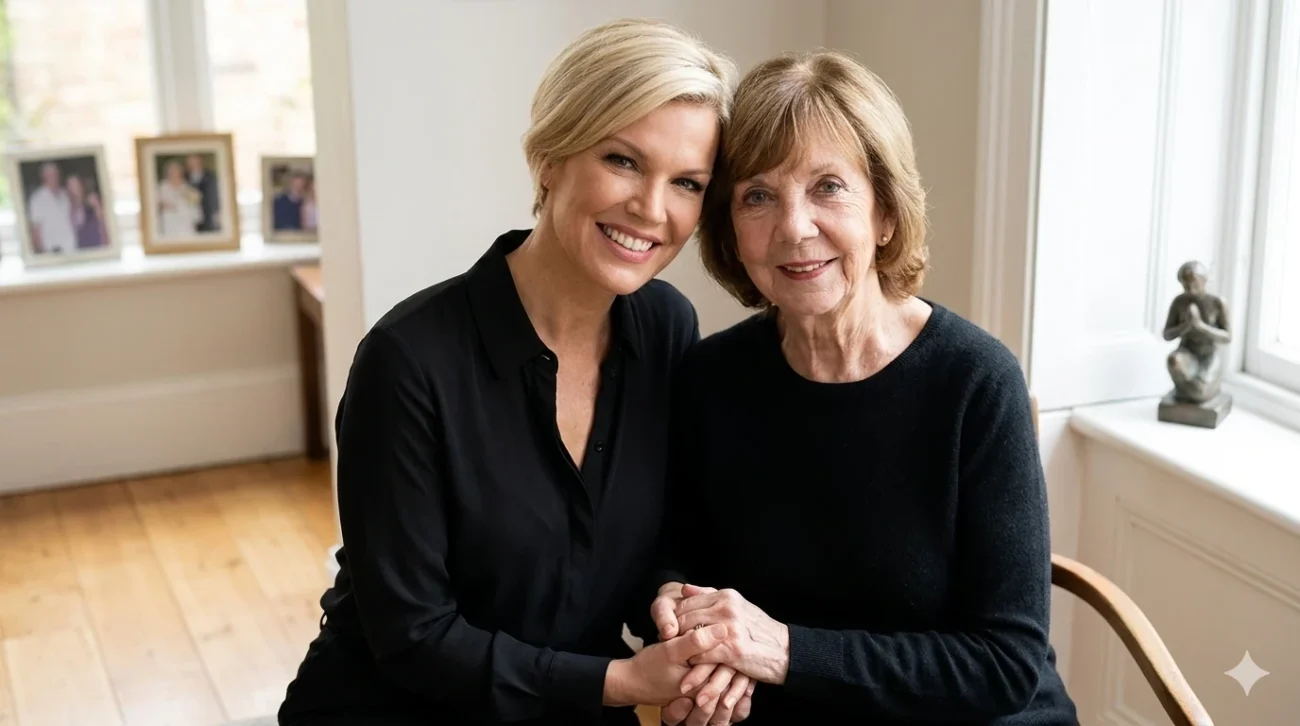
Melodie Kelly’s name reached a wide public audience through her daughter, Hannah Waddingham, but her story began far from red carpets and television awards. She was a British opera singer connected with English National Opera, a mother, and part of a family in which music was not a hobby but a daily discipline. To many readers, she is the woman Waddingham has credited with giving her both a voice and a sense of artistic home. To understand Kelly properly, though, means looking past thin celebrity summaries and treating her as a working performer whose influence moved through stages, rehearsal rooms, and family life.
Public information about Kelly is limited, and that matters. She did not live as a modern celebrity, and much of what is known comes through interviews with Waddingham, reporting around English National Opera, and coverage of Waddingham’s 2023 holiday special at the London Coliseum. The strongest verified facts are clear: Kelly was Waddingham’s mother, she sang with English National Opera, and she belonged to a family line of opera singers. The details that remain private, including her exact date of birth, training history, full performance record, and personal finances, should not be filled in with guesswork.
Early Life and Family Background
Melodie Kelly appears to have come from a family deeply rooted in opera. The Times reported that Hannah Waddingham’s maternal grandparents were also professional opera singers, placing Kelly inside a multigenerational musical household rather than treating her career as an isolated achievement. That background helps explain why Waddingham has spoken about theatre as something that felt almost inevitable in childhood. It also suggests that Kelly’s own artistic life was shaped by a family culture where singing carried professional weight.
The public record does not confirm Kelly’s childhood address, school, conservatoire training, or early teachers. Some online biographies claim more than they can prove, but reliable sources leave those details largely untouched. That absence should not be mistaken for insignificance. It simply shows that Kelly belonged to a generation of performers whose lives were not documented with the constant visibility now attached to entertainers and their families.
Her daughter’s later recollections offer the clearest window into the home Kelly helped create. Waddingham grew up in Wandsworth, south London, with her mother, her father Harry, and an older brother, according to The Times. The household combined ordinary family life with the unusual rhythm of theatre work. Kelly’s professional commitments were not distant from family life; they shaped its hours, its habits, and its atmosphere.
A Career Rooted in English National Opera
Kelly’s best-established professional identity is as an opera singer associated with English National Opera. ENO’s home, the London Coliseum, became central not only to Kelly’s work but also to Waddingham’s childhood memories. Waddingham has described the building as a place where she spent long stretches of time while her mother worked. In Associated Press coverage of Hannah Waddingham: Home for Christmas, Waddingham said she had run around the Coliseum’s corridors since she was eight years old.
That image says a great deal about Kelly’s career without pretending to know every role she sang. Opera companies depend on performers whose work may be constant and skilled without making them household names. Singers rehearse for long hours, learn demanding music, share the stage with large casts, and return night after night to deliver precision under pressure. Kelly’s association with ENO places her in that demanding professional world.
Waddingham has described her mother as a hard worker in terms that feel more vivid than any formal career summary. The Times reported Waddingham remembering Kelly rehearsing all day, coming home to cook supper, and then returning to the West End for an evening performance at the London Coliseum. That detail gives Kelly’s biography a human shape: not glamour alone, but work, parenting, travel, and repetition. It also explains why Waddingham grew up seeing performance as labor as much as art.
Some articles describe Kelly as a soprano, others as a mezzo-soprano, and several assign exact career lengths such as 27, 28, or 30 years. Those claims should be handled carefully because they are often repeated without clear primary documentation. The safer statement is that Kelly had a long professional career in opera and was publicly identified with English National Opera. That narrower claim is less flashy, but it is more honest.
The London Coliseum as a Family Landmark
The London Coliseum became the building around which Kelly’s public story now turns. For Waddingham, it was not just an opera house; it was the place where childhood, performance, and family memory overlapped. She watched singers, directors, musicians, and stage workers build productions from the inside. That kind of exposure can educate a child before formal training ever begins.
Waddingham has said that the Coliseum felt like childhood territory because her mother worked there. The Associated Press reported that Home for Christmas was recorded live at the London Coliseum, a venue that held special meaning because Kelly had performed there as an opera singer. The special, released by Apple TV+ in November 2023, was presented as a festive musical event with guests from Waddingham’s stage and screen life. Beneath the polish, it also functioned as a return to the room that helped form her.
Virgin Radio reported Waddingham describing the special as a love letter to English National Opera, her mother, and her daughter. That framing placed Kelly at the emotional center of the project without turning the show into a conventional biography. It also connected three generations through one performance space. Kelly had sung there, Waddingham returned there as the headliner, and Waddingham’s daughter saw the room through her own mother’s achievement.
Marriage, Children, and Home Life
Kelly was married to Harry Waddingham, described by The Times as a marketing director and former model. Together they raised Hannah and an older son in Wandsworth, south London. The family background that has emerged publicly is specific enough to show a lively, working household, but not so detailed that it invites intrusion. Kelly’s private life, by all available evidence, remained largely private by choice and by circumstance.
Motherhood sits at the center of Kelly’s public legacy because Waddingham has spoken so often about her influence. That influence was not only genetic or vocal. It came through example, through proximity to theatre, and through a child watching what serious performance demanded from an adult. Waddingham saw her mother balance domestic duties with a professional schedule that could stretch from daytime rehearsal into evening performance.
There is no credible public record of Kelly turning her family life into a media narrative. She became a figure of wider interest because Waddingham’s career grew, especially after Ted Lasso. That shift can distort a private person’s biography, making her seem visible only because a famous relative talks about her. In Kelly’s case, the better reading is that fame arrived late to the family story, while the artistic influence had been present for decades.
Influence on Hannah Waddingham
Hannah Waddingham’s career makes Kelly’s influence easier to see. Waddingham became known internationally for playing Rebecca Welton in Ted Lasso, a role that won her the 2021 Emmy Award for supporting actress in a comedy series. Before that, she had spent years in musical theatre and earned three Olivier Award nominations. The Times described her screen breakthrough as a late-blooming success after a long stage career, which fits the pattern of someone shaped by theatre long before television found her.
Kelly’s example appears to have given Waddingham both confidence and professional realism. Waddingham has said she does not remember wanting to do anything other than perform, and coverage of her career has linked that certainty to her early years inside theatres. Her mother and maternal grandparents were opera singers, so the stage was not presented as an exotic fantasy. It was a workplace, a family inheritance, and a demanding craft.
The most personal statement Waddingham has made about Kelly came after her mother’s death was reported. In a 2025 Times interview, Waddingham said Kelly had given her her voice and that she hears her mother in her singing voice all the time. That is not a casual compliment. For a singer, voice carries memory, training, imitation, correction, and the emotional trace of the person who first made music feel possible.
Public Attention Through Home for Christmas
Kelly’s public visibility grew sharply around Hannah Waddingham: Home for Christmas. Apple TV+ released the special in November 2023, and it brought Waddingham back to the London Coliseum with guests including Leslie Odom Jr., Luke Evans, and several Ted Lasso colleagues. The show was festive on the surface, full of music and theatrical warmth. Its deeper emotional pull came from the place where it was filmed and the family history attached to that stage.
Coverage at the time reported that Kelly attended the taping despite serious health challenges. In an interview published by Starry Magazine, Waddingham said her mother was at the back of the stalls and described the effort of getting her there in a wheelchair while she was heavily affected by Parkinson’s disease. Waddingham also spoke about having her father and daughter present, saying the special would remain her greatest achievement if she never did anything else. That statement reveals how strongly she understood the night as family history, not just entertainment.
The public response to the special helped reframe Kelly for audiences who knew Waddingham only from television. Suddenly, the story was not just about a performer with a powerful voice; it was about where that voice came from. Kelly became visible as part of the artistic foundation behind Waddingham’s public identity. That visibility was affectionate, but it also came with the risk of overstatement from websites eager to turn limited facts into a fuller biography than the evidence supports.
Health, Parkinson’s Disease, and Later Years
Kelly’s later years became part of public discussion because of Waddingham’s comments around the Christmas special. The available reporting indicates that Kelly had Parkinson’s disease and used a wheelchair by the time of the 2023 taping. That is the extent of what can be responsibly said from public sources. No reliable public medical timeline, diagnosis date, treatment history, or cause of death has been confirmed.
This distinction matters because illness is often handled poorly in celebrity-adjacent writing. Parkinson’s disease can affect movement, speech, energy, and daily independence, but every person’s experience is different. Applying general assumptions to Kelly would be unfair and inaccurate. The important fact is that Waddingham spoke about her mother’s presence at the Coliseum as something difficult to arrange and deeply meaningful once it happened.
Kelly’s illness also cast the special in a different light after later reporting of her death. What viewers saw as a holiday performance became, in retrospect, one of the most public tributes Waddingham could have given her mother. It placed Kelly in the audience of the building where her own work had shaped her daughter’s imagination. That image has become central to why readers now search for Kelly’s name.
Death and Current Status
The Times reported in June 2025 that Melodie Kelly had died “in December,” which, in the context of that profile, indicates December 2024. The article did not provide, in accessible excerpts, a precise date of death, age, or cause. No widely available official obituary has been identified that confirms those details with the same authority. For that reason, the most accurate current status is that Kelly is reported to have died in December 2024.
Waddingham’s comments after Kelly’s death were intimate and restrained. She spoke of grief through love rather than through spectacle, saying the pain comes because people love those they lose. Her tribute focused on voice, inheritance, and presence. That focus fits the way Kelly’s story has entered public view: not through publicity, but through the sound and discipline she passed on.
The lack of fuller public information should be respected. Readers may want exact dates, funeral details, and private family context, but those details are not always owed to the public. Kelly’s life can be reported meaningfully without crossing that line. The facts that are available already show a serious artist, a mother, and a family influence whose reach became visible through her daughter’s work.
Public Image and Media Portrayal
Kelly’s public image is unusual because it is built mostly through someone else’s fame. She is often described as an opera singer and Hannah Waddingham’s mother, which is accurate but incomplete. The problem comes when brief search articles turn those two facts into inflated claims about celebrity, wealth, or major international stardom. A responsible biography has to keep the warmth while resisting invention.
There is no credible public estimate of Kelly’s net worth. Some websites may attach figures to her name, but those figures are not supported by reliable reporting, probate records, published accounts, or statements from the family. Opera careers can be respected and long without producing public wealth. Any specific money claim about Kelly should be treated as unverified unless tied to a trustworthy source.
Her reputation, as reflected through Waddingham’s comments, rests on craft, stamina, and maternal influence. She was the kind of performer whose life mattered most to those who worked with her, heard her, or grew up under her example. That does not make her less worthy of biography. It makes her biography quieter, more careful, and perhaps more representative of how many arts careers are actually lived.
Legacy in Opera and Popular Culture
Kelly’s legacy now sits between two worlds. In opera, she represents the trained, disciplined professional whose work contributes to a company and its audiences without necessarily producing mass fame. In popular culture, she is part of the backstory of Hannah Waddingham, one of the rare performers to move from West End theatre to global television recognition without losing her musical identity. Those two worlds met publicly at the London Coliseum during Home for Christmas.
Her influence can be heard most clearly through Waddingham’s own account of her voice. Waddingham’s singing has been central to her stage work and has become a recurring part of her screen persona. That vocal authority did not appear out of nowhere. It emerged from training, experience, and a family environment in which music was treated as a serious calling.
The truth is, Kelly’s story matters because it reminds readers that public talent often has private roots. Audiences see the award speech, the streaming special, or the viral performance. They do not always see the parent returning from rehearsal, the child sitting quietly in a theatre, or the years of exposure that teach a young performer how to belong on stage. Kelly’s legacy lives in that hidden preparation.
Frequently Asked Questions
Who was Melodie Kelly?
Melodie Kelly was a British opera singer best known publicly as the mother of actress and singer Hannah Waddingham. Reliable reporting connects her with English National Opera and the London Coliseum. She came from a family of opera singers, and her daughter has credited her with shaping her voice and artistic life.
Was Melodie Kelly Hannah Waddingham’s mother?
Yes, Melodie Kelly was Hannah Waddingham’s mother. The Times identified Kelly as Waddingham’s mother and described her as an opera singer with English National Opera. Waddingham has spoken about Kelly’s influence in deeply personal terms, especially after her mother’s death was reported.
What did Melodie Kelly do for a living?
Kelly worked as an opera singer and was associated publicly with English National Opera. Her daughter has described spending much of her childhood at the London Coliseum while Kelly worked there. Exact role lists and full career dates are not widely confirmed in reliable public sources.
Was Melodie Kelly married?
Kelly was married to Harry Waddingham, who has been described as a marketing director and former model. The couple raised Hannah Waddingham and an older son in Wandsworth, south London. Beyond that, the family’s private life has not been widely documented in reliable public reporting.
Did Melodie Kelly have Parkinson’s disease?
Public comments from Hannah Waddingham indicate that Kelly had Parkinson’s disease in her later years. Waddingham said during promotion for Home for Christmas that her mother was heavily affected by Parkinson’s and attended the taping in a wheelchair. No reliable public source confirms a diagnosis date or full medical history.
Is Melodie Kelly still alive?
Melodie Kelly is reported to have died in December 2024. The Times reported that she had died in December, though a precise date and cause of death were not confirmed in the accessible public reporting reviewed. The most careful wording is that she is reported to have died in December 2024.
What was Melodie Kelly’s net worth?
There is no reliable public estimate of Melodie Kelly’s net worth. Any exact figure attached to her name online should be treated as unverified unless it comes from a credible financial record or direct family disclosure. Her known income source was her professional work as an opera singer, but private earnings and estate details have not been publicly confirmed.
Conclusion
Melodie Kelly’s life does not fit the usual celebrity-biography pattern. The public record is partial, and much of what readers know comes through the memories of a daughter who became famous long after Kelly had built her own working life in opera. That makes accuracy especially important. A thin record should invite care, not invention.
What can be said with confidence is meaningful enough. Kelly was a British opera singer connected with English National Opera, a wife and mother in a theatrical household, and part of a multigenerational line of singers. Through Hannah Waddingham, her influence reached audiences far beyond the opera house. The daughter’s voice carried traces of the mother’s discipline, example, and sound.
Her story also gives a clearer view of how artistic lives are made. Not all influence appears in awards lists or headline credits. Sometimes it appears in a child watching from the back of a theatre, learning what work looks like before she knows how to name it. Melodie Kelly’s place now is there: in the memory of the London Coliseum, in the family history Waddingham continues to honor, and in the voice her daughter says she still hears inside her own.
