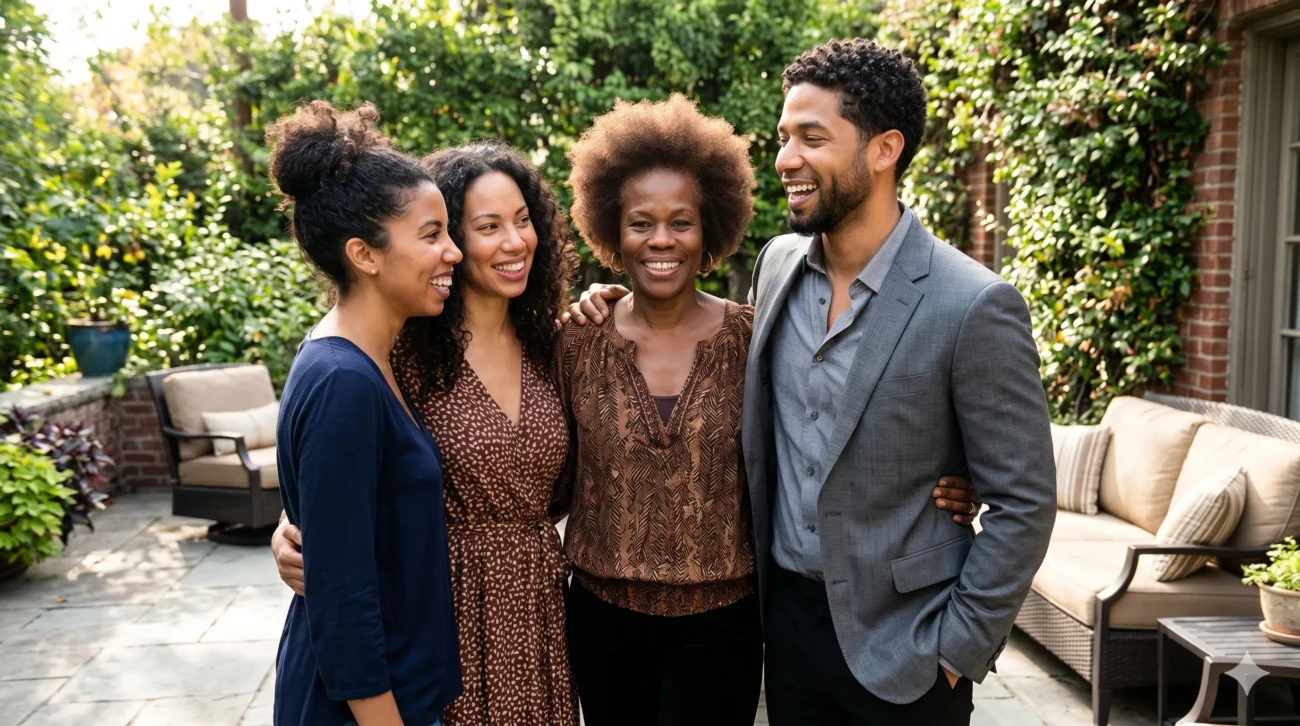
Janet Smollett is not famous in the usual way. She didn’t build her public name through movie premieres, studio deals, or a carefully managed media career. Yet her influence is threaded through one of the more unusual family stories in American entertainment: six siblings who acted together as children, moved into film, television, food, design, music, activism, and tech, and kept returning to the same source when asked where their drive began. That source was their mother, Janet Smollett.
To many readers, Janet is best known as the mother of Jussie Smollett and Jurnee Smollett. That description is accurate, but incomplete. Her life is also the story of a Black mother who raised six children in a restless, creative household, shaped by civil rights ideals, financial pressure, frequent moves, and a deep belief that family could be both shelter and training ground. Because Janet has kept a lower public profile than her children, the best biography of her has to be careful: grounded in what is known, honest about what remains private, and attentive to the work of motherhood that rarely receives a screen credit.
Early Life and What Is Publicly Known
Janet Smollett is often identified in public sources as Janet Harris before marriage, though many personal details about her early life remain lightly documented. Some online biographies claim a specific birth date and birthplace, usually New Orleans, Louisiana, but those details are not consistently supported by primary records available to the public. What can be said with more confidence is that Janet is African American and came of age in a period when civil rights and Black political consciousness were reshaping families, schools, churches, workplaces, and city life across the United States.
That timing matters because the Smollett family’s public story is inseparable from ideas of justice, race, and activism. Janet’s children have often been described as growing up with a strong social conscience, and multiple profiles of the family connect Janet and her late husband, Joel Smollett, to civil rights organizing. People magazine has reported that Janet and Joel met during a civil rights campaign, a detail that helps explain the values their children later carried into their work and public identities. The exact contours of Janet’s early activism are not fully documented, but the family’s language about social responsibility has been consistent over time.
Unlike many celebrity parents who become public figures through interviews and television appearances, Janet has mostly remained at the edge of the frame. She is visible through family stories, food memories, and the careers of her children rather than through a large public archive of her own. That absence can make her a tempting subject for exaggerated online claims, especially about activism, wealth, or personal history. A fair account has to resist filling gaps with speculation simply because the family name is familiar.
Marriage to Joel Smollett
Janet married Joel Smollett, the father of her six children: Jojo, Jazz, Jussie, Jurnee, Jake, and Jocqui. Joel, who died in 2015, has often been described as Jewish, with family roots traced to Eastern Europe, while Janet is Black. Their household gave the children a biracial and culturally layered upbringing, one that shaped how several of them later spoke about identity, belonging, and public responsibility. Jussie Smollett has identified as Black, Jewish, and gay, and Jurnee Smollett has also spoken publicly about race and justice in connection with her work.
The marriage joined two people whose lives were not built around celebrity at the start. Janet and Joel were raising children before the entertainment industry became a defining feature of the family’s public image. Their home life, as later described by the siblings, appears to have mixed artistic encouragement with strict expectations about discipline, food, and care. The children were allowed to dream, but they were also expected to contribute to the family culture around them.
Joel’s death became a private loss with public echoes because it arrived during a period when several of the Smollett siblings were highly visible. Jussie was then known to millions through Empire, while Jurnee had already built a respected acting career from childhood into adulthood. The family’s public statements and projects after Joel’s death continued to present him and Janet as the roots of a large, close, creative clan. Janet’s role, especially after becoming a widow, has been understood by many readers through that continuing family bond.
Raising Six Children in a Creative Household
The most verifiable part of Janet Smollett’s life is her role as the mother of six children who became public figures in different ways. Jojo, Jazz, Jussie, Jurnee, Jake, and Jocqui Smollett all entered the entertainment world young, with several taking acting and modeling jobs as children. In 1994, all six siblings appeared together in the ABC sitcom On Our Own, a rare case of a real family of performers being cast into a fictional family story. The series followed orphaned siblings trying to stay together, a premise that made the children’s real-life closeness part of its appeal.
That shared early career did not come from nowhere. Profiles of the family describe a childhood marked by frequent moves, auditions, creative projects, and a home environment where performance was treated as part of everyday life. The Smollett siblings were not raised as isolated child stars chasing separate careers. They were trained, emotionally and practically, as a unit.
The family’s 2018 cookbook, The Family Table: Recipes and Moments from a Nomadic Life, gives one of the most vivid public accounts of that upbringing. The book says the children moved coast to coast 13 times while growing up, a number that captures both instability and ambition. In that shifting life, the constants were food, family ritual, and a long wooden kitchen table that their mother would build again in each new home. That image of Janet turning planks into a butcher-block table says more about her than many formal biographies could.
Food, Discipline, and the Family Table
Food is one of the clearest ways Janet Smollett’s influence entered public view. Her children’s cookbook and their Food Network series Smollett Eats both present family meals as a central part of their childhood, not just a branding device. The recipes carried memory, but the kitchen also carried rules. The siblings have recalled their mother’s strict standards around cooking, ingredients, and what the children were allowed to consume.
During coverage of Smollett Eats, the brothers discussed Janet’s kitchen training and the family’s limits on soda and sugary drinks. Instead of buying soft drinks, she taught the children how to make a grapefruit “cocktail” that became popular with their friends. That detail has the texture of real family life: practical, frugal, health-minded, and a little theatrical. It also shows how Janet turned boundaries into something the children could share rather than merely obey.
The wooden table from The Family Table has become one of the most memorable symbols attached to Janet. According to the book’s description, each time the family arrived in a new home, she transformed hardwood planks into a smooth, varnished table in a ritual that took three days. It was furniture, but it was also a statement. Wherever the family landed, Janet made a center.
The Smollett Siblings and Their Public Careers
Janet’s children took different paths after their early years as a performing family. Jojo Smollett, the eldest, acted as a child and appeared with his siblings on On Our Own. Jazz Smollett worked as an actor and later moved into producing, design, and lifestyle television. Jussie Smollett became a singer and actor, best known for playing Jamal Lyon on Empire. Jurnee Smollett became the most critically acclaimed actor in the family, building a career that includes Eve’s Bayou, Friday Night Lights, Underground, Lovecraft Country, and Birds of Prey.
Jake Smollett moved from acting into food and hosting, carving out a public identity as a chef and television personality. Jocqui Smollett, the youngest sibling, has been linked to acting in childhood and later to work in technology and data analytics. The variety of their adult work makes the family difficult to reduce to a single category. They are not only an acting family, though acting made them visible first.
Janet’s presence can be seen in the connective tissue between those careers. Food, activism, performance, self-presentation, and sibling loyalty all recur across the family’s projects. Even when her children entered separate industries, they continued to speak in the language of family training. That is why Janet remains a subject of interest even without a long résumé of public-facing jobs.
Jurnee Smollett and the Family’s Artistic Reputation
Jurnee Smollett’s career gives one of the strongest examples of the artistic seriousness associated with the Smollett name. She began acting as a child and earned major attention for her performance in Eve’s Bayou, the 1997 film directed by Kasi Lemmons and starring Samuel L. Jackson, Lynn Whitfield, Debbi Morgan, and Meagan Good. Her later work showed unusual range, from the football drama Friday Night Lights to the historical drama Underground and HBO’s Lovecraft Country. Her Emmy nomination for Lovecraft Country confirmed what many critics had long seen: she had grown from child actor into one of the strongest performers of her generation.
Janet’s direct role in Jurnee’s career is not documented in the same way a manager’s role might be. But the family environment clearly mattered. Jurnee was not an isolated prodigy emerging from nowhere; she was part of a home where auditions, performance, discipline, and political awareness were familiar. The family’s frequent moves and shared projects gave her both professional exposure and a strong sense of group identity.
That background also helps explain why Jurnee’s work often resonates beyond performance alone. She has chosen roles tied to race, gender, history, and power, and she has spoken publicly about justice and representation. It would be too simple to credit all of that to Janet alone, but it would be equally wrong to ignore the home culture from which Jurnee emerged. Janet’s influence is most visible in that blend of art and conscience.
Jussie Smollett and a Family Under Scrutiny
No biography of Janet Smollett can avoid Jussie Smollett, because his public life brought the family into an intense and often unforgiving spotlight. Jussie became widely known through Empire, where he played Jamal Lyon, a gay musician navigating fame, family, and identity. His role made him a meaningful figure for many viewers, especially Black and LGBTQ audiences who saw parts of themselves in the character. Then, in January 2019, Jussie reported that he had been attacked in Chicago in what he described as a racist and homophobic hate crime.
The case quickly became one of the most divisive celebrity legal stories of the decade. Chicago police and prosecutors later accused Jussie of staging the attack, and he was convicted in 2021 of felony disorderly conduct for making false reports. Jussie maintained his innocence, and his family publicly supported him. In November 2024, the Illinois Supreme Court overturned his conviction, ruling that the state could not prosecute him again after an earlier agreement in which charges had been dropped.
That ruling changed the legal status of the case, but it did not erase the public arguments around it. For Janet, the episode placed her family’s private loyalty under national examination. She did not become a central public spokesperson in the way some celebrity parents might have, but her name was pulled into coverage because of her role as the family matriarch. The controversy also shows the difficulty of writing about a private parent connected to public children: the parent’s life becomes searchable because of events she did not create.
Activism and Political Values
Janet Smollett is often described online as a civil rights activist, and the family’s history supports a broad connection to civil rights values. The reported fact that she and Joel met during a civil rights campaign gives that claim a real foundation. Her children’s public lives also reflect a household where questions of justice, race, and responsibility were treated as everyday matters rather than abstract ideals. Several of them have participated in advocacy or chosen work shaped by social themes.
That said, the more specific claims about Janet’s activism should be handled with care. Some sites say she was connected to the Black Panther Party or worked alongside famous movement figures, but many of those claims appear without strong sourcing. They may reflect family history, community memory, or repeated internet biography, but they are not easy to verify through public records. A responsible profile should not turn those claims into settled fact without stronger evidence.
What is clear is that Janet’s children absorbed a strong sense of political identity. Jurnee has been active in causes related to HIV/AIDS awareness and social justice, and Jussie’s public identity long included activism around race and LGBTQ issues. The family’s creative work has often been tied to representation, history, and community. Janet’s legacy in this area is best understood through that pattern rather than through unsupported labels.
Money, Work, and Net Worth
Readers often search for Janet Smollett’s net worth, but credible financial information about her is not publicly available. Some online sites attach estimates to her name, often around a few hundred thousand dollars, but those figures are not backed by transparent records. They should be treated as guesses, not facts. Janet does not appear to have the kind of public business filings, entertainment contracts, or disclosed assets that would allow for a reliable estimate.
Her income sources are also not clearly documented. She is associated with family projects through her influence, recipes, and stories, but the 2018 cookbook The Family Table is credited to Jazz, Jake, Jurnee, and Jussie Smollett. Smollett Eats centered on the siblings and their family food culture rather than presenting Janet as the show’s star. Any claim that she earned a specific amount from those projects would be speculative.
The more meaningful financial story may be the one her children have told indirectly: a large family, frequent moves, creative hustle, and a mother who made a home with her hands. People has described the Smollett childhood as creatively rich but economically modest. That phrasing matters because it resists the idea that the family emerged from Hollywood privilege. Janet’s work was not only emotional; it was practical, domestic, and resourceful.
Public Image and Privacy
Janet Smollett’s public image is unusual because it has been built mostly by others. She is described by her children and by family-centered media as strong, loving, disciplined, political, and creative. She appears as the mother who cooked, set limits, built furniture, moved children across the country, and helped create a home culture that could survive pressure. These descriptions are warm, but they are also partial.
The truth is, Janet has not lived like a celebrity who wants every detail known. There is no major memoir under her name, no long series of solo interviews, and no official public archive laying out her childhood, education, jobs, or private views. That restraint deserves respect. A person can be central to a famous family without making fame her own profession.
Her privacy also creates a challenge for search-driven biography. The internet tends to punish gaps by filling them with confident but weakly sourced claims. Janet’s life shows why restraint is a form of accuracy. What is known is meaningful enough without pretending that every date, address, or dollar figure has been verified.
Where Janet Smollett Is Now
Janet Smollett appears to remain a private family figure rather than a public entertainer. She is still most often discussed in connection with her children’s careers, the family cookbook, and the continuing public interest in Jussie and Jurnee. Since Joel Smollett’s death in 2015, she has been described as widowed, though she has not turned that part of her life into a public storyline. Her current daily life, residence, and personal activities are not widely confirmed.
The family, though, remains visible. Jurnee continues to work in film and television, while Jussie has returned to creative projects after years of legal scrutiny. Jazz and Jake have continued in lifestyle and food media, and the siblings’ older work, including On Our Own and Smollett Eats, still fuels public curiosity. Janet’s name tends to reappear whenever readers seek the origin story behind that unusual sibling group.
That is likely to continue. As long as the Smollett siblings remain in public life, readers will keep asking about the mother who raised them. Janet’s story is not current because she is chasing attention. It is current because her influence keeps showing up in the people she raised.
Frequently Asked Questions
Who is Janet Smollett?
Janet Smollett is the mother of Jojo, Jazz, Jussie, Jurnee, Jake, and Jocqui Smollett. She is best known as the matriarch of the Smollett family, whose members have worked in acting, music, food television, design, and technology. Her public profile comes mainly through her children’s careers and family projects rather than through a solo entertainment career of her own.
Is Janet Smollett Jussie Smollett’s mother?
Yes, Janet Smollett is Jussie Smollett’s mother. Jussie became widely known for his role as Jamal Lyon on Empire and later for the highly publicized 2019 Chicago case. Janet’s name is often searched because of that case, but her family story includes all six of her children and extends beyond any one controversy.
How many children does Janet Smollett have?
Janet Smollett has six children: Jojo, Jazz, Jussie, Jurnee, Jake, and Jocqui. All six appeared together in the 1994 ABC sitcom On Our Own, and several have continued working in entertainment or media. Their shared career beginnings are one of the reasons the Smollett family has remained a subject of public interest.
Was Janet Smollett married to Joel Smollett?
Yes, Janet Smollett was married to Joel Smollett, the father of her six children. Joel died in 2015, and the family has continued to speak of both parents as central influences. Public reporting says Janet and Joel met during a civil rights campaign, a detail that fits the family’s long connection to activism and social awareness.
Is Janet Smollett an actress?
Janet Smollett is not widely known as an actress. Her children became public performers, and her family later built projects around cooking and lifestyle, but Janet herself has not maintained a major acting career in the public record. She is better described as a family matriarch whose influence shaped artists rather than as a celebrity performer.
What is Janet Smollett’s net worth?
There is no reliable public figure for Janet Smollett’s net worth. Some websites publish estimates, but they do not provide enough evidence to treat those numbers as factual. Because Janet’s work, assets, and income sources are not publicly documented in detail, the honest answer is that her net worth is unknown.
Is Janet Smollett still alive?
There is no credible public report of Janet Smollett’s death. She is generally discussed as living, though she keeps a low public profile. Because she is private and not regularly in the media, updates about her current personal life are limited.
Conclusion
Janet Smollett’s biography is not a conventional fame story. It is a portrait built from family memory, public reporting, food traditions, entertainment history, and the visible lives of six children who carried pieces of her influence into the world. She is famous mostly by relation, but that does not make her impact secondary.
What stands out is not a list of awards or public offices. It is the image of a mother building a wooden table again and again as her family moved across the country. It is the discipline of a kitchen without soda, the pressure of auditions, the language of justice, and the expectation that creativity should mean something.
The public may know Janet Smollett because of Jussie, Jurnee, and their siblings. But her real place in the story is older and deeper than celebrity. She represents the kind of private labor that often makes public lives possible, and that may be why readers keep looking for her name long after the headline has moved on.
