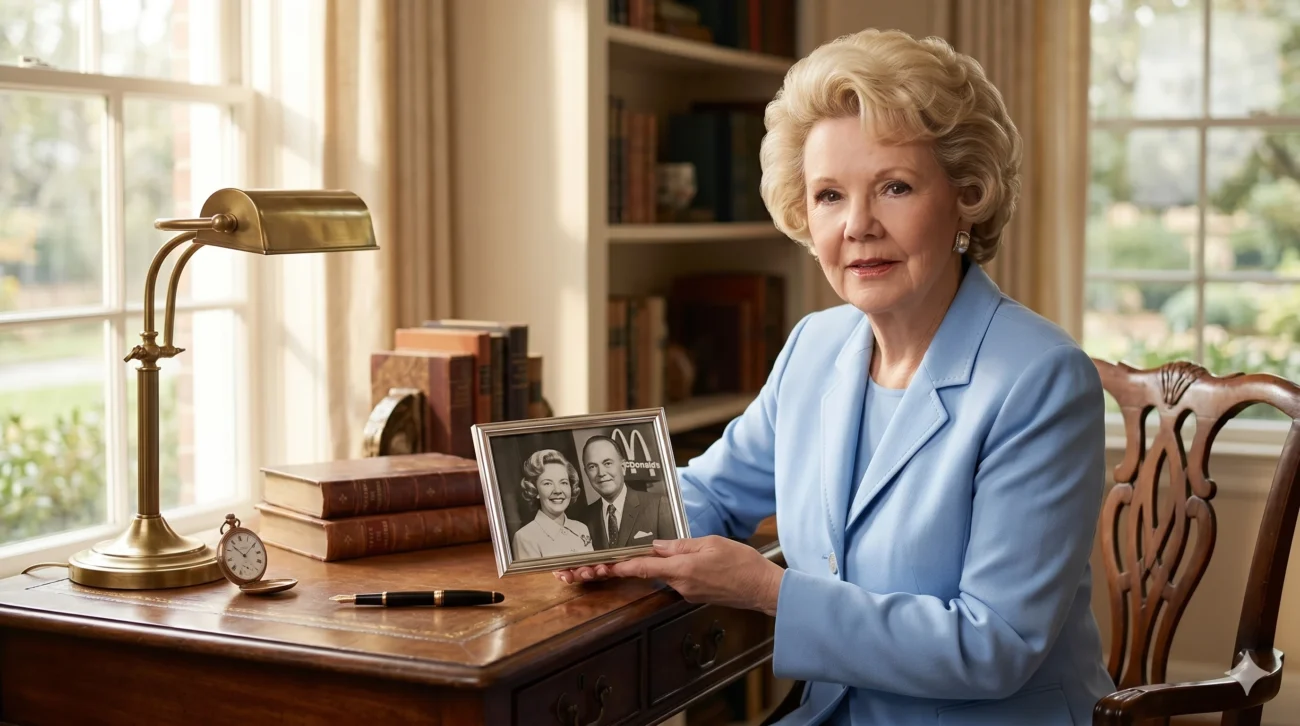
Marilyn Kroc Barg is remembered less for what she made public than for what history has struggled to recover. She was the only daughter of Ray Kroc, the hard-driving businessman who turned McDonald’s from a small California restaurant operation into a global franchise name. Yet Marilyn herself did not become a public executive, media figure, or famous heiress. Her life sits in the quieter margin of a very loud American success story.
Born Marilyn Janet Kroc, she came into the world long before McDonald’s became a symbol of modern fast food. Public genealogy records list her birth as October 15, 1924, and identify her parents as Raymond Albert Kroc and Ethel Janet Fleming Kroc. Her later death notice appeared under the name Lynn J. Barg, a detail that helps explain why records about her can be hard to find. The available evidence points to a woman who lived privately, married twice, and died young in 1973. +2FamilySearch+2
Early Life and Family Background
Marilyn was born into the Kroc family before the name carried any fast-food fame. Her father, Ray Kroc, was not yet the public face of McDonald’s, and his career was still defined by sales, persistence, and repeated reinvention. Britannica describes Ray’s earlier working life as including stints as a musician, real-estate salesman, paper-cup salesman, and milkshake-machine salesman before his McDonald’s breakthrough. That background matters because Marilyn’s childhood did not begin inside an empire.
Her mother, Ethel Janet Fleming, was Ray Kroc’s first wife and Marilyn’s only documented parent besides Ray. Public family records identify Ethel as Marilyn’s mother, and Marilyn’s 1973 death notice refers to her as the late Ethel J. Kroc. Ethel’s marriage to Ray belonged to the years before his late-career fame. By the time Ray became a national business figure, the family story had already moved through private changes that are not fully visible in public records. +1
Marilyn is often described as Ray Kroc’s only child, and that is the reason her name draws steady search interest. People who learn about Ray through McDonald’s history often assume there must be a well-documented heir at the center of the family story. The truth is less cinematic. Marilyn’s record is thin because she did not live as a public representative of the McDonald’s brand.
Growing Up Before McDonald’s Fame
Ray Kroc’s most famous chapter began when Marilyn was already an adult. He first encountered the McDonald brothers’ restaurant operation in San Bernardino, California, in 1954, and he opened his first McDonald’s restaurant in Des Plaines, Illinois, in 1955. McDonald’s corporate history says he later acquired the rights to the company from the brothers in 1961 for $2.7 million. Marilyn was in her thirties by then, with an adult life separate from the company’s early public rise.
That timing changes how her biography should be read. Marilyn was not raised as the child of a fast-food billionaire, and she did not spend her youth inside the McDonald’s machine. Her father’s fortune and reputation came later, after decades of work and after Marilyn’s formative years had passed. Any biography that treats her as a lifelong McDonald’s heiress misses the sequence of events.
The family’s earlier life was closer to the middle-class world of Chicago-area ambition than to corporate dynasty. Ray’s later persona can make it easy to flatten the people around him into supporting characters. Marilyn’s life resists that treatment because the public record does not show her seeking the stage. She appears instead as a private daughter whose name became famous only because her father’s did.
Marriage, Names, and the Public Record
Marilyn appears in public records under more than one name, which has added confusion to her biography. Find a Grave identifies her as Marilyn Janet “Lynn” Kroc Barg, while a Chicago Tribune death notice preserved by FamilySearch calls her “Lynn J. Barg, nee Kroc.” The same notice describes her as being of Arlington Heights and formerly of Evanston. These details are small, but they are among the strongest direct records available. +1
Find a Grave lists Sylvester Nordly Nelson as one spouse and James Walter Barg as another. The Tribune notice names her as the loving wife of James W., confirming the Barg surname in the final public notice of her life. Some secondary sources give different levels of detail about her marriages, but the public memorial and death notice provide the safest foundation. They show that Marilyn’s adult identity cannot be reduced to the Kroc name alone.
Questions about children are harder to answer. Many online biographies say she had no confirmed children, while others avoid the subject altogether. The available public sources reviewed here do not establish a clear record of children. A careful account should leave the matter there rather than filling the gap with guesses.
Was Marilyn Kroc Barg Part of McDonald’s?
There is no strong public evidence that Marilyn Kroc Barg held a corporate role at McDonald’s. The central McDonald’s history runs through Richard and Maurice McDonald, Ray Kroc, early franchise operators, and the system Ray built around uniformity, real estate, and expansion. Marilyn’s name does not appear as a leader in the company’s standard origin story. Her connection was familial rather than documented as professional.
This distinction matters because many short online biographies blur family connection into business contribution. Some describe Marilyn as a businesswoman, charity figure, or quiet influence behind McDonald’s without showing records to support those claims. The more reliable position is simpler and more honest. Marilyn was Ray Kroc’s daughter, but the public record does not show her building or managing McDonald’s.
That does not make her life unimportant. It makes her life different from the story people expect. The search interest around marilyn kroc barg comes partly from that mismatch. Readers look for a hidden business heir and find a private woman whose documentary trail is modest.
Money, Inheritance, and Net Worth Claims
Money is one of the least reliable parts of Marilyn’s online biography. Some websites attach net worth estimates to her name, often suggesting large sums because of her father’s later fortune. Those figures should be treated with caution. They usually do not cite estate records, tax records, or reliable financial reporting tied specifically to Marilyn.
The timeline also limits what can be claimed. Marilyn died in September 1973, while Ray Kroc lived until January 14, 1984. Because she died more than a decade before him, she did not inherit the estate he left at death. She may have benefited from family wealth during her lifetime, but there is no reliable public basis for assigning a precise net worth. +1
A better way to describe her financial position is with restraint. She belonged to the Kroc family during the years McDonald’s grew rapidly, and she was the only child of a wealthy businessman. But wealth by association is not the same as a documented personal fortune. In Marilyn’s case, the numbers often say more about internet repetition than about verified biography.
Death at 48
Marilyn Kroc Barg died in September 1973, when she was 48 years old. Find a Grave lists her death date as September 11, 1973, and the death notice preserved by FamilySearch appeared in the Chicago Tribune on September 13, 1973. The notice says private services were held at Lauterburg & Dehler Funeral Home in Arlington Heights, Illinois. It identifies her as the wife of James W. Barg and the daughter of Raymond A. Kroc and the late Ethel J. Kroc. +1
The cause of death is less firmly documented in the sources most readily available to readers. Many online accounts say she died from complications related to diabetes, but the death notice itself does not state a cause. That does not prove the diabetes claim false, but it does mean the claim should not be presented as settled without stronger documentation. For a private person, especially one who died decades ago, this kind of restraint is part of responsible biography.
Her death came while Ray Kroc was still expanding his public profile. McDonald’s had already grown far beyond the original California restaurant that caught his attention, but it had not yet reached the later global scale associated with the brand today. Marilyn did not live to see the later chapters of the Kroc fortune, including the massive philanthropy linked to Joan Kroc. Her life ended before the family name became tied to some of its best-known charitable gifts.
The Joan Kroc Confusion
One reason Marilyn’s biography gets distorted is that readers sometimes confuse her with Joan Kroc. Joan was Ray Kroc’s third wife, not his daughter, and she became one of the most visible philanthropists connected to the McDonald’s fortune. Joan’s name is tied to major gifts to peace studies, public radio, community centers, and social services. Marilyn’s public record is far quieter.
The University of Notre Dame says Joan Kroc gave $69.1 million between 1985 and her death in 2003 to establish and support the Kroc Institute for International Peace Studies. The Associated Press reported that Joan left $1.8 billion to the Salvation Army after her death, a gift that helped fund Kroc Centers across the United States and Puerto Rico. Those gifts belong to Joan’s legacy, not Marilyn’s. Marilyn had died decades before many of those decisions were made.
This distinction is essential for anyone trying to understand the Kroc family. Ray Kroc’s business legacy, Joan Kroc’s philanthropy, and Marilyn Kroc Barg’s private life are separate stories that intersect through family. Blending them creates a more dramatic biography, but it does not create a more accurate one. Marilyn deserves to be understood without borrowing another woman’s public record.
Public Image and Private Reality
Marilyn Kroc Barg’s public image today is mostly a product of absence. Because there are few interviews, photographs, or first-person accounts widely available, writers often build around the Kroc surname rather than Marilyn’s own documented choices. That produces a strange effect. She is famous enough to be searched, but not public enough to be easily known.
The most respectful reading of her life begins with that limitation. She was not a celebrity hiding from cameras in the modern sense, and there is no evidence that she crafted a public silence as a statement. She appears to have lived outside the machinery that turns family members into public figures. Her name became searchable because of Ray Kroc, not because she pursued attention.
There is also something revealing in the way Marilyn is remembered. The internet often rewards confident claims, even when the evidence is thin. Marilyn’s biography asks for a different rhythm, one that accepts incomplete records and avoids dressing up uncertainty as fact. That makes her story less flashy, but more human.
Marilyn Kroc Barg’s Place in the Kroc Story
Ray Kroc’s life is usually told as a story of drive, timing, and appetite for scale. He was a salesman who saw a restaurant system and imagined something much larger. His achievement changed American eating habits and helped make franchising a dominant business model. Marilyn’s place in that story is personal rather than operational.
She was part of the family life that existed before the legend hardened. She belonged to the years when Ray was still trying to make his career work, before his name became attached to billions of hamburgers and thousands of restaurants. That position gives her biography a quiet historical value. Through her, readers can see that Ray Kroc’s famous second act did not erase the family history that came before it.
Her early death also marks a boundary in the Kroc family narrative. Marilyn did not become an elder keeper of the family story or a public steward of the fortune. She did not give long interviews looking back on her father’s rise. What remains is a spare record, and in that spare record is a reminder that proximity to fame does not always produce public identity.
Frequently Asked Questions
Who was Marilyn Kroc Barg?
Marilyn Kroc Barg was the only daughter of Ray Kroc and his first wife, Ethel Janet Fleming Kroc. She was born Marilyn Janet Kroc and later appeared in records as Lynn J. Barg. She is best known because of her connection to Ray Kroc, the businessman who expanded McDonald’s into a major global brand.
When was Marilyn Kroc Barg born?
Public genealogy records list Marilyn Janet Kroc as born on October 15, 1924. Some secondary records and online databases give conflicting details, including different birthplaces or years, so the most careful approach is to rely on the better-supported family-history listings. What is clear is that she was born decades before her father became famous through McDonald’s.
Who were Marilyn Kroc Barg’s parents?
Her parents were Raymond Albert Kroc and Ethel Janet Fleming Kroc. Ray Kroc later became known for building McDonald’s into a global franchise operation after encountering the McDonald brothers’ restaurant system in the 1950s. Ethel was Ray’s first wife and is named as Marilyn’s mother in public family records and death-notice references.
Was Marilyn Kroc Barg married?
Yes, public memorial records identify Marilyn as having been married to Sylvester Nordly Nelson and later to James Walter Barg. Her Chicago Tribune death notice identifies her as Lynn J. Barg and the wife of James W. Barg. The Barg surname is the one most commonly attached to her in modern searches.
Did Marilyn Kroc Barg work for McDonald’s?
There is no reliable public evidence that Marilyn Kroc Barg worked as a McDonald’s executive or helped run the company. Her connection to McDonald’s appears to have been through her father rather than through a documented corporate role. Claims that she helped build the company should be treated carefully unless supported by records.
What was Marilyn Kroc Barg’s net worth?
There is no credible, well-documented public estimate of Marilyn Kroc Barg’s personal net worth. Some online sources attach figures to her name, but those figures usually do not cite estate records or reliable financial documents. Because she died before Ray Kroc, she did not inherit the estate he left after his 1984 death.
How did Marilyn Kroc Barg die?
Marilyn Kroc Barg died in September 1973 at age 48. Some online accounts say she died from diabetes-related complications, but the available death notice does not state a cause. The most accurate answer is that her death is documented, while the commonly repeated cause is not fully confirmed by the public records cited most often.
Conclusion
Marilyn Kroc Barg remains a quiet figure in a family story often told at maximum volume. Her father’s name became part of American business history, but her own life did not follow the path of public power or inherited celebrity. What we know about her comes from family records, memorial listings, and a brief death notice, not from interviews or corporate archives.
That limited record should not be treated as an invitation to invent a fuller one. The most honest biography of Marilyn Kroc Barg is careful about what it can prove and plain about what remains uncertain. She was Ray Kroc’s daughter, Ethel Kroc’s child, James Barg’s wife, and a private woman whose life ended too early.
Her story still matters because it complicates the way people think about famous families. Not everyone near a fortune becomes a public actor in that fortune’s history. Marilyn’s life reminds readers that some people remain just beyond the bright edge of a famous name, visible enough to be remembered, but private enough to resist easy explanation.
