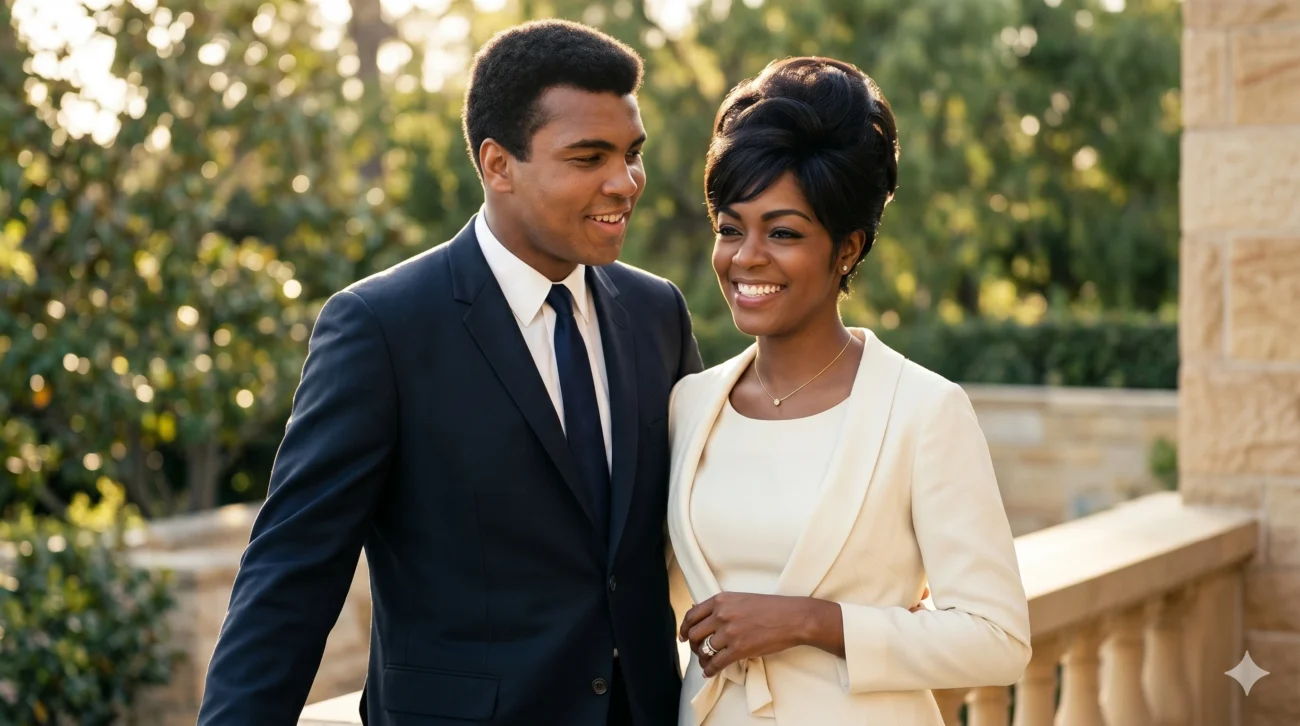
Sonji Roi entered Muhammad Ali’s life at the exact moment the young heavyweight champion was becoming more than a boxer. In 1964, Ali had just stunned Sonny Liston, changed his name, embraced the Nation of Islam, and become one of the most watched men in America. Roi, a young woman working in Chicago nightlife, was suddenly pulled into a story shaped by fame, faith, race, power, and public scrutiny. Their marriage lasted less than two years, but it still tells us something important about Ali, about the cost of proximity to greatness, and about a woman who refused to be remade for someone else’s legend.
Roi is often described in passing as Ali’s first wife, which is true but incomplete. She was also Sonji Clay during their marriage, later Sonji Clay-Glover, and a private woman whose public record remains thinner than the attention surrounding her name. She worked as a waitress, modeled, recorded music, and spent much of her later life outside the celebrity machine. The facts that survive are scattered, sometimes conflicting, and often filtered through Ali’s enormous fame.
That makes a careful biography of Sonji Roi harder than it may appear. Her life is not fully documented in public archives, and many online accounts repeat claims without showing where they came from. The strongest record confirms her marriage to Ali, their divorce, her later years in Chicago, and her death in 2005. Around those facts is a human story about independence, pressure, and the difficult space occupied by women who stand beside famous men but do not disappear into them.
Early Life and Family Background
Sonji Roi was born in the United States, with most public memorial and entertainment references listing her birth date as November 23, 1945. Some genealogical records give a different year, including 1948, and a few later articles have repeated other ages. The most commonly cited public record connected to her grave lists 1945 and says she died at 59 in 2005. Because the record is not uniform, the fairest approach is to acknowledge the conflict rather than force a certainty that the evidence does not support.
Reliable information about Roi’s parents, childhood home, schooling, and early family life is limited. Some family-history sites connect her to Brooklyn, New York, while other accounts speak more generally of her being from the United States. There is no strong public record that allows a detailed reconstruction of her childhood in the way readers might expect for a famous performer or political figure. What is clear is that Roi was not born into national fame; she became publicly visible because of the man she married.
By the early 1960s, Roi was part of the working world that surrounded nightlife, entertainment, and city social circles. Most accounts describe her as a cocktail waitress, and several also describe her as a model or aspiring singer. Those labels are useful, but they should not be stretched into a grand career story without evidence. She appears to have been ambitious and stylish, but the public record does not support claims that she was already a major entertainer before Ali.
Her early life matters because it reminds readers that Roi was not a character created by Ali’s biography. She had her own identity before she became Mrs. Clay, and she had her own life after the divorce. The difficulty is that the fame machine preserved Ali’s movements in great detail while leaving much less about the woman beside him. That imbalance is part of the story itself.
Meeting Muhammad Ali in 1964
Sonji Roi met Muhammad Ali in 1964, one of the most dramatic years of his life. In February, then known publicly as Cassius Clay, he defeated Sonny Liston and became heavyweight champion of the world. Soon after, he confirmed his association with the Nation of Islam and took the name Muhammad Ali. By the time Roi entered the picture, he was already shifting from sports sensation to cultural flashpoint.
Many accounts say Ali met Roi through Herbert Muhammad, the son of Nation of Islam leader Elijah Muhammad and an important figure in Ali’s business life. The familiar version of the story is that Ali was captivated quickly and proposed almost immediately. Like many stories around celebrities, the exact details have been retold in slightly different ways over time. What is firmly established is that the relationship moved fast and led to marriage within weeks.
Roi and Ali married on August 14, 1964, in Gary, Indiana. The timing is striking because Ali was still adapting to the pressures of his new public identity. He was young, rich, admired, mocked, feared, and heavily scrutinized by sportswriters, civil rights observers, religious critics, and government agencies. Roi did not simply marry a champion; she married a man being turned into a symbol almost faster than he could manage.
The marriage drew attention because it joined two very different worlds. Ali’s circle increasingly expected discipline, religious conformity, and loyalty to the Nation of Islam. Roi represented glamour, nightlife, and personal freedom in ways that clashed with those expectations. The conflict was not hidden for long, and it soon became part of Ali’s public story.
Marriage to Muhammad Ali
At first glance, the marriage of Sonji Roi and Muhammad Ali looks like a whirlwind celebrity romance. He was the young heavyweight champion with unmatched charisma, and she was a striking woman who caught his attention at a moment when he could have almost anything he wanted. But beneath that surface was a more complicated arrangement. Ali’s private choices were being watched by advisers, religious leaders, reporters, and fans who all had ideas about what he should represent.
Roi became Sonji Clay during the marriage, since Ali had only recently begun using his new Muslim name publicly. In press and public references, the naming itself could be confusing because the world was still adjusting from Cassius Clay to Muhammad Ali. Roi’s identity was caught in that transition, too. She belonged to the short period when Ali’s old name, new name, new faith, and public rebellion were all colliding.
The marriage soon ran into disagreements over how Roi should dress, where she should go, and what kind of wife she should become. Ali’s religious circle expected modest clothing and conduct that fit its standards. Roi did not accept those rules as naturally as Ali and others hoped. Reports from the period and later biographies suggest that lipstick, clothing, social life, and religious practice became repeated sources of conflict.
This was more than a private argument about household habits. Ali’s faith was tied to his sense of racial pride, political defiance, and public self-definition. Roi’s resistance, then, could be read by Ali’s circle as resistance to the larger project around him. For Roi, the issue appears to have been more personal: she did not want to surrender her independence to become the kind of wife others had designed for her.
Religion, Control, and the End of the Marriage
The central conflict in Roi and Ali’s marriage was religion, but religion was not the only issue. The deeper struggle involved control, identity, and the pressure placed on a young wife to serve a public image. Ali had embraced the Nation of Islam at a time when the group’s rules and expectations shaped his daily life. Roi did not share the same commitment, and she was not willing to reshape herself completely around it.
Ali later spoke bluntly about the marriage, suggesting that his first wife had been one of his toughest battles. The comment has often been repeated because it reveals how seriously he viewed the domestic conflict. But it also shows the limits of seeing the story only through Ali’s perspective. What he experienced as defiance may also have been Roi’s effort to keep control over her own body, clothing, beliefs, and future.
Their marriage ended in divorce in January 1966. The split came before Ali’s famous refusal to be inducted into the U.S. Army and before the legal fight that cost him years of his boxing career. That timing places Roi at the edge of Ali’s transformation, before the exile, comeback, and late-life reverence. She was there during the becoming, not during the settled myth.
Roi and Ali had no children together. That fact is important because some casual accounts of Ali’s family life blur relationships and timelines. Ali would later marry Belinda Boyd, Veronica Porché, and Lonnie Williams, and he would have children through later relationships. Roi’s place in his family history is specific: she was his first wife, but not the mother of his children.
Life After Ali
After the divorce, Sonji Roi did not remain a regular figure in the national spotlight. That choice, or at least that outcome, separates her from many people who become attached to famous names and then build careers from the association. She lived for many years in Chicago and eventually became known as Sonji Clay-Glover after marrying Reynaldo Glover. Public records and memorial pages connect her later life to Illinois, especially Chicago.
Several secondary accounts say Roi had children after Ali, including sons named Brian Reynaldo Glover Jr. and Herman Griffin. These claims appear often, but they are not as strongly documented in widely accessible public records as her marriage to Ali and her death record. A careful profile should treat them as reported details rather than firm public facts. What can be stated with confidence is that she did not have children with Ali.
Roi’s post-Ali years seem to have been quieter, but they were not empty. Some music databases list recordings under the name Sonji Clay, including singles associated with the mid-to-late 1960s. Her recording career appears to have been brief and modest rather than a major commercial breakthrough. Still, it suggests that Roi had creative ambitions and did not define herself only through marriage.
There is a temptation to turn her retreat from fame into a romantic statement about dignity. The truth is likely more ordinary and more human. After a highly public marriage that ended under pressure, she built a life away from the spectacle. For someone who had been judged in public for her clothes, beliefs, and choices, privacy may have been less a disappearance than a form of protection.
Career, Music, and Public Image
Sonji Roi’s work life is often described through three labels: waitress, model, and singer. The first is tied to accounts of how she met Ali, while the second and third appear in later profiles and entertainment listings. She was part of a social world where beauty, performance, nightlife, and opportunity often overlapped. Yet the surviving record does not allow a long, fully documented career timeline.
Her music is the most concrete piece of her public work outside Ali. Record listings under the name Sonji Clay show that she recorded songs, and collectors still reference those releases. The existence of those records matters because it gives Roi a public voice beyond the marriage. It also corrects the mistaken idea that she simply vanished the moment the divorce was final.
That said, her music career should be kept in proportion. There is no solid evidence that she became a major recording star, won major awards, or built a long professional catalog. Some online biographies inflate this part of her life because it gives the story a more dramatic arc. The more truthful version is still interesting: she tried, she recorded, and she left traces.
Roi’s public image has changed over time. During the marriage, she was often viewed through Ali’s choices and the expectations of his religious world. Decades later, readers are more likely to see her as a woman pushing back against control. That change says as much about modern readers as it does about Roi herself.
Money, Income, and Net Worth
There is no reliable public net worth figure for Sonji Roi. Many celebrity websites assign net worth estimates to public figures and relatives of famous people, but those numbers are often unsupported. Roi was not a modern influencer, company founder, high-profile performer, or long-running television personality with visible income streams. Any precise claim about her wealth should be treated with skepticism unless tied to documents.
Her known or reported income sources included service work, modeling, and some music activity. During her marriage to Ali, she was connected to one of the most famous athletes in the world, but that does not automatically reveal her personal finances. Divorce terms from that period are not widely documented in accessible public reporting. Without court records or verified estate information, estimates are little more than guesses.
It is also misleading to measure Roi’s life mainly by money. Her public significance comes from her place in Ali’s early adult life and from the choices she made under pressure. Wealth may be a common search question, but in this case there is little credible evidence to answer it in detail. The honest answer is that her net worth at death is not publicly confirmed.
For readers trying to understand her lifestyle, the safest description is modest compared with Ali’s fame. She lived away from the center of celebrity coverage and did not appear to trade heavily on her former marriage. That does not mean she lacked ambition or comfort. It simply means the public record does not support a clear financial portrait.
Death in Chicago
Sonji Roi died on October 11, 2005, in Chicago, Illinois. Memorial records list her burial at Mount Glenwood Memory Gardens South in Glenwood, Cook County, Illinois. Her name is commonly recorded as Sonji Roi Glover or Sonji Clay-Glover in later references. The date of death is one of the better-supported facts in her biography.
Reports from the time described her death as occurring at her home in the Hyde Park area of Chicago. Some accounts say she was found at home and that officials considered the death natural. A relative was reported as believing she may have suffered a heart attack. Later articles often state “heart attack” as fact, but the more careful wording is that a heart attack was suspected or reported by family, not publicly established through an autopsy.
Her age at death is another point where sources conflict. Memorial and entertainment references using the 1945 birth date place her at 59. Some articles state that she was 64, which likely comes from conflicting birth-year claims or copying errors. The strongest public memorial record supports 59, but responsible writers should acknowledge that not every source agrees.
Ali outlived Roi by more than a decade, dying in 2016 after many years with Parkinson’s disease. By the time of his death, his life had been retold through biographies, documentaries, tributes, and public memorials. Roi’s name returned in those stories, usually in the early chapters. She remained fixed in memory as the first wife from the explosive opening act of Ali’s adult fame.
Why Sonji Roi Still Matters
Sonji Roi matters because she stood at a revealing point in Muhammad Ali’s life. Before her, he was the brash young fighter who upset Sonny Liston. During their marriage, he was becoming Muhammad Ali in name, faith, politics, and public meaning. After her, he moved into the draft case, boxing exile, comeback, and global sainthood that later softened many hard edges in his story.
Her story also matters because it complicates the way we remember celebrated men. Ali’s courage in public life was real, especially in his refusal to fight in Vietnam and his willingness to sacrifice his title and earning power. But private life can tell a different kind of truth. Roi’s marriage to him shows a young man trying to enforce beliefs and expectations inside his home while also fighting for freedom in the public square.
That contradiction does not erase Ali’s greatness, but it makes the history more honest. Famous people are not made of one trait, and the people around them are not props. Roi’s resistance helps readers see Ali’s early religious transformation not only as a political and spiritual event, but also as something that affected the women closest to him. Her story is small only if we think domestic pressure is small.
Roi also represents the many women whose lives brush against history without being fully preserved by it. She did not leave behind the same volume of interviews, memoirs, or archive material as Ali. Yet the fragments that remain are enough to show a woman who wanted her own life. That is why she continues to draw interest long after the marriage ended.
Common Misunderstandings About Sonji Roi
The most common misunderstanding is that Sonji Roi’s biography is fully settled. In reality, her public record contains gaps and contradictions, especially around her birth year, early life, and later family details. Writers often smooth over those gaps to create a cleaner story. A better biography lets the uncertainty remain visible.
Another misunderstanding is that she became famous because of a major entertainment career. Roi did have connections to modeling and music, and recordings under the name Sonji Clay appear in music databases. But the available evidence does not show a large or lasting entertainment career. Her fame came mainly from her marriage to Ali and the dramatic timing of that relationship.
A third misunderstanding concerns her cause of death. Many pages say she died of a heart attack, but the more cautious record points to natural causes with a suspected heart attack mentioned by a relative. That difference matters because biography is not just storytelling; it is a record of a person’s life. Stating uncertainty honestly is a form of respect.
There is also a tendency to describe Roi only as rebellious. That word can flatten her into a symbol, as if her life existed only to oppose Ali. She may well have been independent, stylish, and resistant to control, but she was also a private person whose full inner life is not publicly known. The strongest portrait gives her agency without pretending to know every feeling behind her choices.
Frequently Asked Questions
Who was Sonji Roi?
Sonji Roi was the first wife of Muhammad Ali. She married him in 1964, the same year he became heavyweight champion and publicly embraced the Nation of Islam. Their marriage lasted less than two years and ended in divorce in January 1966.
She was also known as Sonji Clay during the marriage and later as Sonji Clay-Glover. Public accounts describe her as a waitress, model, and singer, though her best-documented public role is her short marriage to Ali. Her life after the divorce was much more private.
When did Sonji Roi marry Muhammad Ali?
Sonji Roi married Muhammad Ali on August 14, 1964, in Gary, Indiana. The wedding came during a major turning point in Ali’s life, only months after he defeated Sonny Liston for the heavyweight title. He was still in the early stage of presenting himself publicly as Muhammad Ali rather than Cassius Clay.
The marriage moved quickly after they met. Many retellings describe a rapid courtship, though the exact personal details vary by source. What is clear is that the relationship began and ended within one of the most intense periods of Ali’s life.
Why did Sonji Roi and Muhammad Ali divorce?
Roi and Ali divorced because of serious conflicts over religion, lifestyle, and personal freedom. Ali had embraced the Nation of Islam and expected his wife to live according to standards connected to that faith community. Roi resisted those expectations, especially around dress, social life, and religious identity.
Their divorce was finalized in January 1966. The marriage had no children, and Roi did not remain a major public figure afterward. The split is often remembered as one of the first private signs of how demanding Ali’s new public identity could be.
Did Sonji Roi have children with Muhammad Ali?
No, Sonji Roi and Muhammad Ali did not have children together. Ali later had children through other marriages and relationships, but Roi was not the mother of any of them. This point is important because Ali’s family history can be confusing due to his multiple marriages.
Some secondary accounts report that Roi had children after her marriage to Ali. Those claims appear in several online biographies, but they are not as strongly documented in widely accessible public sources. The confirmed answer is that she had no children with Ali.
What was Sonji Roi’s career?
Sonji Roi is most often described as a waitress, model, and singer. She was reportedly working in nightlife when she met Ali, and later music listings show recordings under the name Sonji Clay. Her singing career appears to have been brief rather than commercially major.
There is no reliable evidence that she became a famous recording artist or built a long entertainment career. Still, her music recordings show that she had creative ambitions beyond being known as Ali’s former wife. That part of her life deserves mention, but not exaggeration.
When and how did Sonji Roi die?
Sonji Roi died on October 11, 2005, in Chicago, Illinois. Public memorial records list her burial at Mount Glenwood Memory Gardens South in Glenwood, Illinois. She is often recorded under the name Sonji Roi Glover.
Her death was reported as natural causes, with some accounts saying a relative believed she may have suffered a heart attack. Later articles often state heart attack as fact, but the public record is more cautious. The most accurate wording is that a heart attack was suspected, not conclusively established in widely available records.
What was Sonji Roi’s net worth?
Sonji Roi’s net worth is not publicly confirmed. Some websites may publish estimates, but they generally do not provide strong evidence or financial records. Because Roi lived privately and did not have a large documented entertainment career, precise wealth claims are unreliable.
Her known or reported income sources included service work, modeling, and music recordings. Her marriage to Ali brought public attention, but it does not provide a clear picture of her personal finances. The honest answer is that no credible public net worth figure can be confirmed.
Conclusion
Sonji Roi’s life is remembered because of Muhammad Ali, but it should not be reduced to him. She stood beside Ali during the moment when he was changing his name, his faith, his politics, and his place in American life. That position gave her a place in history, even though the record of her own life remains incomplete.
The most compelling part of Roi’s story is not celebrity glamour. It is the pressure she faced to become someone else’s idea of a proper wife, and her refusal to accept that role completely. Her marriage ended quickly, but the reason it still interests people is that it exposed a private conflict inside a public transformation.
A respectful biography of Sonji Roi has to live with uncertainty. We know the main dates, the marriage, the divorce, the absence of children with Ali, and her death in Chicago. We know less about her childhood, her private family life, and her later years than many readers might expect.
That absence should not make her invisible. Sonji Roi remains a meaningful figure because she reminds us that history is not only made by the people at the microphone or in the ring. Sometimes it is also shaped by the people who say no, step back, and choose a quieter life on their own terms.
